



Adobe Sign individual
Adobe Sign pricing starts at $12.99/month for Acrobat Standard (individual) and scales to $29.99/month per user for Acrobat Studio for Teams, with Enterprise plans available at custom pricing. All plans include PDF editing and basic e-signature tools, while advanced features like bulk sending, custom branding, AI Assistant, and enterprise compliance (HIPAA, FERPA) require higher-tier plans. Annual billing is required, with a 7-day free trial available for Acrobat Pro.
When it comes to eSignature solutions, Adobe Acrobat Sign is one of the most well-established platforms. However, with a wide range of pricing plans and feature-packed tools, it can be tough to determine if Adobe Sign is the right choice for your business.
Choosing between eSignature platforms can be challenging, especially since Acrobat Sign offers more than just eSignatures. With additional features like PDF editing, payment collection, and integrations with everyday productivity tools, Adobe Sign has positioned itself as a multifunctional solution for enterprises in the U.S. and around the world.
In this article, we'll break down Adobe Sign’s pricing, compare its features to competitors in the market, and help you decide if it’s the best fit for your organization.
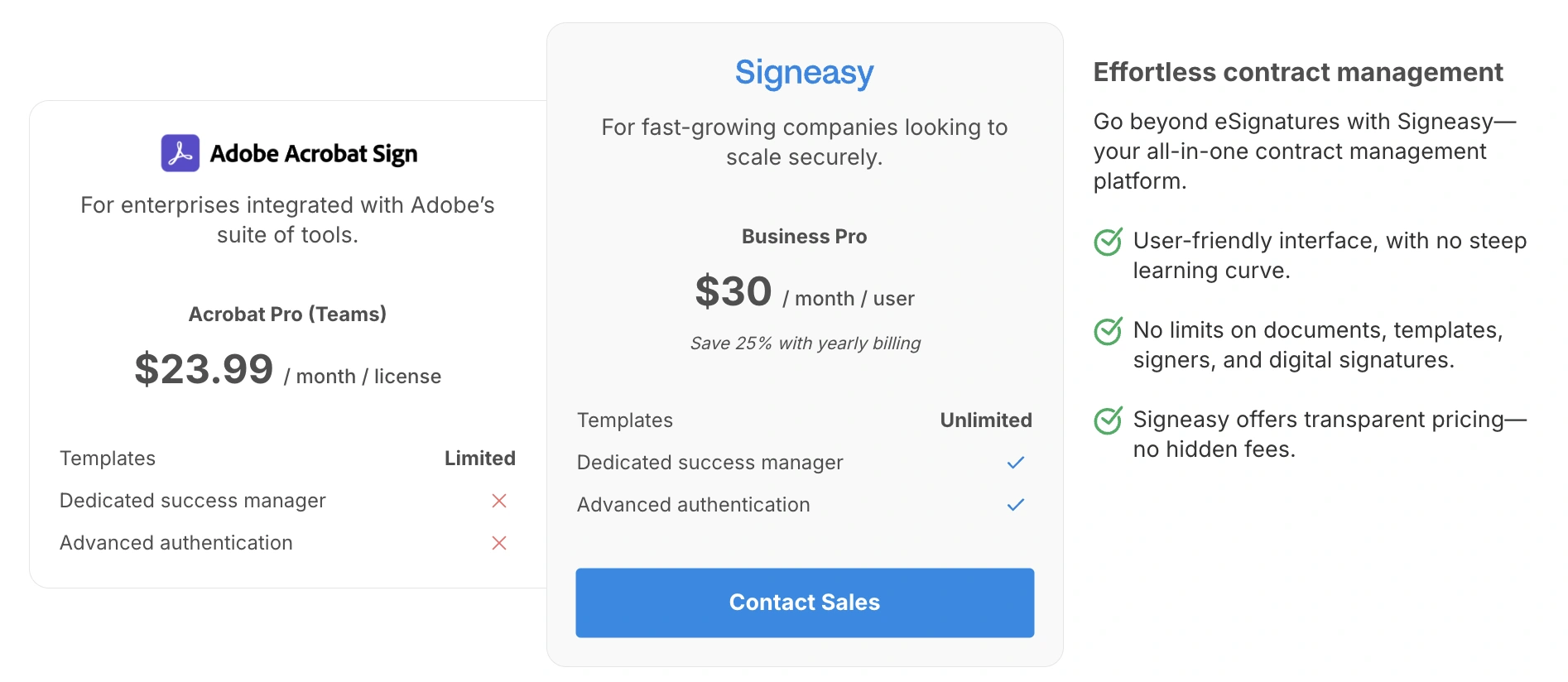
Things to keep in mind:
- Adobe Sign offers customized pricing plans for individuals, small businesses, and enterprise-level organizations.
- Adobe Sign plans include Adobe’s built-in PDF editing capabilities, a key differentiator in the market.
- Transaction limits and tiered security features could pose limitations, depending on the size and needs of your organization.
How we sourced our data on Adobe Sign pricing
To give you the clearest picture of Adobe Sign pricing, we pulled our data from several reliable sources. We started by diving into Adobe Sign’s official pricing pages to get the most up-to-date information on their plans.
We also looked at what real users are saying about the pricing and value through customer reviews, and gathered insights from industry reports to see how Adobe Sign’s pricing stacks up against competitors.
On top of that, we did our own research, exploring the platform to better understand how each pricing tier translates into features and benefits. Our goal is to help you make an informed decision about whether Adobe Sign’s pricing fits your business needs.
Acrobat Sign pricing overview
Adobe Sign provides pricing options that cater to different user needs, from individuals and small businesses to large enterprises. Here's an overview of the available plans:
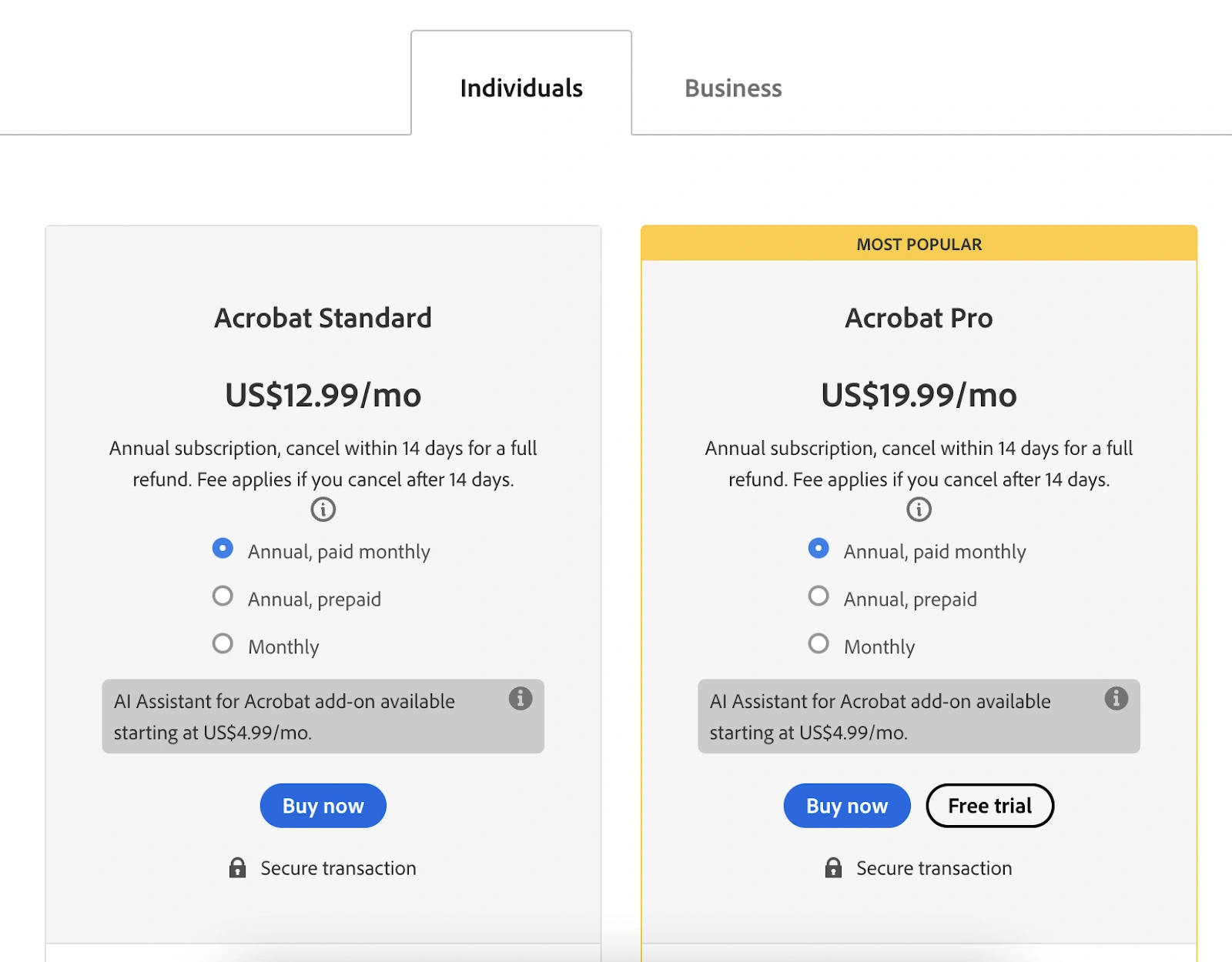
1. Adobe Acrobat Standard
- Cost: $14.99/month (annual plan)
- Features: Basic eSignature capabilities, PDF editing, integration with Microsoft 365, and limited form creation tools.
- Best for: Individuals and small businesses handling low to moderate eSignature workflows.
2. Adobe Acrobat Pro
- Cost: $19.99/month (annual plan)
- Features: Includes everything in the Standard plan, plus custom branding, payment collection tools, bulk sending options, and access to Adobe Document Cloud for cloud-based document management.
- Best for: Businesses needing a more comprehensive eSignature workflow with branding and payment integration.
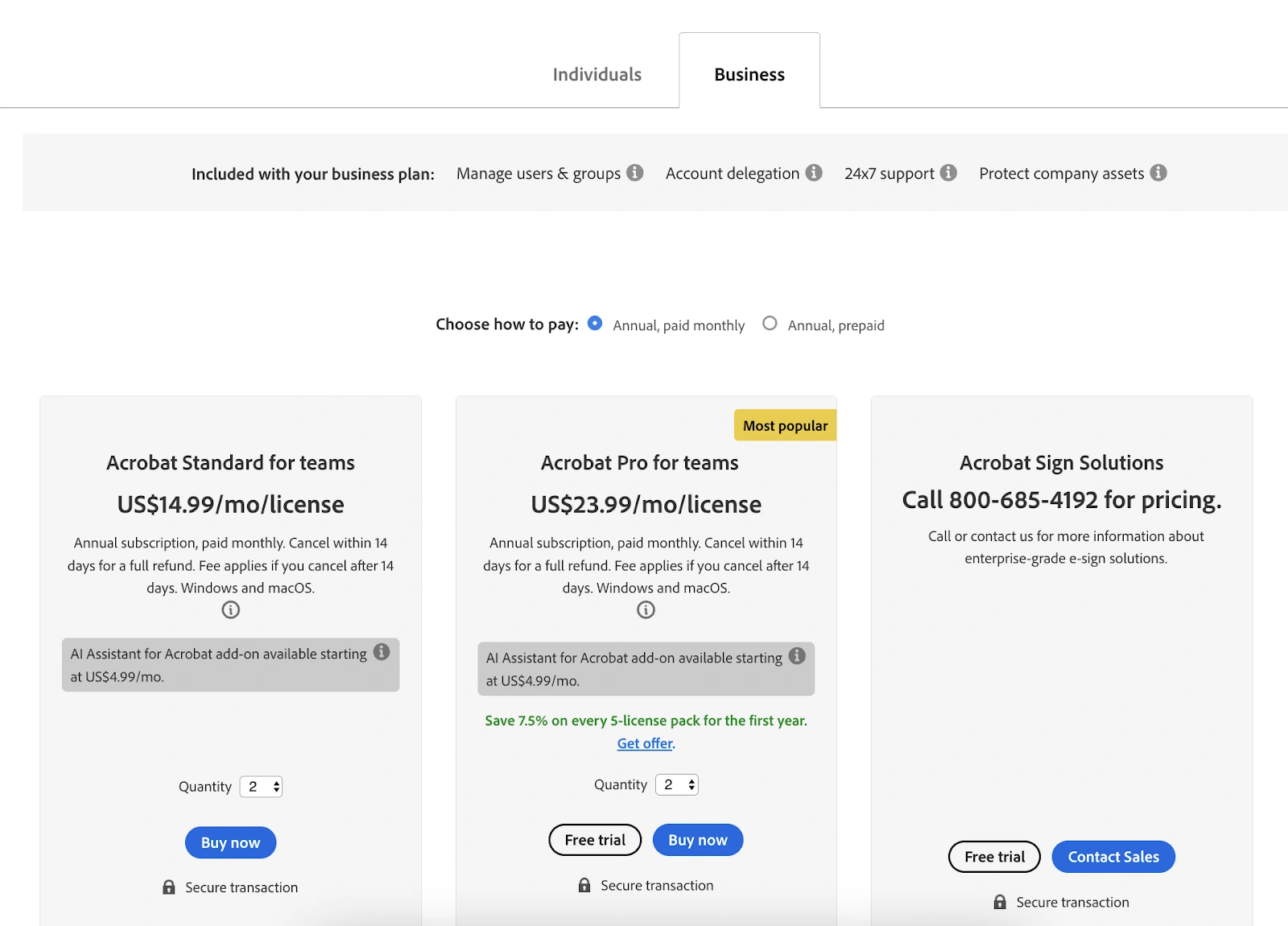
3. Acrobat Standard for Teams
- Cost: $16.99/month per user (annual plan)
- Features: User and group management via Admin Console, account delegation, PDF editing, and eSigning tools. This plan is designed for teams with capped transactions (150 per user, per year).
- Best for: Teams that need basic eSignature tools and basic user management but can manage with limited transactions.
4. Acrobat Pro for Teams
- Cost: $23.99/month per user (annual plan)
- Features: All features from the individual Pro plan, plus custom branding, advanced form creation, and 24/7 customer support for quick issue resolution.
- Best for: Teams looking for robust document workflows and round-the-clock customer support.
5. Acrobat Studio for Teams
- Cost: $29.99/month per user (annual plan)
- Features: Everything in Acrobat Pro for Teams, plus Acrobat AI Assistant, PDF Spaces for collaborative knowledge hubs, Adobe Express Premium for content creation. Launched August 2025 as Adobe's most advanced Acrobat offering.
- Best for: Teams needing AI-powered document analysis, collaborative workspaces, and creative content tools alongside PDF and eSignature workflows.
6. Adobe Acrobat Sign Enterprise
- Cost: Custom pricing
- Features: Enhanced security and compliance features (including HIPAA, FERPA, GLBA compliance), CRM integration (Salesforce, Workday), API access for embedded signing, and advanced authentication options. Additional features like PDF editing can be added at extra cost.
- Best for: Large enterprises that need high-level security and integrations with CRM tools but may require additional features like PDF editing as paid add-ons.
When considering Adobe Sign pricing, there are several important details to keep in mind, especially around add-ons, user requirements, and payment options:
For teams using Acrobat Standard and Acrobat Pro plans, Adobe offers an AI Assistant add-on, available at an additional cost of $4.99 per month. This feature can enhance your document workflow by providing AI-driven assistance, making document management more efficient.
The Acrobat Standard for Teams and Acrobat Pro for Teams plans come with a minimum user requirement of two licenses. This means that teams must purchase at least two licenses, which could increase the overall cost for smaller teams. The pricing is listed as per user, so larger teams should account for multiple licenses in their overall budget.
A free trial option is available for certain plans, such as Acrobat Pro for individuals and Acrobat Pro for Teams. This trial allows users to experience the platform before committing to a paid plan. However, it's worth noting that not all plans offer a free trial — for example, the Acrobat Standard for Teams plan does not include this option. Be sure to check the availability of a free trial based on the plan you're interested in.
Adobe Sign offers two annual payment options: Annual, paid monthly and Annual, prepaid. With the Annual, paid monthly option, you commit to an annual subscription but pay on a monthly basis. You can cancel within 14 days for a full refund, but if you cancel after 14 days, a fee applies. The Annual, prepaid option requires you to pay the entire subscription cost upfront. If you cancel within 14 days, you’re eligible for a full refund, but no refund is offered if you cancel after 14 days.
For teams deeply embedded in Salesforce, Conga Sign is another option worth comparing for native CRM integration. If you’re researching Conga pricing, it’s also worth considering how its pricing compares with Adobe Sign based on your team’s requirements.
Adobe Sign individual vs team plans: What's the difference?
This is one of the most common sources of confusion when evaluating Adobe Sign, and it is worth addressing directly.
At first glance, individual and team plans look similar in price. Acrobat Pro for individuals costs $19.99/month, while Acrobat Standard for Teams comes in at $16.99/month per user, so a team plan can actually cost less per seat. But the differences go deeper than the price tag.
The key differences:
When to choose an individual plan: If you are a solo professional, freelancer, or very small business where one person handles all the signing, the individual Acrobat Pro plan offers more flexibility. You get unlimited transactions, monthly billing options, and a lower commitment overall.
When to choose a team plan: If your team needs centralized user management, the ability to delegate accounts, or shared workflows, a team plan is the right direction. Just factor in the 150-transaction annual cap and the minimum two-license requirement before you calculate your actual cost.
The key point: do not assume a team plan is simply a cheaper version of an individual plan. The transaction limits and admin features represent a genuinely different product structure, one better suited to managed, team-level workflows rather than high-volume individual use.
Adobe Sign transaction limits: What you need to know
Transaction limits are arguably the most important pricing detail that Adobe Sign does not surface prominently on its plans page, and they are the detail most likely to affect your budget once you are past onboarding.
How transaction limits work:
A transaction occurs each time an electronic document, or a collection of related electronic documents, is sent to one or more recipients through Acrobat Sign. It does not matter whether the document gets signed or not. If you send it, it counts.
Acrobat Sign plans sold as user licenses include 150 transactions per user per year unless otherwise stipulated in your contract.
What counts as a transaction:
- Sending a contract to one signer = one transaction
- Sending a contract to three signers in a single envelope = one transaction
- Sending via third-party integrations (Salesforce, Workday, Microsoft Teams) = counts toward your limit
- Sending via the API = counts toward your limit
- Using Fill and Sign within the Acrobat app = does not count
When does this become a problem?
150 transactions per user per year works out to roughly 12.5 sending events per month per user. For an HR professional processing onboarding paperwork or a sales team handling a steady flow of proposals and NDAs, that cap can become a real constraint well before year-end.
Business and enterprise-level customers who process a high volume of transactions can speak to Adobe's sales team about purchasing additional transaction volume. But this means a conversation with sales, custom pricing, and moving out of the self-serve tier, an unexpected step for teams that assumed they had room to grow.
Individual plans are different: Acrobat Standard and Acrobat Pro (individual plans) carry unlimited transactions. The cap applies specifically to the team plans.
If your team sends more than 150 documents per user per year and you want predictable, unlimited sending without a sales call, Signeasy's paid plans include unlimited document sends with no annual cap.
Pricing insights from user reviews
User reviews of Adobe Acrobat Sign often highlight that the platform can be slightly more expensive than other eSignature solutions. However, many users feel that the extra cost is justified by its advanced features and strong security.
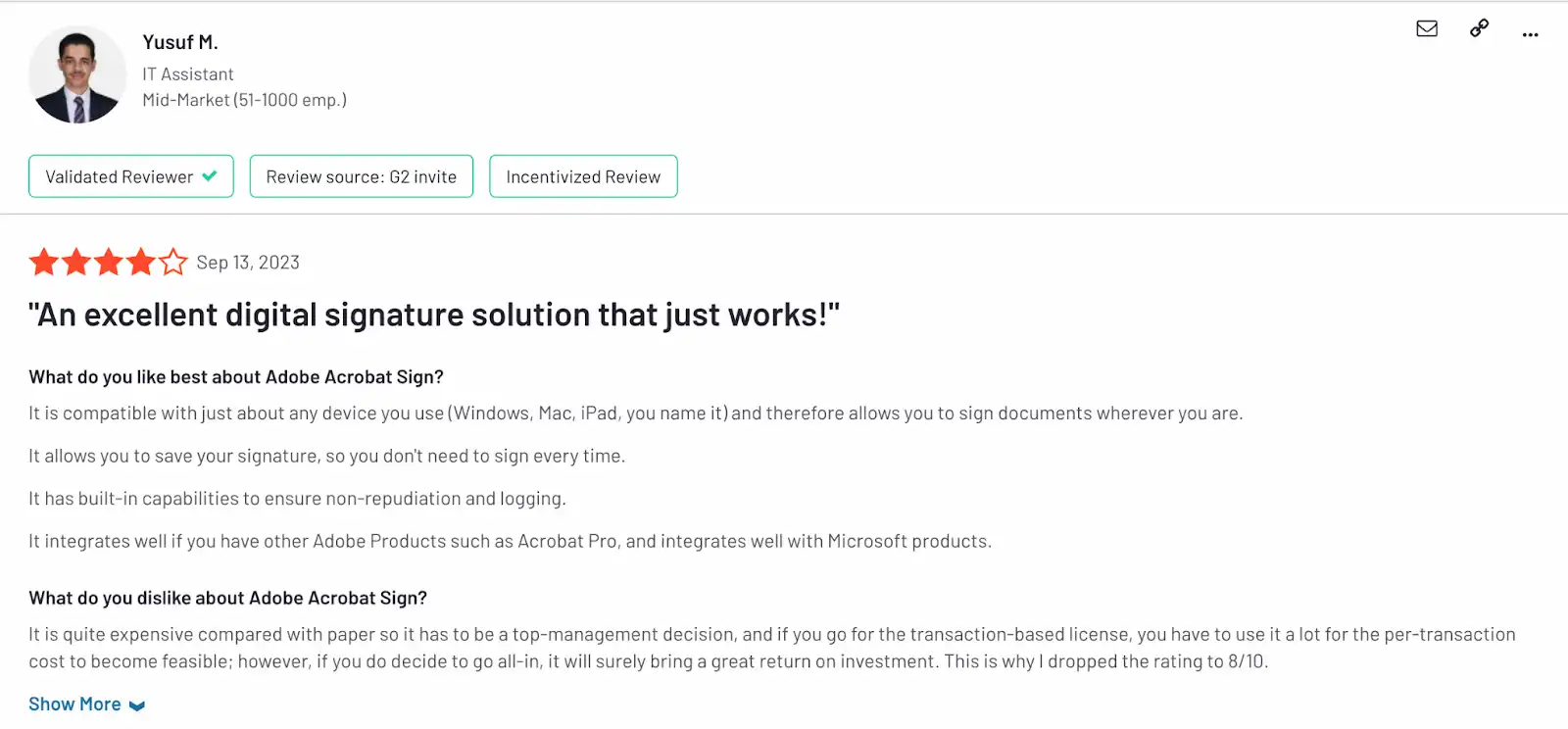
Teams considering alternatives can also explore our PandaDoc reviews to learn more about the platform.
Businesses with higher document volumes find the pricing more competitive, while smaller organizations might notice the cost more. For enterprises, the platform’s compliance capabilities and integrations provide additional value, but for small businesses or infrequent users, the pricing may not be as convenient or cost-effective.

Key Considerations Before Choosing an Adobe Sign Plan
- Billing: Annual plans (paid monthly) offer lowest rates. Month-to-month is higher (e.g., Pro: $29.99/mo vs. $19.99/mo annual).
- Transaction limits: Individual plans = unlimited. Team plans cap at 150/user/year. Contact Adobe for custom limits.
- Free trial: 7-day trial for Acrobat Pro (individual + teams). Not available for Standard for Teams.
- Minimum licenses: Team plans require minimum 2 licenses. Teams of 5+ may get 7.5% volume discount.
- Hidden costs: AI Assistant add-on = $4.99/mo extra. HIPAA/FERPA compliance only in Enterprise at custom pricing.
Adobe Sign plans and features: The possible pitfalls
When it comes to eSignature solutions, the landscape is competitive, with platforms like Signeasy, Docusign, PandaDoc, and HelloSign providing alternatives.
If you're comparing costs, our Docusign pricing and Dropbox Sign pricing guide provide a closer look at pricing across popular eSignature platforms. Here are some potential pitfalls to consider when evaluating Acrobat Sign.
Transaction limits
One area where Adobe Sign may not be ideal for every business is transaction limits. While individual plans offer “unlimited transactions,” team plans cap usage at 150 transactions per user/year. Competitors of Adobe Sign provide more flexibility, particularly for high-volume businesses, by offering customizable transaction limits.
Security and compliance
Adobe Sign provides high-level security, with enterprise plans ensuring compliance with industry standards such as HIPAA and GLBA. However, it’s important to note that only the enterprise plan includes these enhanced compliance features. Competitors of Adobe Sign, like Signeasy, also offer strong security and compliance, but without the segmentation between individual and enterprise plans. This makes those competitors gain a strategic advantage over Adobe Sign to be relevant for smaller organizations seeking top-level security.
Important for SharePoint users
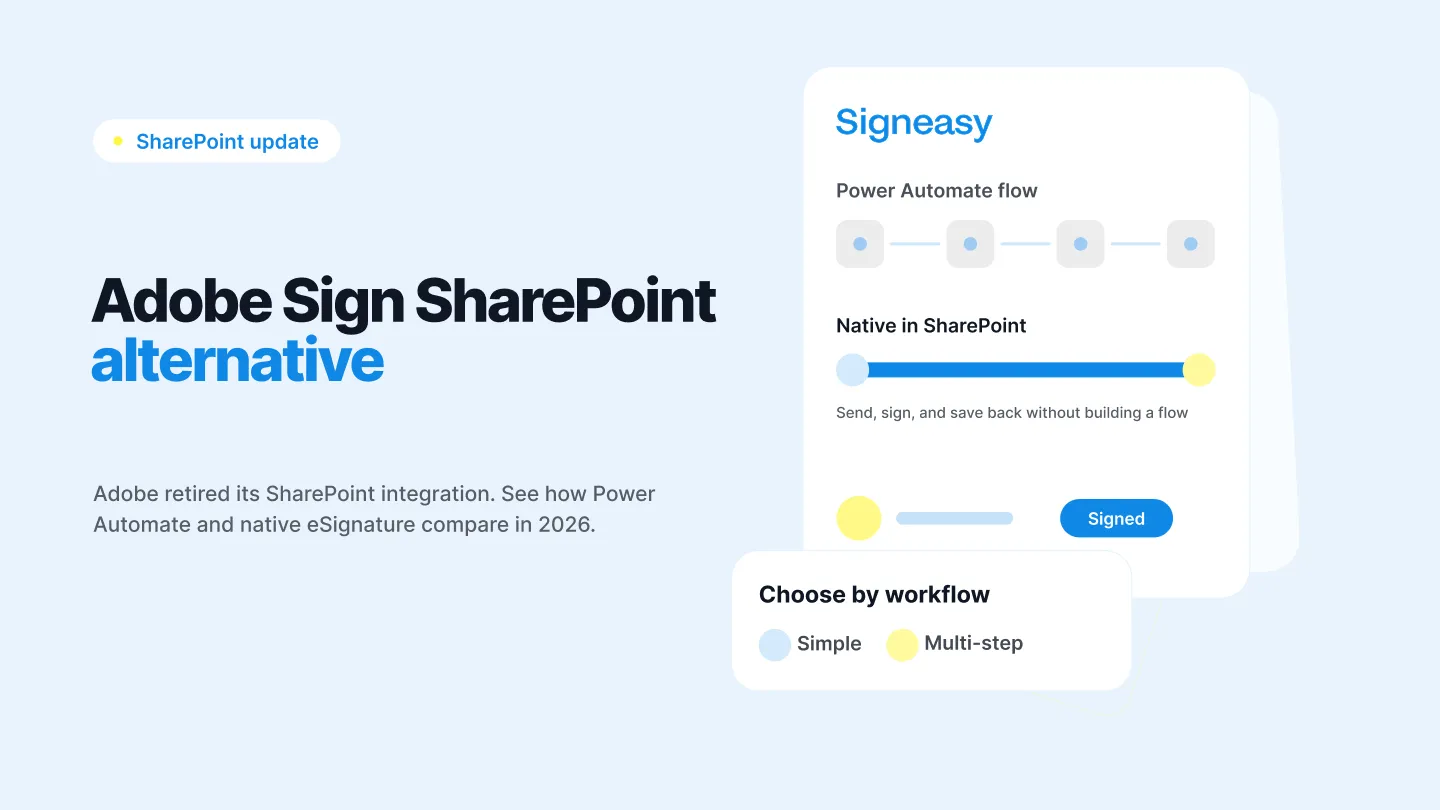
If your contract workflows depended on Adobe Sign’s SharePoint integrations, the end of service has already become a critical factor in your eSignature strategy.
After June 28, 2024, the Acrobat Sign SharePoint Online plug‑in stopped working for new agreements, and completed documents no longer save automatically to SharePoint.
Rebuilding these workflows in other tools, training teams, and managing manual workarounds adds hidden operational costs that go well beyond the subscription price.
For SharePoint‑first organizations, evaluating alternatives like Signeasy—which offers a live SharePoint integration—helps avoid ongoing disruption and overhead.
Features breakdown by plan
Acrobat Sign’s plans are structured to meet different business needs, with a variety of features available across tiers. When you're deciding which Adobe Sign plan to choose, it's important to understand how the features vary across plans and how that affects the pricing.
Let’s see what each plan offers and where you might need to upgrade depending on your business needs.
Basic features for all plans
No matter which plan you choose, you’ll have access to essential eSignature tools.
These basic features include:
- Collecting signatures and signing agreements – the fundamental purpose of any eSignature platform.
- Scan and sign on mobile – flexibility to sign documents on the go.
- Track and manage agreements – keep an eye on document progress with real-time tracking.
- Prepare forms and customize languages – basic form creation and language support.
- Keep records and audit trails – ensures transparency and traceability for your signed documents.
For smaller teams or businesses just starting with eSignatures, these features are more than enough to manage straightforward signing workflows. You’re getting everything you need to collect signatures and manage agreements, all while staying mobile and efficient.
Advanced features (Available in Pro and Enterprise plans)
However, if your business has more complex needs, you might find that these advanced features, available in Pro and Enterprise plans, are worth the upgrade:
- Custom branding – personalize your documents with your own logo and brand elements.
- Bulk sending – save time by sending documents to multiple recipients at once.
- Collect payments with Braintree – easily integrate payment collection into your signing workflows.
- Advanced roles and routing – ensure documents are sent to the right people with advanced workflows.
- 24/7 customer support – get assistance whenever you need it, a crucial feature for larger teams that depend on quick issue resolution.
When it comes to security and compliance, the Enterprise plan takes things up a notch with advanced security certifications, industry-specific compliance (like HIPAA and FERPA), and enhanced authentication options. These features are especially important for businesses in highly regulated industries where compliance is non-negotiable. Lower-tier plans won’t have these, so if compliance is a top concern, be prepared to invest in a higher plan.
Next up is admin features. As your team grows, managing users and permissions becomes more important. Features like Admin Console, group management, and account delegation are essential for larger teams. These tools are available in the Team and Enterprise plans, making them ideal for businesses managing multiple users. The Standard plans, while cost-effective, don't offer advanced admin support or 24/7 customer service, so if your team needs more control and quicker support, upgrading to a higher plan makes sense.
For those looking to integrate Adobe Sign with other platforms, the Pro and Enterprise plans come with built-in integrations for tools like Microsoft 365, Salesforce, Workday, and ServiceNow.
If API access is a priority for your team, explore our detailed guide on the adobe sign api to understand its capabilities, limitations, and how it compares to alternatives.
These integrations allow you to streamline workflows and connect eSignatures with the platforms your teams already use. If you need even deeper customization, the Enterprise plan also offers API access and additional pre-built integrations, making it a good fit for businesses that require complex, multi-tool ecosystems.
Additionally, if you’re working with a lot of PDFs, the Pro and Enterprise plans give you access to advanced PDF editing tools. From creating fillable forms to redacting sensitive information and validating PDFs for ISO and accessibility standards, these tools make managing documents easier and more secure.
These added functionalities make these plans more expensive, but they’re necessary for businesses with advanced document needs.
Adobe Sign support
Adobe Sign offers varying levels of customer support depending on the plan.
While basic support is available in the lower-tier plans, only the Pro and Enterprise plans provide 24/7 customer support, ensuring you can get assistance anytime you need it. This is especially valuable for larger teams or businesses that rely heavily on the platform and can’t afford delays.
For users on Standard plans, support is more limited, so upgrading is worth considering if quick and reliable assistance is a priority for your business.
How to choose the right plan
When selecting an Acrobat Sign plan, the choice largely depends on the size of your business and the complexity of your document workflows.
The pricing of Adobe Sign plans reflects the features they include. If your business has complex workflows, requires strict security, or handles high document volumes, you’ll likely need to invest in a higher-tier plan to obtain the functionality you require.
On the flip side, if you’re a smaller operation with simpler needs, the basic plans provide solid eSignature tools without breaking the bank. The Acrobat Pro plan offers great value at $19.99/month, with PDF editing, payment collection, and bulk sending.
What makes Adobe Sign different from other eSign tools?
Before comparing Adobe Sign to alternatives, it helps to understand what genuinely sets it apart, so you can decide whether those differentiators matter for your specific workflow.
1. Native PDF editing built into the signing flow
Most eSignature platforms, including DocuSign, SignNow, and Signeasy, allow you to upload a PDF and prepare it for signing. Adobe Sign goes further. Because it is part of the Adobe Acrobat ecosystem, users can edit document text, redact sensitive content, add or replace images, and restructure pages directly within the platform before sending for signature.
This is a meaningful capability for teams whose documents frequently change up to the last moment, or for legal and compliance teams that need to redact information before sending. It is a capability that no other signing tool at this price point matches natively.
2. Deep integration with the Adobe ecosystem
For organizations already using Adobe Acrobat, Creative Cloud, or Adobe Document Cloud, Sign integrates without adding another app to manage. If your team works in PDF-native environments day to day, the workflow friction of switching tools is largely eliminated.
3. Enterprise-grade workflow complexity
Workflow Designer, advanced routing, and multi-step signing sequences in the Enterprise plan give Adobe Sign genuine depth for organizations managing high volumes of complex, multi-party agreements.
Where Signeasy makes more sense:
These are genuine strengths, but they come at a cost in both price and complexity. If your team does not rely on native PDF editing as part of the signing workflow, you may be paying for capabilities you will rarely use.
For straightforward eSignature needs, including sending contracts, collecting signatures, maintaining audit trails, and staying HIPAA-compliant, Signeasy delivers the same core experience at a lower price with unlimited document sends and no transaction caps. If PDF editing is not a workflow requirement, it is worth comparing the two before committing to Adobe's pricing model.
Adobe Sign Vs Signeasy: An in-depth comparison
When choosing between Adobe Sign and Signeasy, it’s essential to look at how they differ in pricing, plan structure, features, and support to determine the best fit for your needs.
Pricing and plan structure
Adobe Sign’s pricing starts at $12.99 per month for individuals, but the cost can quickly rise for businesses that need advanced features or enterprise-level security. For larger teams or organizations, plans like Acrobat Pro for Teams or Enterprise offer more functionality but at a higher cost. While Adobe Sign doesn't offer a free plan, it does provide a free trial on some plans, allowing potential users to test the platform before committing to a paid plan.
Signeasy, on the other hand, has a more affordable starting point, with plans beginning at $10 per month for individuals. This makes it a great option for mid-sized businesses that need essential eSignature features without a significant financial commitment. Additionally, Signeasy offers a free plan, allowing users to send a limited number of documents each month, which is perfect for individuals or businesses that only need eSignatures occasionally.
For users on paid plans, Signeasy provides unlimited documents and templates, making it easy to handle high volumes of contracts without worrying about limits. Signeasy’s pricing remains straightforward and accessible, providing value even in its lower-tier plans and giving users more flexibility to try the platform at no cost before upgrading.
Features
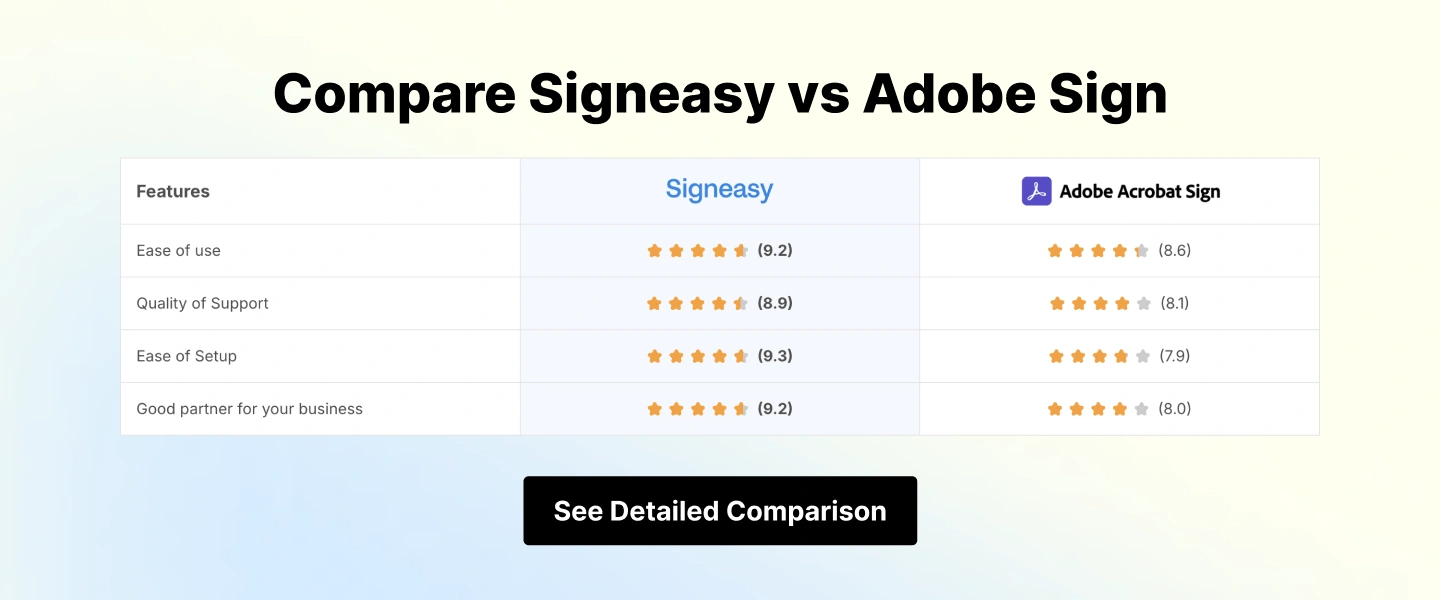
Both Adobe Sign and Signeasy offer the core eSignature features you’d expect, such as collecting signatures, document tracking, and mobile signing. For a side-by-side breakdown. Adobe Sign’s higher-tier plans introduce more advanced features like custom branding, bulk sending, and integrations with enterprise tools like Salesforce and Microsoft 365.
Adobe Sign is also more equipped for businesses with strict security compliance needs, offering HIPAA and FERPA certifications in its enterprise plans.
Signeasy excels in providing a simplified, easy-to-use platform with all the essential tools, including cloud storage integrations with Google Workspace, Microsoft 365, and HubSpot. While it lacks some of Adobe’s more complex features, Signeasy is ideal for users who prioritize a smooth, user-friendly experience without needing to configure extensive workflows or manage deep integrations.
Teams that find its pricing steep can consider Signeasy, which offers comparable security and compliance credentials alongside AI-powered contract management at a significantly lower per-user price point. This makes it worth comparing alongside other SignNow alternatives, Dropbox Sign alternatives, and DocuSign alternatives.
Support
While Adobe Sign offers 24/7 support in its higher-tier plans, Signeasy is known for providing reliable and highly responsive customer support across all plans. Our users consistently praise Signeasy’s support for its quick response times and helpfulness, regardless of the plan they’re on. The ability to get prompt assistance has become a standout feature of Signeasy, with many users noting how it enhances their overall experience with the platform.
Signeasy is trusted and chosen by businesses who want a simpler, user-friendly solution for their eSignature and contract management needs. While Adobe Sign offers a wide range of features, it can feel cluttered for those who don’t need all of them.
If you’re looking for a tool that’s easy to set up, use, and customize, Signeasy might be the better choice, especially for small to medium-sized businesses and fast-growing companies.
Is Adobe Sign right for you?
The honest answer depends on what your team actually does with documents day-to-day.
Adobe Sign is a strong fit if you:
- Work heavily with PDFs and need to edit, redact, or restructure documents as part of your signing workflow. This is where Adobe's native Acrobat integration adds clear, unique value.
- Are already using Adobe Acrobat, Creative Cloud, or the broader Adobe Document Cloud ecosystem and want a signing tool that integrates without adding friction.
- Manage complex enterprise signing workflows with multi-step routing, conditional logic, and Workflow Designer.
- Need Salesforce or Workday integration at scale (available in Enterprise).
Adobe Sign is likely not the right fit if you:
- Are a small or mid-sized team sending fewer than 150 documents per user per year and do not need PDF editing as part of your workflow. You would be paying for capabilities you are unlikely to use.
- Need HIPAA or FERPA compliance but are not ready for Enterprise pricing. These are gated features that require a custom quote.
- Previously relied on Adobe Sign's SharePoint integration, which was discontinued in June 2024.
- Want predictable, unlimited sending with transparent, flat-rate pricing.
For teams in the last group, Signeasy is worth a close look. It covers the core eSignature use case, including sending contracts, collecting signatures, maintaining audit trails, and staying HIPAA-compliant, at a lower price with unlimited document sends and no transaction caps.
Is Adobe Sign the right choice for your business?
Adobe Sign offers a comprehensive set of features designed to meet the needs of businesses of all sizes. One of its key strengths is its seamless integration with Adobe Acrobat, making it an excellent choice for organizations that work heavily with PDF documents.
However, the platform’s transaction limits and higher costs, especially for enterprise plans, may not be ideal for all businesses — particularly those looking for more flexibility or advanced integrations. For companies that prioritize document management alongside eSignatures, Adobe Sign provides a robust solution.
Ultimately, whether Adobe Sign is right for your business depends on your specific needs. If your workflows rely heavily on PDFs, Adobe Sign’s features may justify the investment.
If you're considering alternatives, Signeasy offers a 14-day free trial with no credit card required, and you can cancel anytime. Check our electronic signature pricing to see why it's a popular choice for businesses looking for a simpler, more affordable e-signature solution. Request a demo to explore if it’s the right fit for you.