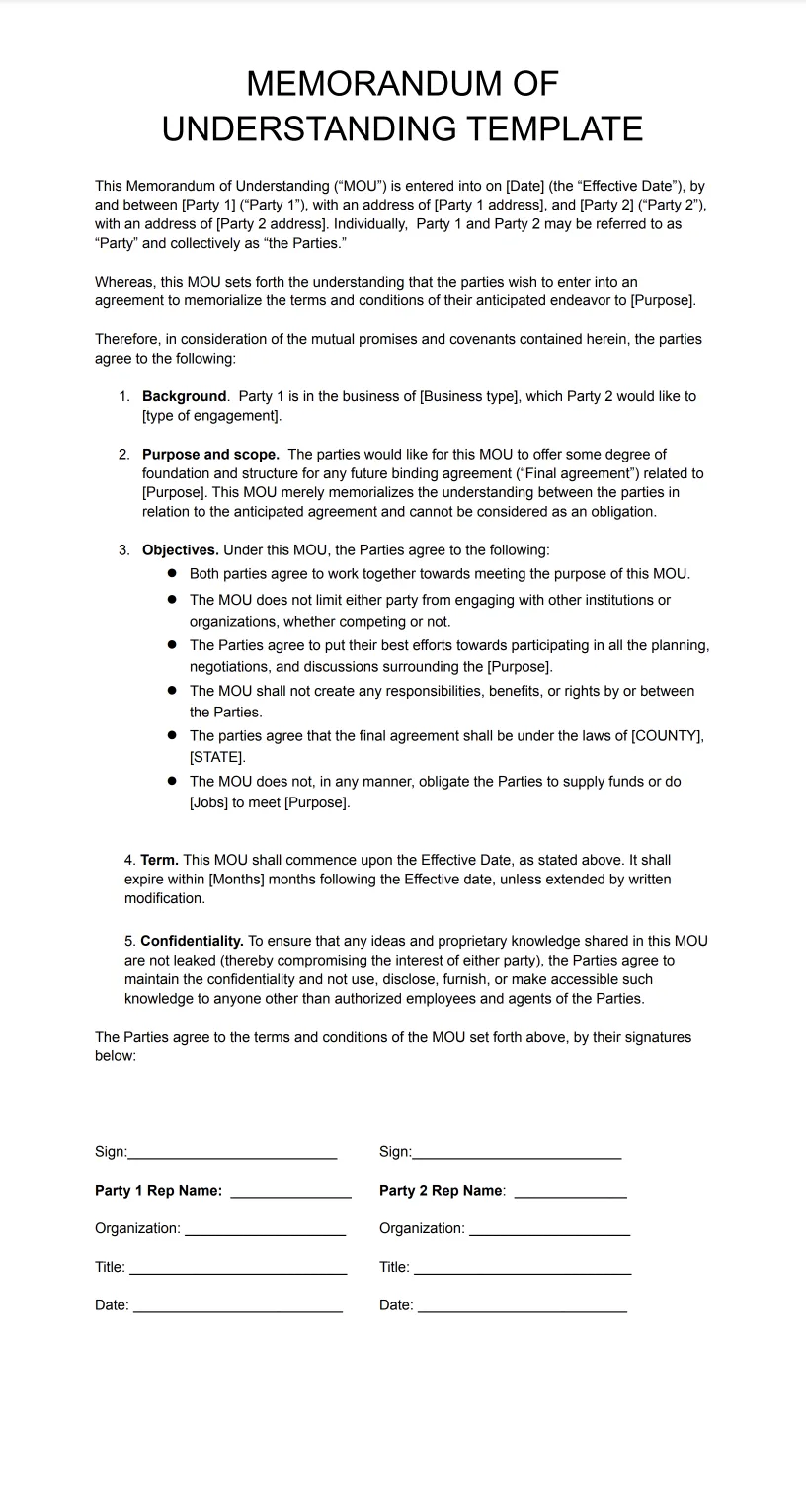
A memorandum of understanding (MOU) formalizes an agreement between two or more parties before they enter into a legally binding contract. Whether you are establishing a business partnership, launching a joint venture, or collaborating on a nonprofit project, an MOU template helps document mutual expectations and responsibilities.
Signeasy offers a free, customizable MOU template that you can download in Word or PDF format. Personalize it with your specific terms, add your organization's details, and collect electronic signatures from all parties. Our memorandum of understanding template works for business collaborations, government partnerships, educational agreements, and more.
What is a memorandum of understanding?
A memorandum of understanding is a written document that outlines the preliminary agreement between parties who intend to work together. Unlike a formal contract, an MOU is typically non-binding but serves as an important first step in formalizing a relationship.
Think of an MOU as a detailed handshake put into writing. It captures what each party brings to the collaboration, establishes shared goals, and creates a paper trail of negotiations. While not enforceable in court in most cases, an MOU demonstrates good faith and provides clarity that can prevent disputes later.
MOUs are commonly used in international relations, business partnerships, nonprofit collaborations, government contracts, and academic research projects. The flexibility of a memorandum of understanding format makes it suitable for virtually any situation where parties want to document their intentions before committing to a binding agreement.
When to use an MOU template
A memorandum of understanding template is appropriate in several situations:
Early-stage negotiations
When two organizations are exploring a potential partnership but are not ready to commit to a binding contract, an MOU documents the discussions and intentions. This creates a foundation for the formal agreement that will follow.
Multi-party collaborations
Projects involving multiple organizations benefit from an MOU that clarifies each party's role, contribution, and expectations. This is especially important for joint ventures, research collaborations, and community initiatives where coordination is essential.
Government and institutional partnerships
Government agencies, universities, and large institutions often require MOUs to formalize relationships with external partners. These documents establish the framework for collaboration while allowing flexibility for specific projects to be defined later.
International agreements
When parties operate in different legal jurisdictions, an MOU provides a neutral starting point. It captures shared understanding without immediately navigating the complexities of cross-border contracts.
Essential elements of an MOU template
A comprehensive memorandum of understanding format includes the following sections:
Identification of parties
Include the full legal names, addresses, and contact information for each organization or individual entering into the MOU. Clearly identify the authorized representatives who will sign on behalf of each party.
Purpose and background
Explain why the parties are entering into this agreement. Describe the context, the opportunity being pursued, and the mutual benefits expected from the collaboration. This section often begins with "whereas" statements that outline the background.
Scope and objectives
Define what the collaboration covers and what it specifically excludes. List the shared goals and objectives that the parties intend to achieve together. Be as specific as possible to avoid misunderstandings.
Roles and responsibilities
Detail what each party will contribute to the partnership. This may include financial resources, staff time, equipment, expertise, or other assets. Clearly distinguish between the obligations of each party.
Duration and termination
Specify when the MOU takes effect and how long it remains valid. Include provisions for extending the agreement if both parties wish to continue. Define how either party can terminate the MOU and any notice requirements.
Confidentiality provisions
If the parties will share sensitive information during their collaboration, include confidentiality clauses that protect proprietary data. For more comprehensive protection, consider using a separate mutual non-disclosure agreement.
Dispute resolution
Even though an MOU is typically non-binding, it is wise to include a process for resolving disagreements. This might involve escalation to senior management, mediation, or other resolution mechanisms before pursuing formal legal action.
MOU vs MOA: Understanding the difference
A memorandum of understanding (MOU) and a memorandum of agreement (MOA) are similar documents that are often confused. While both formalize arrangements between parties, there are important distinctions.
An MOU expresses mutual intent and understanding between parties. It typically outlines broad goals and general terms of collaboration without creating legally enforceable obligations. MOUs are used in the early stages of a relationship to document shared expectations.
An MOA is more detailed and specific, often including concrete deliverables, payment terms, and performance requirements. Depending on its language and the jurisdiction, an MOA may be legally binding. MOAs are commonly used when parties are ready to commit to specific actions and outcomes.
Companies exploring joint ventures, strategic alliances, or distribution agreements use MOUs to document initial terms before investing in detailed legal contracts. Business MOUs often cover revenue sharing, territory rights, and resource commitments.
Nonprofit and community organizations
Nonprofits frequently enter MOUs with corporate sponsors, government agencies, and other community organizations. These agreements clarify how resources will be shared and how the collaboration supports each organization's mission.
Education and research
Universities and research institutions use MOUs to formalize academic partnerships, student exchange programs, and collaborative research projects. These documents protect intellectual property while enabling knowledge sharing.
Government and public sector
Government agencies at all levels use MOUs to establish interagency cooperation, public-private partnerships, and cross-jurisdictional agreements. Government MOUs often have specific formatting and approval requirements.
Real estate and property
In real estate transactions, MOUs document preliminary agreements between buyers and sellers before the formal purchase contract is drafted. They can also formalize arrangements between property managers and service providers.
How to write a memorandum of understanding
Follow these steps to create an effective MOU:
Identify all parties: Gather the legal names, addresses, and contact information for each organization or individual entering the agreement.
Define the purpose: Clearly articulate why the parties are entering into this arrangement and what they hope to accomplish together.
Outline roles and contributions: Specify what each party will bring to the collaboration, including resources, expertise, and responsibilities.
Set the timeline: Establish when the MOU takes effect, how long it lasts, and any key milestones or review dates.
Add protective clauses: Include confidentiality provisions, dispute resolution processes, and termination conditions as appropriate.
Review with stakeholders: Share the draft with all parties and incorporate feedback before finalizing.
Obtain signatures: Have authorized representatives from each party sign the document to indicate their acceptance of the terms.
Benefits of a memorandum of understanding
Long rounds of discussions and negotiations can get bogged down in “he said, she said” if they are not officially documented. Putting all the agreed-upon terms into an MOU, and having it signed by both parties, reduces uncertainty and the risk of future disputes.
An MOU also works as a blueprint for whenever the parties decide to draw up an agreement in the future. That said, since the document is not legally binding, if either party wishes to change the terms of the association, there is nothing preventing them from doing so.
If you are ready to create your own MOU, then check out our free memorandum of understanding template, and sign-up for Signeasy’s 14-day free trial to remotely sign and request a signature from the other party!
Download your free MOU template
Ready to formalize your partnership? Download Signeasy's free memorandum of understanding template in Word or PDF format. Our MOU template includes all the essential sections and is easy to customize for your specific needs.
With Signeasy, you can personalize your MOU sample, collect electronic signatures from all parties, and store your signed documents securely in the cloud. Start your collaboration on solid ground with a professional memorandum of understanding that clearly defines expectations for everyone involved.
Note: These templates are provided for general informational purposes only and are not intended to constitute legal advice. We recommend consulting a qualified professional to ensure the template meets your specific needs and complies with applicable laws.
Frequently asked questions
What is the purpose of a memorandum of understanding?
A memorandum of understanding template helps record items that have been mutually agreed upon by different parties before they are ready to commit to a legally binding deal.
What is the difference between MOA and MOU?
An MOA is a document in which different parties agree to the terms of a shared goal, whereas an MOU is a conditional agreement between parties relating to the transfer of funds for services offered. The latter is raised before the support agreement/reimbursable order form. Neither document obligates the parties to perform any action and neither are legally binding.
What is the formatting of an MOU?
A memorandum of understanding template contains the details and terms of an agreement. It will include all the important provisions, with placeholders for case-specific details.
How do you write a simple memorandum of agreement?
Open the memorandum of understanding template, Make note of the parties involved, their details, and the purpose of the MOU Include the salient points agreed upon by all parties, Upload the draft of your MOU to Signeasy, Attach a eSignature to the document, Finalize the MOU and send it to the other party asking for their signature
Is a memorandum of understanding legally binding?
In most cases, a memorandum of understanding is not legally binding. It expresses mutual intent rather than creating enforceable obligations. However, certain elements within an MOU, such as confidentiality clauses or non-compete provisions, may be binding if specifically drafted that way. Always consult legal counsel if enforceability is important.
What is the difference between an MOU and a contract?
A contract is a legally binding agreement with specific terms that can be enforced in court. An MOU is typically a preliminary document that outlines intentions and understanding but does not create legal obligations. Contracts usually follow after an MOU once parties are ready to commit to binding terms.
Can an MOU be modified after signing?
Yes, an MOU can be modified if all parties agree to the changes. Amendments should be documented in writing and signed by all parties. Some MOUs include an amendment clause that specifies the process for making changes.
How long should an MOU last?
The duration of an MOU depends on the nature of the collaboration. Some MOUs are valid for a specific period, such as one or two years, while others remain in effect until a formal contract is signed or until either party terminates the agreement. Include clear duration and renewal provisions in your MOU template.