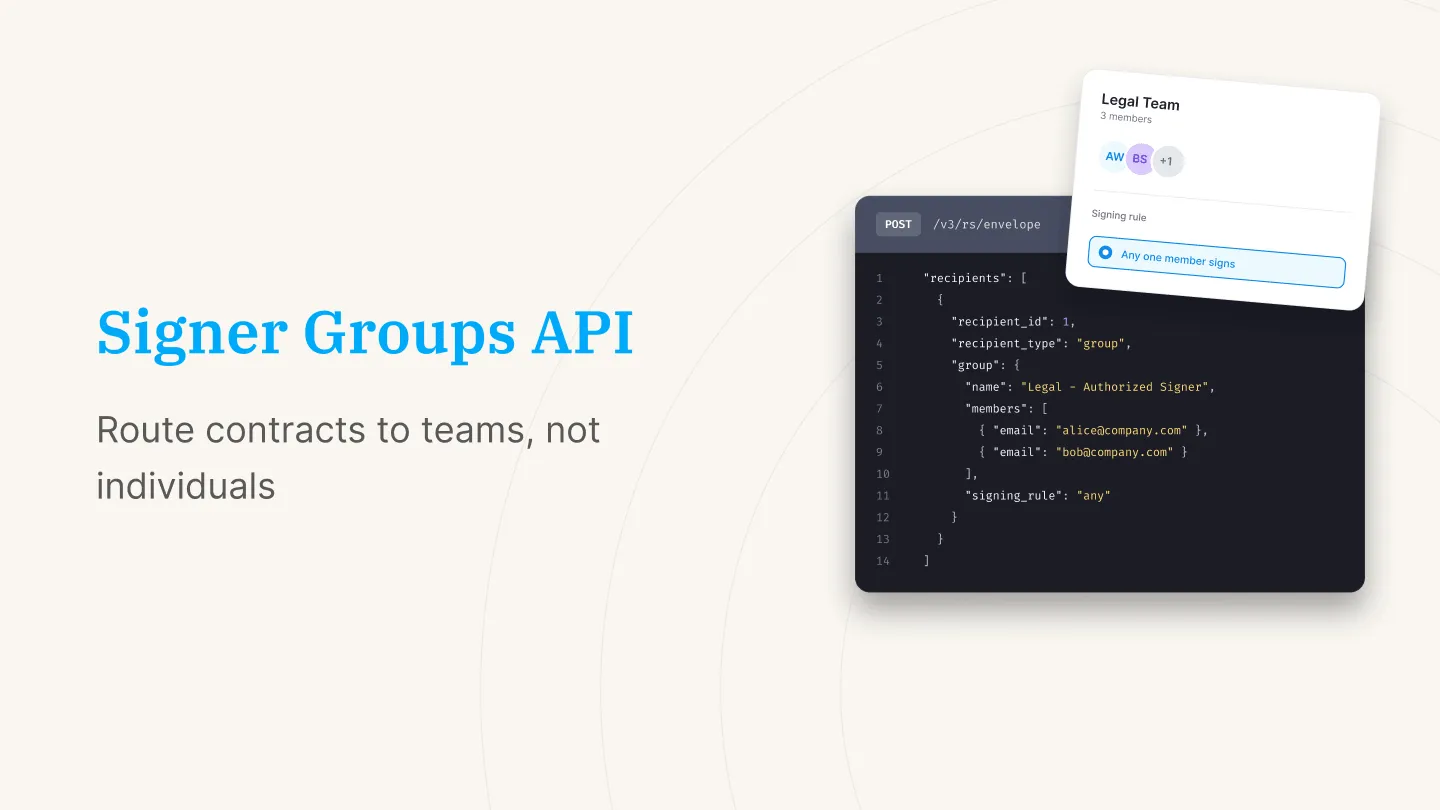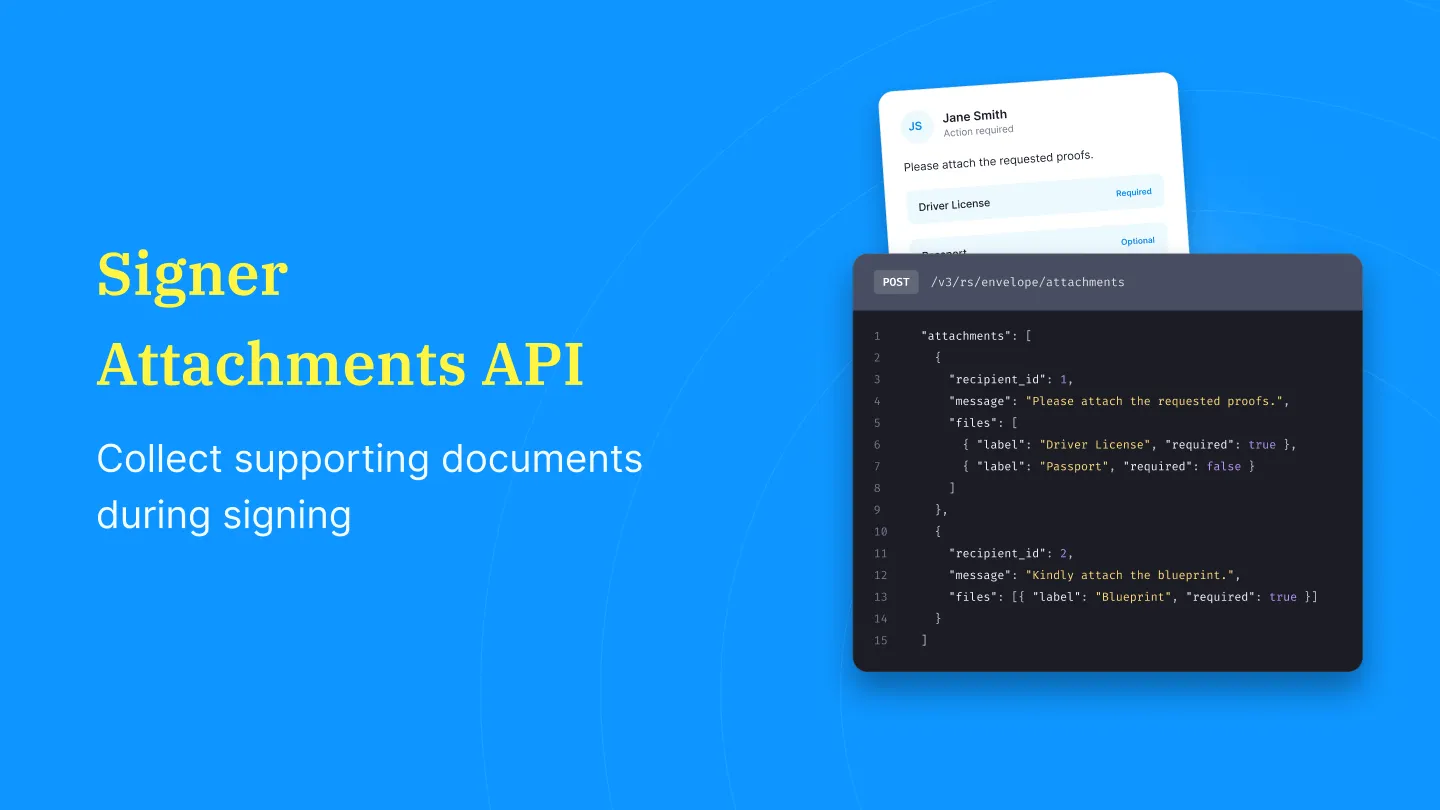





Your customers shouldn't need to download an agreement, sign it in another tool, and upload it to your application. An eSignature API brings the signing experience into the system where the agreement starts. Choosing the best eSignature API also means checking what happens after you send: who authenticates the signer, how your application receives the signed file, and whether an incomplete request consumes paid usage.
To identify the best eSignature API for different applications, we compared 13 providers on signing workflows, developer tools, and production pricing.
Best eSignature APIs at a glance
One envelope can contain several documents and recipients, but providers do not necessarily bill for it in the same way. Youtrust, for example, counts signature requests by recipient. This distinction affects the usage allowance businesses should compare when selecting the best eSignature API.
Building signing into your product? See embedded requests, signer fields, and completion events in a Signeasy API demo.
How we selected the best eSignature APIs
We reviewed official API documentation, each vendor's pricing page where available, developer resources, and published customer implementations. This is a documentation-led comparison. We did not test every provider's production API, so we cannot independently assess API quality under live workloads.
The evaluation covers these aspects of developer experience and production use:
- Development: API endpoints, SDKs, OAuth, sandbox access, documentation quality, and go-live steps.
- Signing: Embedded signing and sending, templates, recipient roles, and webhooks.
- Cost: Included production usage, billable events, additional transactions, and authentication charges.
- Security: Recipient verification, audit records, and controls relevant to the compliance requirements of each signing use case.
- Buyer fit: The documents each application creates and where signed copies must return.
13 best eSignature APIs for developers and businesses
1. Signeasy API
Signeasy is the best eSignature API for growing businesses that want customers to sign agreements inside an existing website or application. Developers use the Signeasy eSignature API for document creation, signer assignments, embedded signing, and returning completed records to their own systems.
Signeasy's completion-based billing is especially relevant where some requests remain unsigned. A paid credit is deducted when every required signer finishes an envelope, not simply when the request is sent.
Key capabilities: Embedded signing, embedded sending, reusable templates, merge fields, signing order, OAuth 2.0, webhook events, and retrieval of signed PDFs and certificates.
Signeasy API pricing has four options:
- Starter: A free plan with a developer sandbox for building and testing an integration. Sandbox credentials aren't for live customer signing.
- Intermediate: $125/month, billed $1,499 annually, including 1,000 completed eSignature requests per subscription year, embedded signing and sending, reusable templates, and webhooks.
- Advanced: $250/month, billed $2,999 annually, including 2,000 annual requests, embedded template creation, additional authentication, and assisted onboarding.
- Build Your Plan: Custom quote for applications with high document volume or specialized API requirements.
For an HR platform, developers can prefill offer letters from candidate records, display signing within the portal, and receive a completion event to update onboarding status.
Main trade-off: Signeasy's standard eSignature plans provide unlimited regular sends on the Business plan and Business Pro plan, but API subscriptions have separate annual request allowances. An application expecting higher transaction volume needs an appropriate API quote.
Best for: Growing SaaS, HR, and customer-service applications that need signing and document status updates within their existing workflows.
2. Docusign eSignature API
Docusign is among the best eSignature APIs for organizations already using its agreement tools or evaluating enterprise features such as PowerForms, API Bulk Send, and identity verification. Its REST API creates envelopes, routes documents to recipients, and retrieves completed agreements.
Key capabilities: REST APIs, SDKs, OAuth, templates, embedded sending, audit trails, Docusign Connect webhooks, and plan-specific bulk sending.
Docusign Developer API pricing starts at $50/month with annual billing for the Starter plan and a starting allowance of 40 envelopes per month. The Intermediate plan costs $300/month and the Advanced plan $480/month with annual billing; both start at 100 envelopes monthly.
Main trade-off: Docusign places embedded signing on its custom-priced Enhanced plans. Intermediate and Advanced begin with the same envelope allowance, so an upgrade between them primarily pays for features. Sent envelopes generally count even when signing is unfinished.
Best for: Existing Docusign customers and applications needing its Advanced or Enhanced API functionality.
3. Dropbox Sign API
Dropbox Sign is among the best eSignature APIs for SaaS applications that want to control the user experience and branding of their signer interface. Its API creates requests, sends signing links, and reports recipient actions.
Key capabilities: Embedded signing and requesting, templates, OAuth, custom branding, callbacks, audit trails, and signature-request tracking.
The Dropbox Sign Essentials API plan starts at 50 signature requests per month, while the Standard API plan starts at 100. Premium API pricing requires a custom quote. Embedded signing and embedded requesting require at least the Standard API plan; Essentials supports non-embedded signing and requesting. Dropbox Sign also provides a free API test mode. Our Dropbox Sign API feature overview explains its developer tools.
Main trade-off: Live requests count against monthly allowances even when recipients don't finish. Check how seasonal usage fits the selected request volume. The Signeasy and Dropbox Sign comparison shows why this billing difference is relevant to incomplete agreements.
Best for: SaaS companies that want signing screens and document requests branded for their customers.
4. DocuSeal API
DocuSeal provides open-source electronic signature software with cloud and self-hosted deployment. Developers can embed signing, configure document fields, and receive completion events while choosing where to operate the service.
Key capabilities: RESTful API, self-hosting, reusable templates, embedded signing, multi-signer submissions, webhooks, and document retrieval.
API and embedding features require a Pro subscription. DocuSeal also charges $0.20 per completed API submission; one submission with several files and recipients counts once.
Main trade-off: Pro licensing and completed-submission fees still apply to API use. With self-hosting, the customer operates the server, software updates, and infrastructure.
Best for: Development teams that require a self-hosted signing service or control over their deployment environment.
5. PandaDoc API
PandaDoc combines document automation with eSignatures, making it one of the best eSignature APIs for sales applications that prepare customized proposals or agreements. A sales system can populate a template with customer information and send the resulting document for signature.

Key capabilities: Document generation, template variables, fillable fields, signatures, SDKs, status events, and enterprise customer relationship management (CRM) integration options.
PandaDoc's free tier is available to eligible accounts created after June 5, 2026 and includes 60 production document sends per year, a two-recipient limit per document, five templates, and a developer sandbox. The API Developer plan starts at $40/month and includes 40 documents monthly. The PandaDoc API feature breakdown covers document preparation and signing in more detail.
Main trade-off: The Free API tier's recipient and template limits restrict multi-party proposals and larger template libraries. Enterprise CRM integration and additional document volume require the appropriate paid plan.
Best for: Sales products that generate proposals or agreements from stored customer data before signing.
6. BoldSign API
BoldSign offers customization options for signing fields, templates, and embedded requests in applications creating their own signature workflows. Its Enterprise API subscription combines an included envelope allowance with additional sent-envelope charges.
Key capabilities: Embedded signing and requesting, templates, branding, text tags, webhooks, OAuth, and optional signer authentication.
Enterprise API begins at $30/month with 40 envelopes included; extra sent envelopes cost $0.75 each. SMS authentication and some identity-verification services are charged separately.
Main trade-off: Sending beyond 40 envelopes triggers usage charges. Sandbox documents are watermarked and automatically deleted after 14 days, so the sandbox isn't suitable for retaining long-term test records.
Best for: Developers needing field placement and branded signing with a smaller initial monthly allowance.
7. SignNow API
airSlate SignNow offers an API that developers use for workflow automation around recurring signing requests in business portals and internal applications. Developers prepare fillable documents, assign signer roles, and collect status notifications through its API.
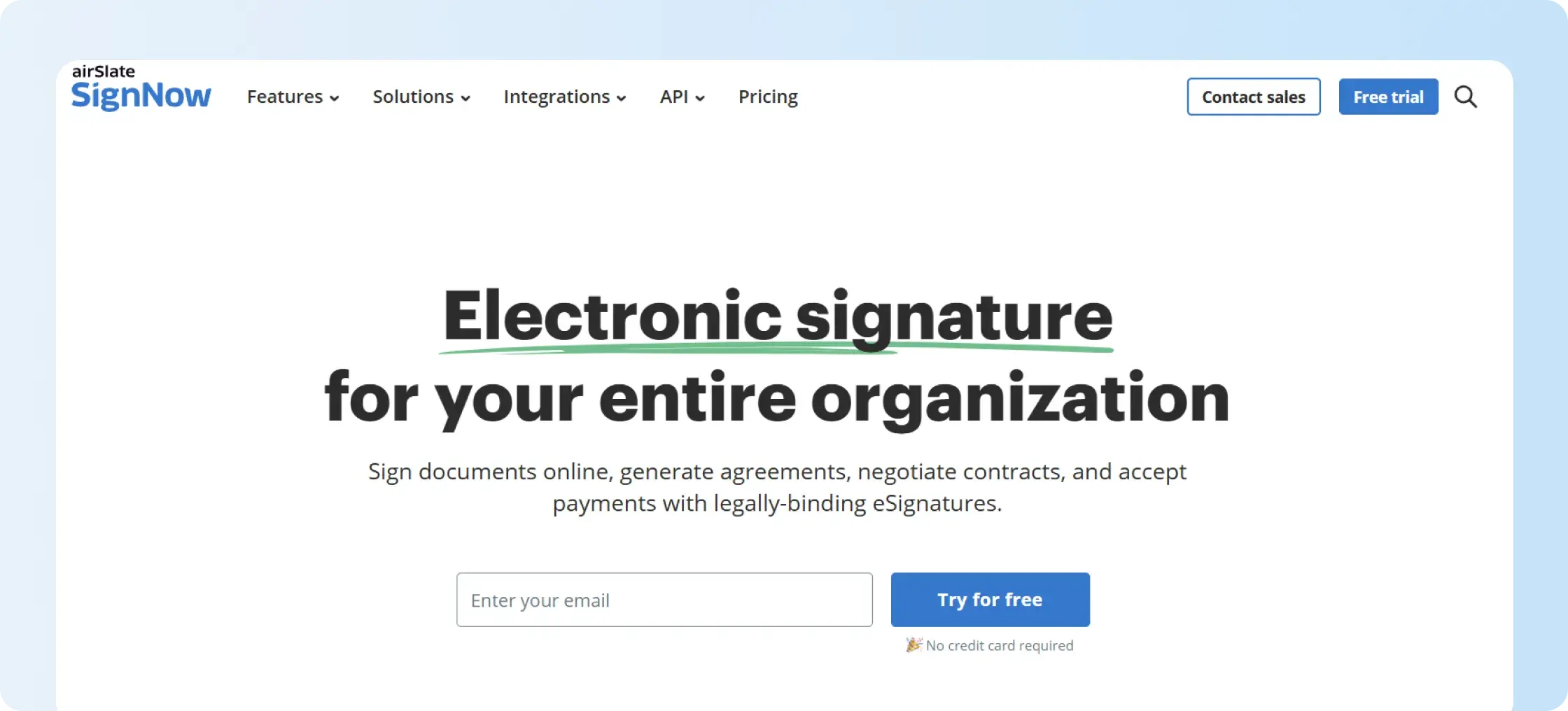
Key capabilities: REST API, SDKs, embedded signing, reusable templates, OAuth, role-based invites, webhooks, and audit trails.
The API Professional plan lists 1,000 documents annually at $146/month, while the Intermediate API plan lists 100 documents monthly at $300/month. Both are distinct from the regular SignNow web-app subscriptions. The SignNow API feature overview covers its template and embedded workflows.
Main trade-off: The two API tiers use different allowance periods. Buyers need to compare monthly peaks with their annual totals and confirm which signing features require Intermediate.
Best for: Applications repeatedly sending prepared onboarding forms, approvals, and business agreements.
8. Adobe Acrobat Sign API
Adobe Acrobat Sign supports API-based signing inside applications that already use Adobe document tools. Developers create agreements, receive status updates, and download signed files for storage in their business systems.
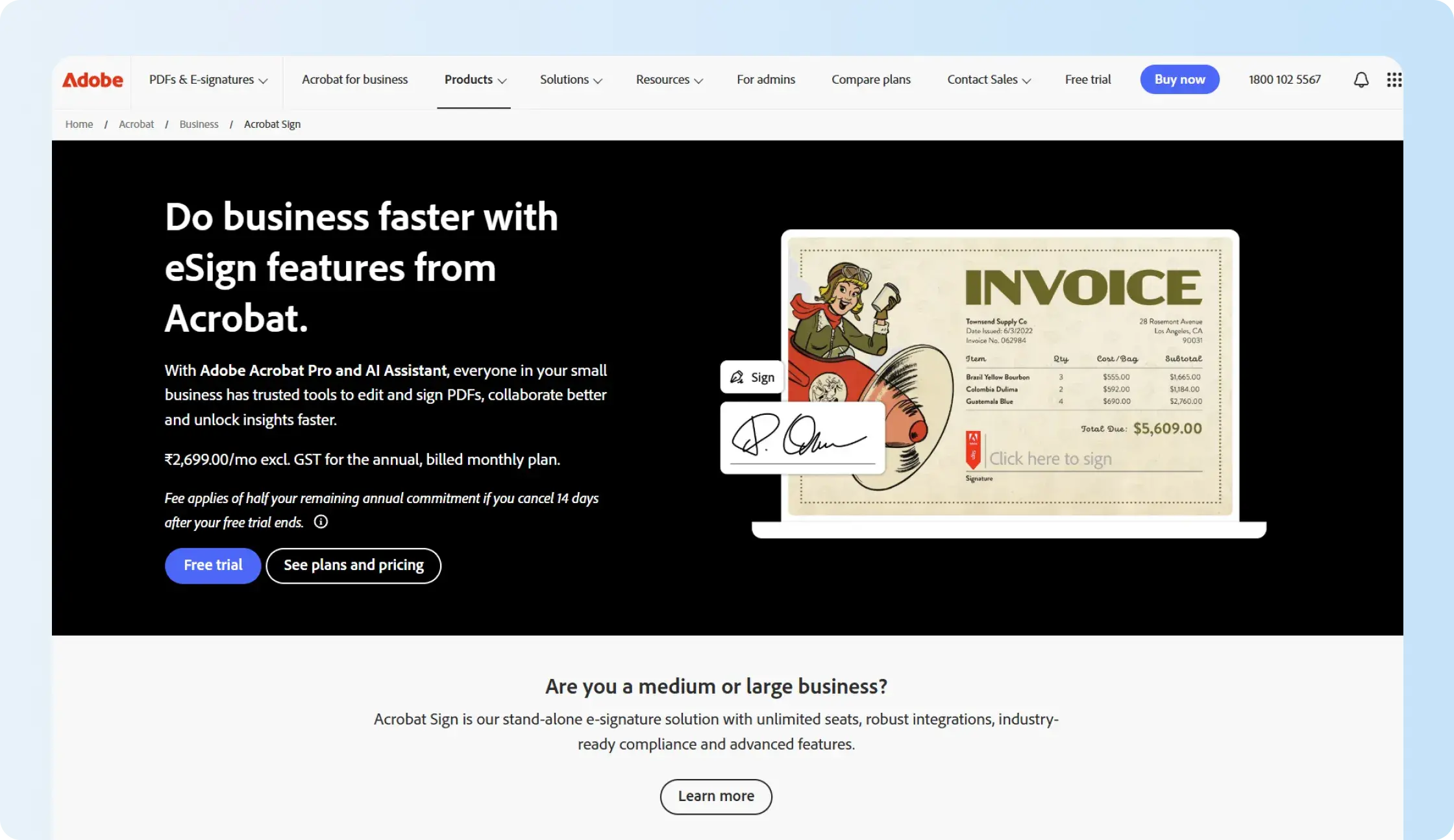
Key capabilities: REST APIs, embedded signing, library documents, webhooks, reminders, audit trails, and agreement retrieval.
Adobe offers a free Developer Edition for testing. Live API use requires an eligible commercial account, with production access and transaction volume established through the enterprise subscription. The Adobe eSign API overview covers its document and API functions.
Main trade-off: A free developer account doesn't authorize production transactions. Buyers need to document live transaction allowances and the API functions included in their Adobe agreement.
Best for: Adobe-centered document workflows and enterprises with an existing Acrobat Sign agreement.
9. Zoho Sign API
Zoho Sign provides REST APIs for document signing within the Zoho ecosystem or custom business systems. Its API-only product uses prepaid credits instead of a recurring per-user subscription.
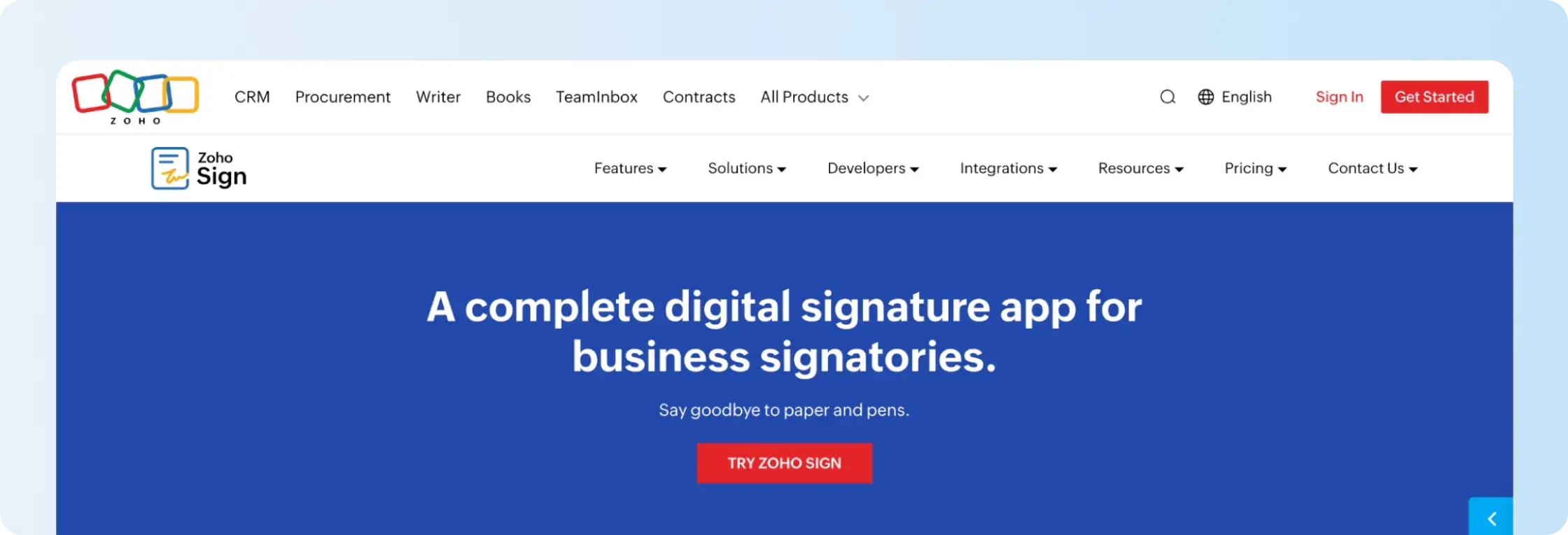
Key capabilities: Embedded sending and signing, templates, conditional fields, signing order, reminders, webhooks, audit trails, and optional recipient verification.
Zoho Sign's API-only plan charges $0.50 per sent envelope, using five prepaid credits. Credits cost $0.10 each and are sold in minimum purchases of 500 credits ($50). SMS delivery and selected identity-verification services consume additional credits. Our Zoho Sign API features overview explains the request process and integrations.
Main trade-off: The envelope rate doesn't include every authentication or delivery service. API-only accounts also restrict ordinary document-sending actions in the Zoho Sign web and mobile apps.
Best for: Zoho-based integrations and applications with variable envelope volume.
10. OneSpan Sign API
OneSpan Sign is among the best eSignature APIs for financial services and insurance applications requiring identity checks alongside electronic signing. It supports embedded signing, recipient authentication, and transaction audit records.
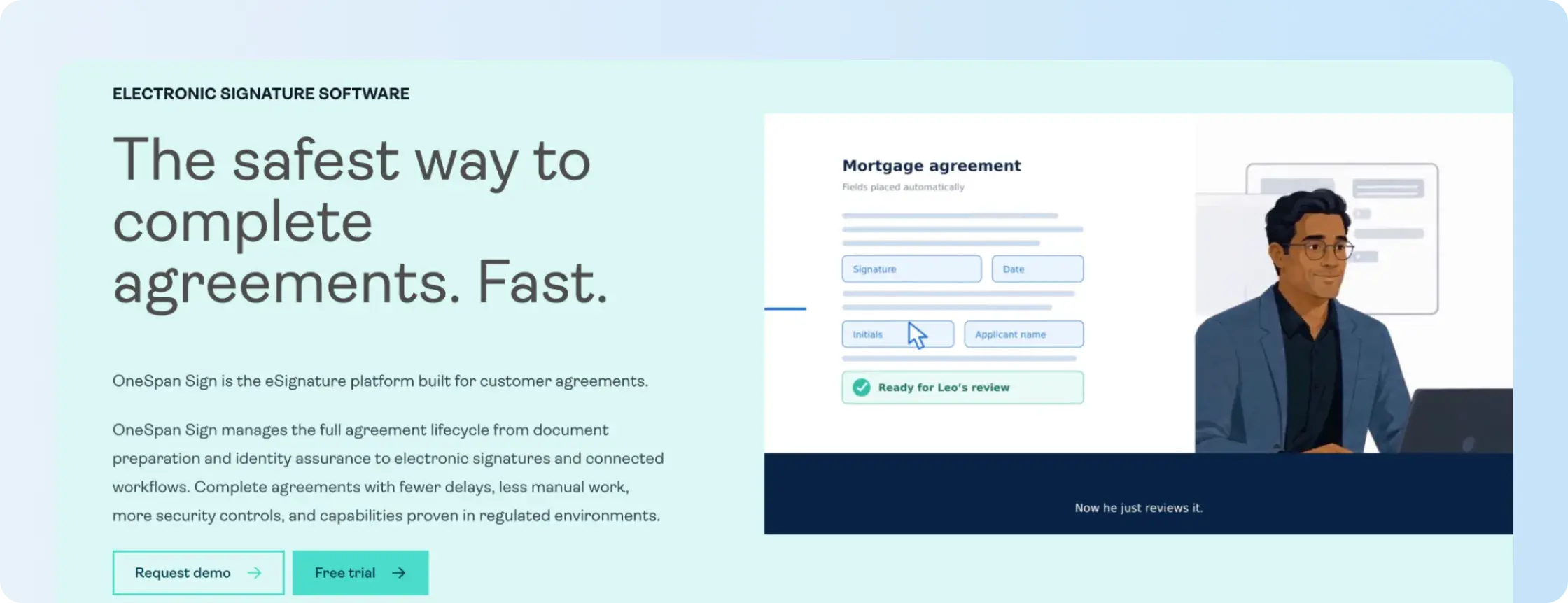
Key capabilities: REST APIs, SDKs, embedded signing, white labeling, templates, signing order, audit records, and optional identity-document or biometric verification.
Production API access belongs to the custom-priced OneSpan Sign Enterprise plan. The $22/user/month Professional plan is a separate web-app subscription and isn't the relevant API starting price.
Main trade-off: Identity-document checks, biometric verification, and some authentication options add charges to the negotiated transaction price.
Best for: Regulated applications that need to document signer authentication and evaluate their signing process against applicable compliance standards.
11. SignWell API
SignWell provides embedded signing and document requests on a usage-based API model. The free developer account supports testing, while production document charges scale with monthly volume.
Key capabilities: Embedded signing and requesting, reusable templates, webhooks, bulk sending, SDK support, and audit records.
A free developer account allows up to three documents monthly and unlimited API testing. With a payment method on file, the first 25 API documents each month are free; additional documents start at $0.85 each, with lower per-document rates at higher volumes.
Main trade-off: SignWell charges by API document sent, regardless of whether the recipient finishes. Multiple files and signers within one API document don't multiply that document charge.
Best for: Products with changing monthly signing volumes that prefer usage-based billing.
12. Youtrust API (formerly Yousign)
Youtrust is an eSignature API for European applications requiring signature options under the EU's eIDAS framework. Its services support simple, advanced, and qualified electronic signatures with relevant identity checks.
Key capabilities: Embedded signing, templates, webhooks, audit evidence, identity verification, and higher-assurance signatures through applicable services.
Youtrust uses annual API subscriptions with signature quotas and provides a free 40-day sandbox. Signature requests are counted per recipient, with each request above the quota billed at €2.
Main trade-off: An agreement requiring three signatures uses three signature units. Higher-assurance verification services have additional commercial requirements.
Best for: European applications needing eIDAS signature levels and recipient identity checks.
13. Box Sign API
Box Sign API fits applications already storing and managing agreements in Box. Developers initiate signature requests and keep completed records connected to existing Box content workflows.

Key capabilities: Signature requests, reusable templates, embedded signing, branding options, status tracking, and Box content integration.
Box Business includes 100 third-party and custom integration signature requests annually, Business Plus includes 150, and Enterprise includes 250. Developer access is available for testing.
Main trade-off: The annual custom-integration allowance is separate from unlimited signing within eligible Box web-app subscriptions. Businesses exceeding it need additional Sign API terms from Box.
Best for: Organizations using Box as the document repository for their signing workflow.
Comparing the 13 providers for production use? See how embedded signing, completed requests, and webhook events fit the application you're building.
How much do the best eSignature APIs cost?
To identify the best eSignature API for your signing volume, compare what each provider bills: sent envelopes, completed requests, individual documents, or signatures per recipient. Also account for subscription commitments and whether embedded signing or identity verification requires a higher plan.
How incomplete requests affect API costs
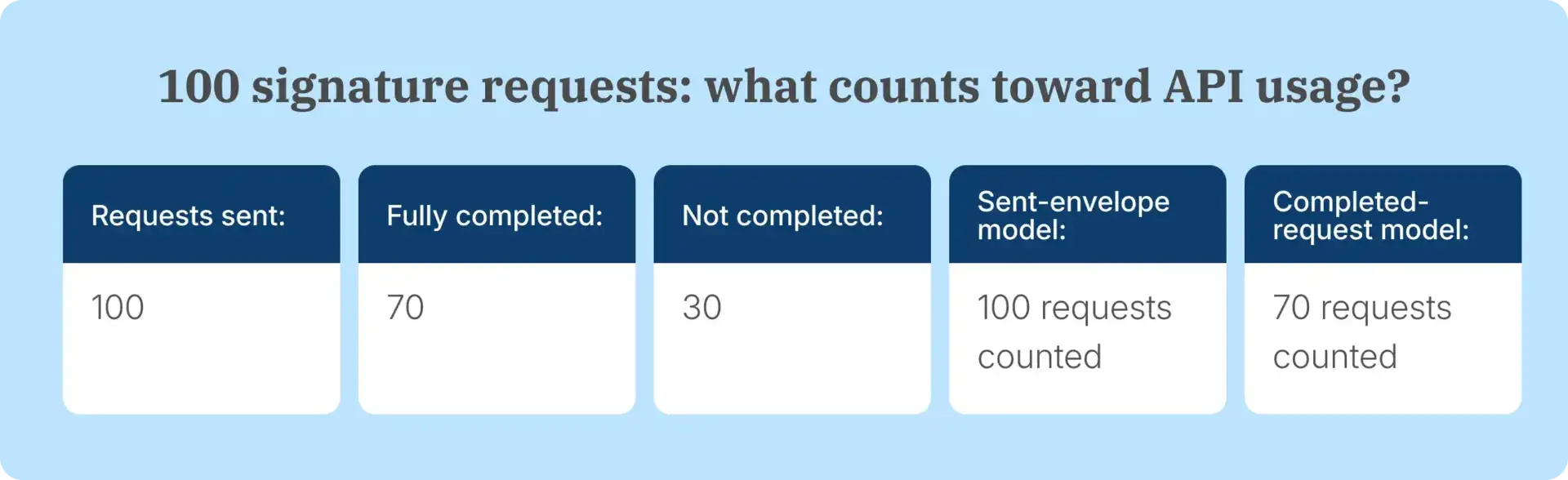
Suppose an HR platform sends 100 separate offer-letter envelopes. Seventy are fully signed; 30 aren't. Under a sent-envelope allowance, all 100 count when sent. Under our completed-request billing, 70 use paid credits. If any of the other 30 are eventually completed, they consume credits then.
This example compares billed usage, not subscription totals. The application still needs to account for annual commitments, plan allowances, and authentication charges.
How Signeasy and Docusign compare for embedded signing
Our Intermediate API plan is $125/month with annual billing and includes 1,000 completed-request credits per subscription year, embedded signing, embedded sending, templates, and webhooks. Docusign's Intermediate Developer API plan is $300/month on annual billing and starts at 100 sent envelopes per month; its embedded signing entitlement is listed on Enhanced, which requires a custom quote.
These plans have different billing units and allowance periods, so the figures aren't interchangeable. For an application requiring in-app signing, compare the production feature entitlement first, then the expected number of sent and completed requests. Also include SMS or identity-verification charges, overages, and developer maintenance.
What developers should test before choosing the best eSignature API
To select the best eSignature API for your application, use each provider's sandbox to test a complete transaction: prepare the document, authenticate the signer, handle unfinished requests, process status events, and retrieve the completed PDF. The eSign API integration walkthrough covers the implementation sequence for developers building this into an existing system. For each provider, also check whether comprehensive API documentation covers authentication, webhooks, status events, and errors.
- Prepare the document. Test with redacted samples of the real documents your application handles. Upload a PDF or use a reusable template, then prefill known values and place required signing fields.
- Route recipients. Assign signer roles, signing order, and mandatory fields. For complex workflows, test documents with multiple signers and different signing sequences.
- Secure embedded signing. Authenticate recipients in the host application and generate unique signing URLs. Our embedded signing documentation describes this requirement for in-app signatures.
- Handle incomplete requests. Test declines, expiry, cancellation, and requests that remain unsigned; confirm what consumes a paid credit.
- Process webhooks. Verify incoming event tokens, test error handling and retries for failed deliveries, and handle out-of-order notifications.
- Retrieve records. Download signed documents and audit records, then attach the right file to the customer or employee record.
- Prepare for production. Check API compatibility with your tech stack, OAuth scopes, rate limits, document-size and recipient limits, and the procedure for generating live credentials.
For example, an HR platform should update a candidate's status when an offer letter is fully signed, while keeping declined or expired offers in a separate state. Otherwise, the application might incorrectly mark an unsigned offer as accepted.
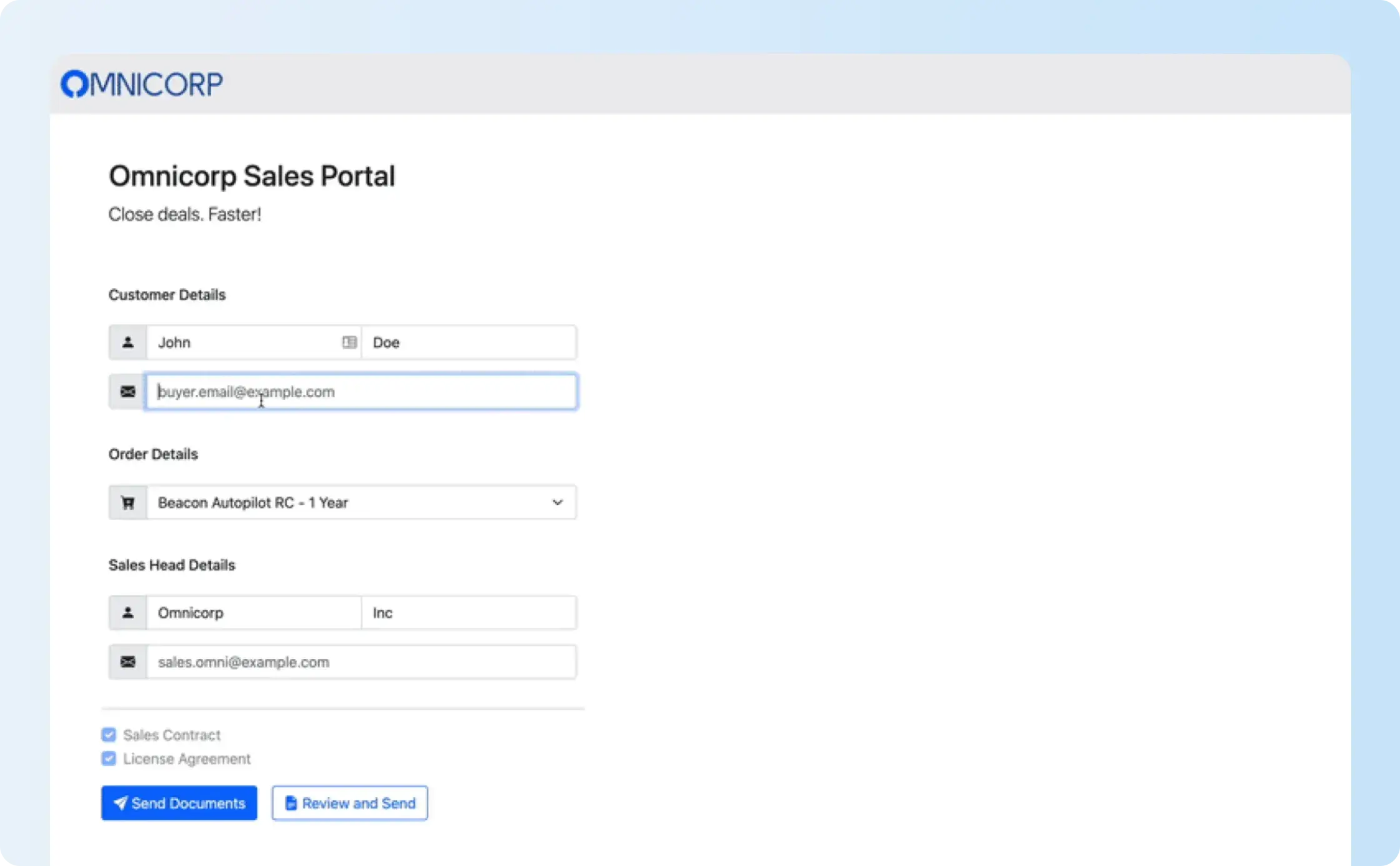
Testing signer authentication or webhook events? Walk through recipient links, completed PDFs, and developer setup with our API team.
Why Signeasy is the best eSignature API for growing businesses
For a growing business, the API needs to fit existing customer data, document templates, and application events. Signeasy connects document preparation, embedded signing, and completion notifications to reduce the manual work of moving agreements between systems.
Add embedded signing and sending to existing applications
Our reusable templates and merge fields help developers prepare the same type of agreement with different customer details. Embedded sending lets an authorized user place fields and start a request inside the application. Embedded signing then lets the recipient finish it there.
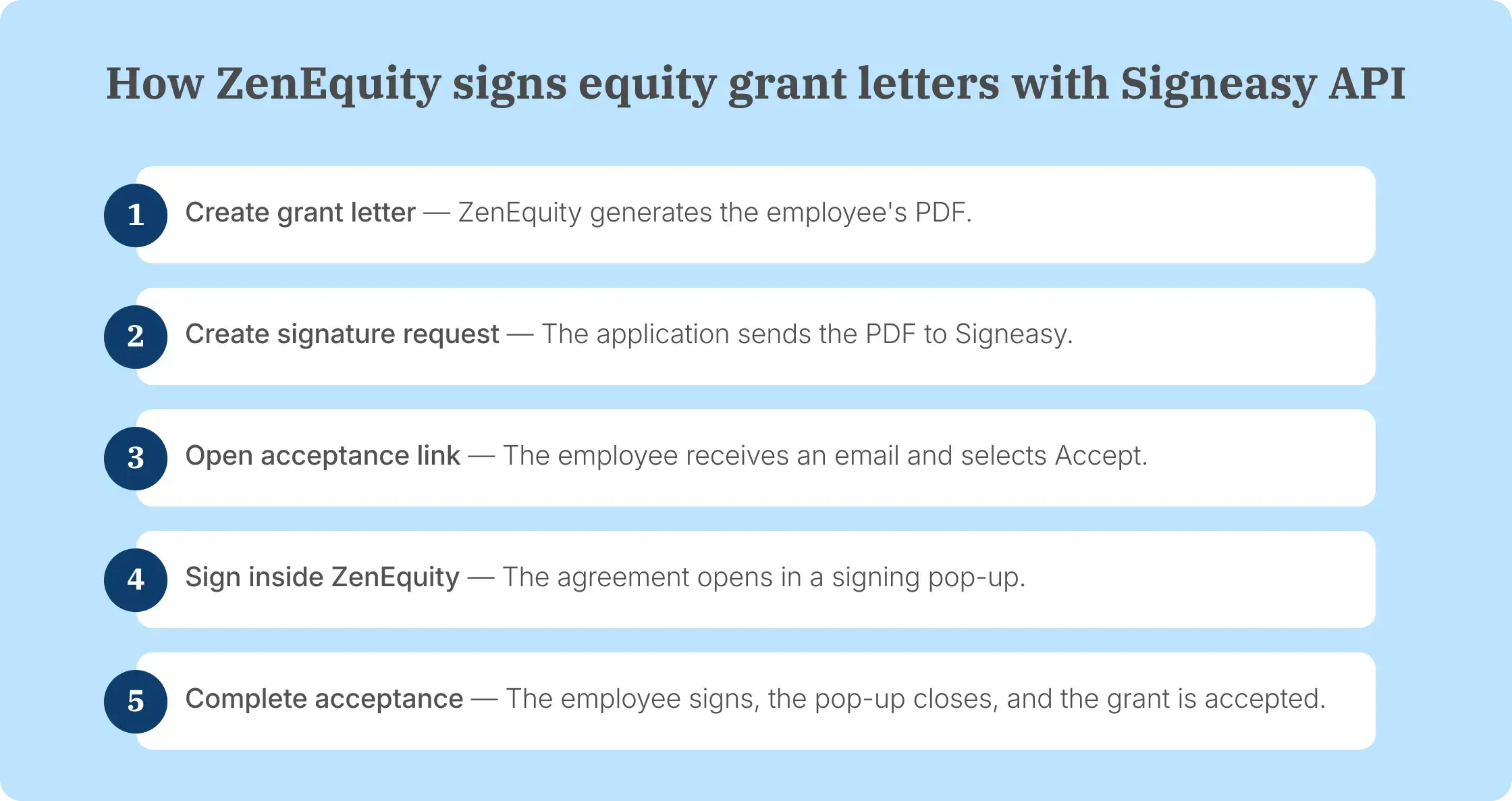
ZenEquity uses this flow for employee equity grant letters. Its platform generates a PDF and sends it to Signeasy. The employee receives an email, clicks Accept, and signs in a pop-up within ZenEquity. The pop-up closes after signing, and the grant is accepted. ZenEquity also stores client-specific templates with different branding and legal content.
Pay for completed signing transactions
Our paid API credits are deducted only when an envelope has been signed by every required recipient. One fully signed envelope counts once even if it contains multiple documents or signers. An application sending 100 envelopes but completing 70 uses 70 credits, while unfinished requests use none until completed.
Businesses can use their actual completion rate to estimate how quickly the Intermediate plan's 1,000-credit annual allowance or the Advanced plan's 2,000-credit annual allowance will be used. The billing rule is useful when agreements are frequently abandoned, declined, or left open.
Get developer onboarding and implementation support
Our API team supports developers working through authentication, document preparation, and production setup. Intermediate includes 24/7 email support; the Advanced API plan adds assisted onboarding through a dedicated Success Manager.
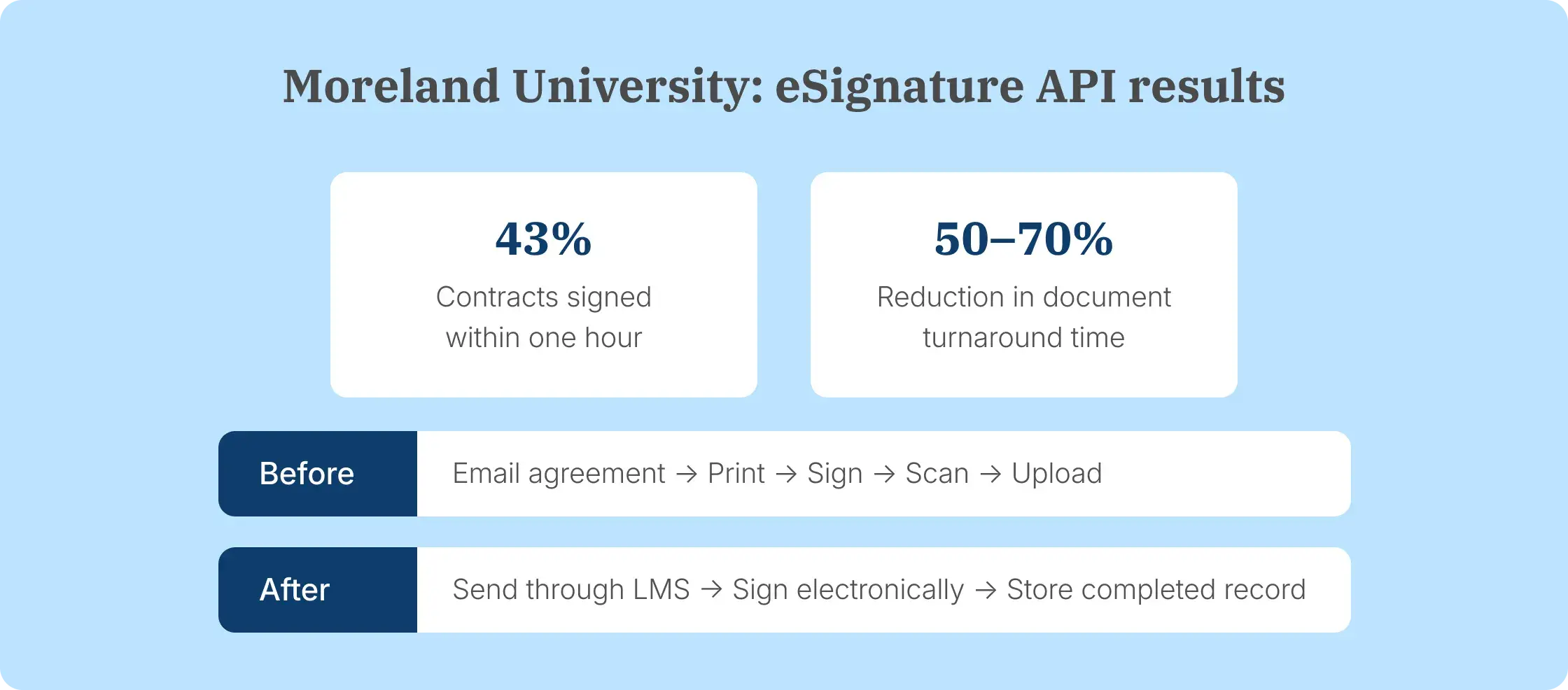
Moreland University integrated Signeasy with its learning management system (LMS) for enrollment agreements and other student documents. Candidates previously received emails, printed contracts, signed and scanned them, then uploaded the results. With the API integration, candidates sign electronically and completed records return to the university's workflow. Moreland reports 43% of contracts signed within one hour and 50–70% lower document turnaround time.
Want signing records returned to your application? See how completed documents and webhook updates connect to an existing system.
Switch with white-glove migration and competitor contract buyout
We offer white-glove migration assistance and competitor contract buyout options for qualifying businesses switching signing providers. The technical scope and buyout terms are discussed with our team before a migration starts.
An API migration involves mapping authentication, document templates, signer roles, webhook events, and file retrieval to the replacement integration. For Docusign customers, our template migration guidance explains how common signing fields transfer and which fields, including payments and conditional logic, need rebuilding.