



eSignature tools in 2026 are used across sales, HR, finance, procurement, and operations. Sales teams send proposals and agreements, HR handles offer letters and policies, finance manages approvals, and procurement works with supplier documents. Once several teams rely on the same eSignature platform for electronic signatures, the monthly subscription is only one part of the cost. The signing process, sender count, integrations, and plan controls can all change what the team actually pays.
That is why Dropbox Sign pricing (formerly HelloSign pricing) is worth looking at beyond the advertised monthly rate. The amount you pay changes with the number of senders, the plan your team needs, and any integrations or controls that sit outside the starting tier. This article breaks down those costs so you can see what each plan includes and where the bill can increase.
How much does Dropbox Sign (HelloSign) cost in 2026?
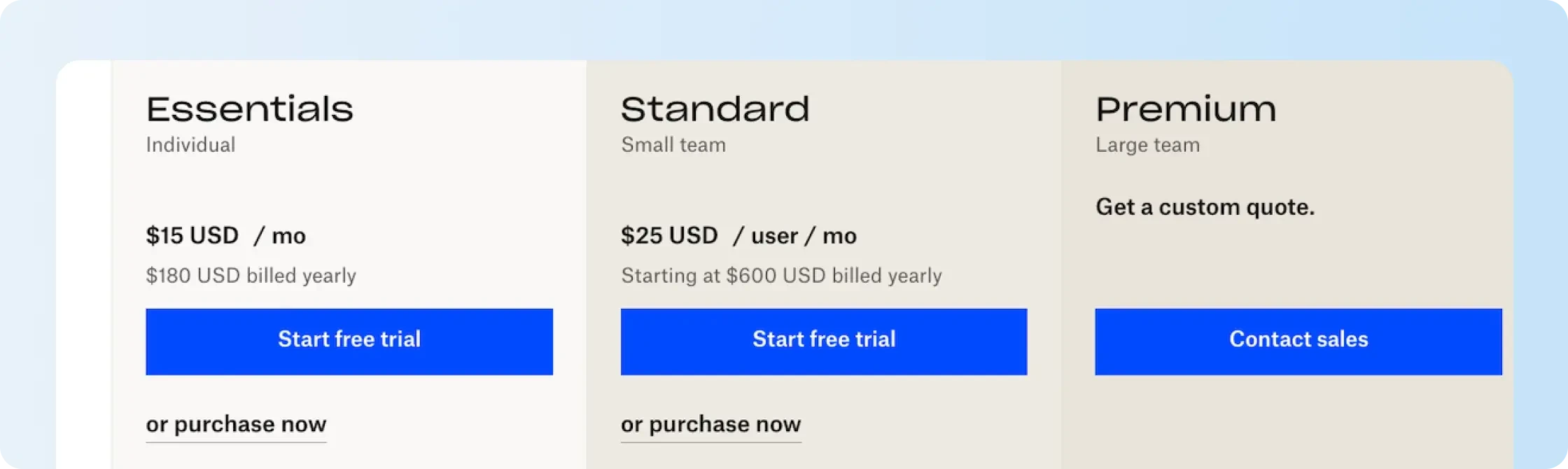
At regular annual rates, Dropbox Sign pricing starts at $15/month for the Essentials plan. Standard costs $25/user/month and starts with 2 users, while Premium has no published rate.
Dropbox’s current offer terms provide 30% off the first year of an eligible annual plan or 15% off the first three months of an eligible monthly plan. After the promotional period, billing returns to the regular plan price unless the subscription is cancelled.
Here are the current Dropbox Sign plans and the pricing details to compare:
* Pricing checked in September 2026. Promotional offers can change.
See what the same sender setup would cost with Signeasy.
Dropbox currently shows Essentials at $10.05/month equivalent and Standard at $17.50/user/month equivalent for the first annual term. Regular pricing resumes after the promotional period, and Dropbox states that changing plans ends the offer. For ongoing budgeting, compare those first-year rates with the regular $15 and $25 rates.
Dropbox uses the user count for people who can send signature requests. Recipients do not need a paid sender seat just to receive and sign an agreement.
These rates cover the base subscription. The next section explains what each paid plan includes and which requirements move a team to a higher tier.
What does each Dropbox Sign plan include?
The 3 paid web plans include unlimited regular signature requests, but templates, team administration, branding, reporting, security controls, and user access change as you move up.
The differences below show what each plan covers, who it suits, and what makes a team move up.
Dropbox Sign Essentials plan
The Essentials plan has a regular Dropbox Sign pricing rate of $15/month on annual billing, or $180 for the year. The current first-year offer reduces that to $120.60, equivalent to $10.05/month.
Essentials is built for one user and includes:
- unlimited signature requests;
- 5 reusable templates;
- audit trails and tamper-proof completed documents, with each signed document receiving its own digital seal;
- form fields such as signature blocks, text fields, checkboxes, and dates;
- email notifications and automatic email reminders for outstanding requests;
- Dropbox Sign integrations with common storage and business tools.
Essentials fits a workflow where one person handles sending. It does not include the administration, branding, reporting, in-person signing, bulk sending, or larger template allowance available on Standard.
Once another employee needs their own sender access, the account moves into Standard pricing. That is the main cost change to watch for a business starting with Essentials.
Dropbox Sign Standard plan
The Standard plan costs $25 per user per month at its regular annual rate. It starts with 2 users, which puts the regular minimum at $50/month or $600/year.
Under the current annual promotion, 2 Standard users cost $420 for the first year, equivalent to $17.50/user/month.
Standard adds:
- 15 reusable templates;
- team administration and roles;
- custom branding;
- bulk sending;
- in-person signing;
- advanced signer fields;
- reporting;
- additional business integrations.
Standard is where Dropbox Sign adds more team features and admin settings for a shared signing workflow. Bulk Send helps when the same agreement needs to reach many recipients, while in-person signing can collect a signature on a mobile device.
The trade-off is the starting cost. Standard requires 2 users, putting the regular annual minimum at $600 even if the second sender is used only occasionally. Dropbox directs buyers with more than 5 users to sales instead of showing a larger-team rate on the public pricing page.
Signeasy Business is also priced per user, but its public pricing does not list a 2-user minimum. A team that needs only one paid sender can therefore compare the required seat commitment as well as the per-user rate.
Some integrations can add another charge. Dropbox Sign for Salesforce, for example, is sold as an add-on for eligible Standard and Premium accounts.
Dropbox Sign Premium plan
The Premium plan uses custom Dropbox Sign pricing, so there is no published monthly or annual rate.
Premium is aimed at larger teams and large companies that need advanced features beyond everyday sending. These include unlimited templates, SSO, data residency, multi-team administration, performance dashboards, and customizable reports.
Premium becomes relevant when the buying requirement moves from everyday signing to IT and administration controls. SSO lets employees access Dropbox Sign through the company’s identity system, data residency affects where completed document data is stored, and multi-team administration helps separate users and permissions across departments.
The trade-off is price visibility. Dropbox does not publish a Premium rate, so teams that need these controls have to request a quote and confirm which integrations, security settings, and add-ons are included.
Pro tip: Compare the renewal rate before committing to the first-year discount. The promotional price changes what you pay now; the regular rate determines what the same setup costs later.
For teams handling sensitive documents, security should be checked alongside plan features. Dropbox Sign says it takes a proactive approach to information security and lists SOC 2 Type II, ISO 27001, eIDAS, and GDPR among its compliance credentials. Two-factor authentication provides an added layer of protection for account access.
What can increase Dropbox Sign cost or require a higher plan?
Unlimited signature requests keep document volume from increasing the price of Dropbox Sign’s paid web plans. Costs start to change when more people need sender access, the team needs Premium-level controls, or an integration requires another plan or add-on.
These are the points most likely to change what a growing team pays or how it works with Dropbox Sign, and they are useful checkpoints when comparing Dropbox Sign alternatives.
1. Adding senders raises the minimum spend
Essentials supports one user, while Standard starts with 2. At regular pricing, that moves the annual subscription from $180 for Essentials to at least $600 for Standard.
The first-year promotion lowers the first-year bill, but regular pricing resumes afterward. For 2 Standard users, that means $420 during the current promotional term and $600 at the regular annual rate.
2. High-volume signing can expose workflow and support issues
Dropbox Sign lists unlimited signature requests on its paid web plans. A large batch sent against a deadline can still put more pressure on the workflow and support response time.
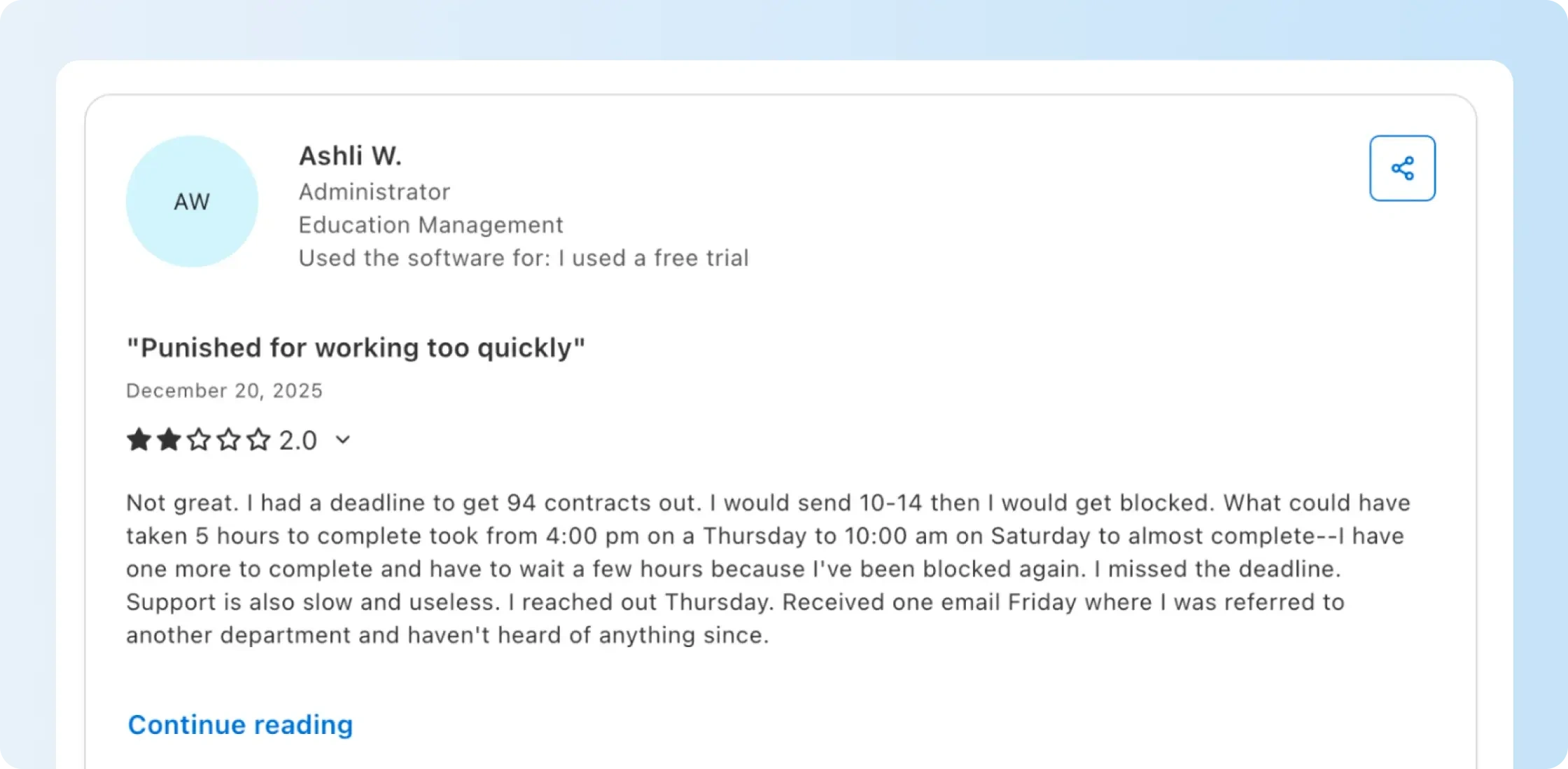
In the customer example shown below, the user was working through 94 contracts and reported repeated sending blocks as well as delays getting help. This is a customer-reported experience, not a published Dropbox Sign sending cap.
Dropbox lists customer support across its plans and says customers can use email and chat support. Dropbox describes this as access to a knowledgeable customer support team, though response time can still be important when a large signing batch is deadline-sensitive.
3. SSO, data residency, and multi-team controls require a Premium quote
Standard covers team administration and reporting, but SSO, data residency, multi-team management, advanced reporting, and performance dashboards sit on Premium.
Dropbox does not publish a Premium price, so teams that need those controls have to request a quote.
4. Some integrations change the plan or add cost
An integration can change the cost even when the core plan price stays the same.Dropbox Sign works with tools such as Dropbox, Google Drive, Microsoft Word, Salesforce, and OneDrive, but availability and pricing vary by integration.
Dropbox Sign for Salesforce, for example, is an add-on available with Standard and Premium. An Essentials customer would need to move to an eligible plan before adding it.
5. SharePoint now needs a different signing setup
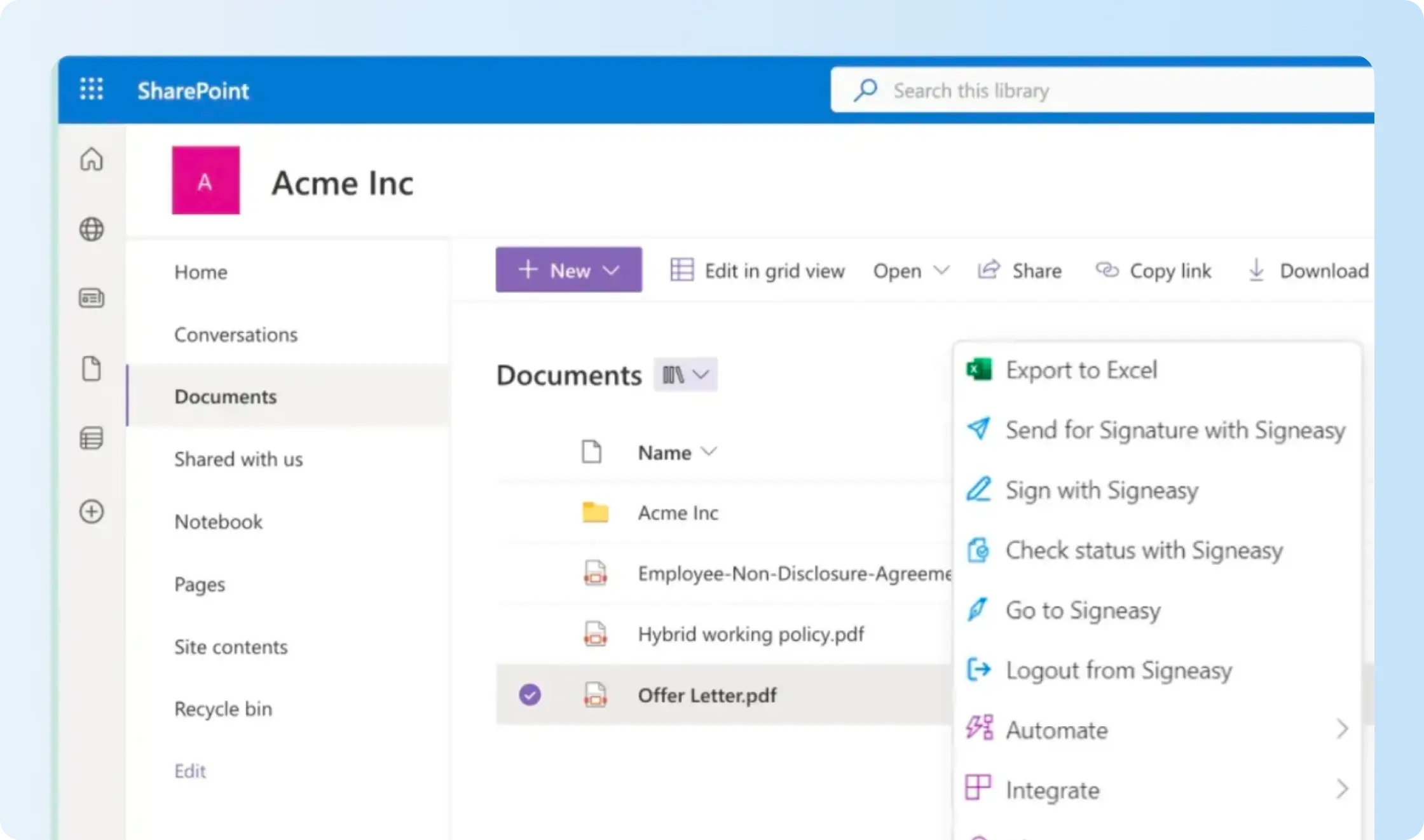
Dropbox Sign discontinued its native SharePoint integration starting March 16, 2026. Teams that previously sent documents from SharePoint and returned completed agreements there now need a Dropbox Sign SharePoint alternative or a custom integration to keep that workflow in SharePoint.
Signeasy supports that workflow through its SharePoint integration. Users can select a document in SharePoint, send it for signature, track its status, and archive the completed agreement back in SharePoint.
Can you use Dropbox Sign for free?
Yes. Dropbox Sign Free is a permanent free tier alongside its paid plans. It is a limited free plan for low-volume use, with 3 signature requests every 30 days. Adding your own signature through self-signing does not use those requests. A single signature request can also contain multiple individual documents and multiple signers when they are sent together.
The Free plan is separate from the 30-day paid-plan trial. The Free plan is for ongoing low-volume use, while the trial lets a buyer test paid-plan features before subscribing.
A sender who needs reusable templates, more than 3 outgoing requests in a 30-day period, or team controls will need a paid plan.
How does Dropbox Sign pricing compare with Signeasy?
For teams comparing paid eSignature plans, Dropbox Sign Standard and Signeasy Business provide a useful team-plan comparison because both support multiple senders and unlimited regular signing. The main pricing difference comes from Dropbox Sign’s current first-year discount and the regular rate that applies afterward.
For a two-person team, the annual cost works out to:
- Dropbox Sign Standard during the current first year: $420
- Dropbox Sign Standard at the regular annual rate: $600
- Signeasy Business: $480
Dropbox Sign Standard therefore costs $60 less for two users during the current promotional year. Once the regular $25/user/month rate applies, the same two seats cost $120 more per year than Signeasy Business.
Price is not the only difference. Dropbox Sign Standard includes 15 reusable templates at this tier, compared with 5 on Signeasy Business. Signeasy Business has the lower regular annual list price and includes unlimited document sends.
Want to compare the cost using your actual number of senders?
Where Signeasy fits for growing teams
Signeasy fits growing businesses that prioritize transparent team pricing, unlimited document sends, reusable team templates, and straightforward administration.
Signeasy Business costs $20/user/month billed annually on its eSignature pricing. The plan includes unlimited document sends, 5 reusable templates, team template collaboration, reminders, an admin dashboard, two-factor authentication, and 24/7 email support.
Business Pro costs $30/user/month billed annually and adds unlimited templates, roles and permissions, usage reporting, signer document requests, signer two-factor authentication, approval workflows, and SharePoint integration.
For example, approval workflows let a team route a document for internal review before it is sent for signature. Approvers can review sequentially or in parallel, and signing starts after the required approvals are complete. That is useful when an offer, purchase agreement, or contract needs manager approval first.
If your decision is down to these two products, the Signeasy vs Dropbox Sign comparison looks beyond subscription price at templates, integrations, SharePoint, mobile workflows, and team controls.
See whether Business or Business Pro fits your workflow.
Is Dropbox Sign pricing worth it?
Dropbox Sign fits teams that need unlimited regular signature requests and can cover their workflow within Essentials or Standard. Standard adds branding, bulk send, reporting, and in-person signing, while Premium covers SSO, data residency, and multi-team administration.
The main cost checks are the 2-user Standard minimum, the regular price after the first-year discount, selected paid integrations, and the move to custom pricing when Premium controls are required. Teams that rely on SharePoint also need another signing setup after Dropbox Sign ended its native integration.
Before committing, compare the plan your team would actually need with Signeasy using the same sender count, integrations, and signing requirements. That gives you a more useful cost comparison than looking at Dropbox Sign’s introductory rate alone.