

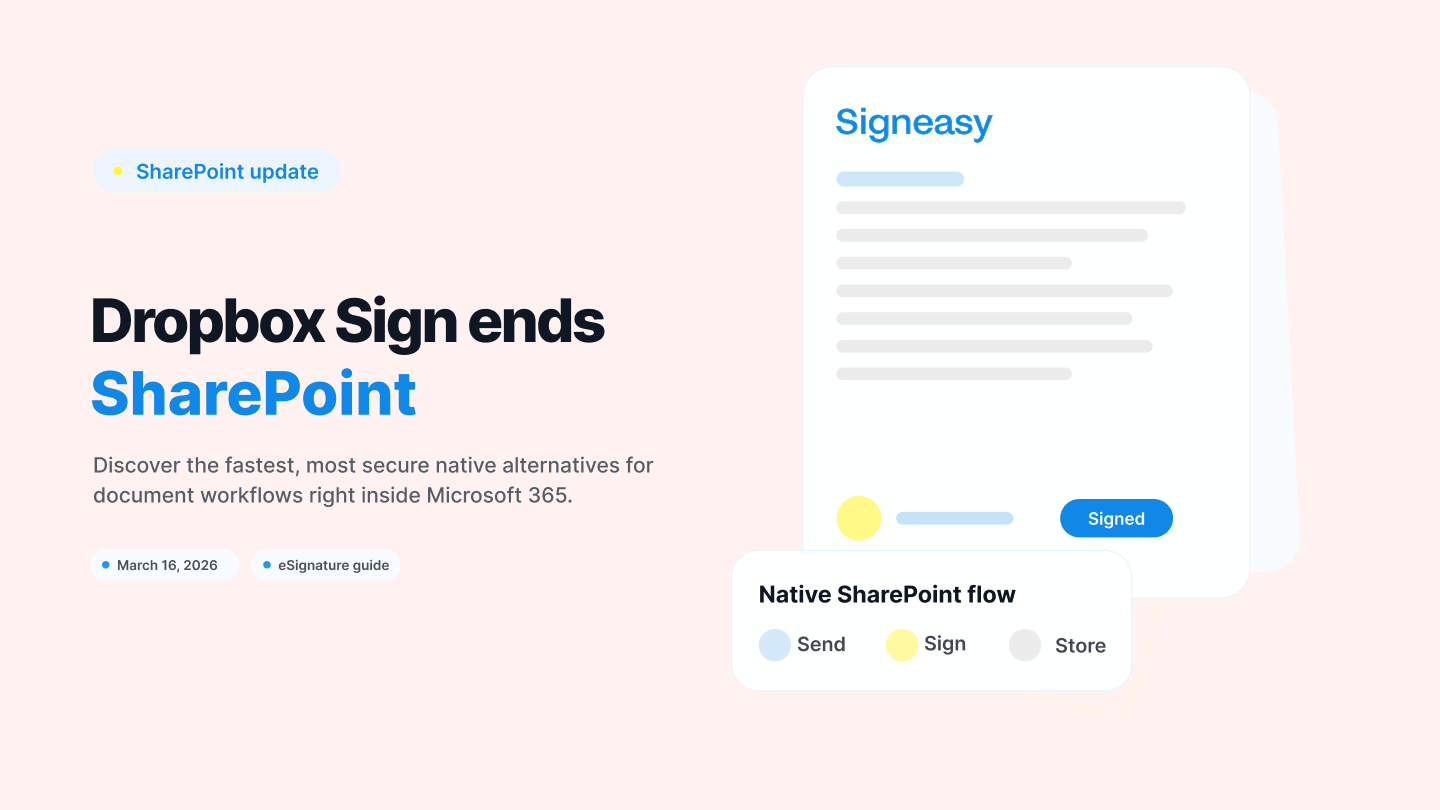


If you use Dropbox Sign inside SharePoint, you have probably seen the notice by now: the integration is shutting down on March 16, 2026. No extended transition period. No automatic replacement. Just a recommendation to explore a “custom API integration,” which is not a realistic option for most teams that relied on the plug-and-play setup they already had.
For organizations that sign contracts, NDAs, vendor agreements, and HR documents directly within SharePoint, this is a real workflow disruption. You need a Dropbox Sign SharePoint alternative that works natively inside your Microsoft environment, maintains your compliance standards, and does not require weeks of IT work to get running.
This guide covers your best options, including one that lets you get back up and running inside SharePoint before the shutdown date.
What the Dropbox Sign SharePoint shutdown means for your team
The Dropbox Sign for SharePoint integration is being discontinued starting March 16, 2026. After that date, Dropbox recommends using a custom API integration or switching to a similar service provider.
For most teams, a custom API build is not a viable replacement. It requires developer resources, testing time, and ongoing maintenance. That is precisely the kind of overhead that made the native integration valuable in the first place.
What this means in practice: any workflow that currently lets your team send a document for signature directly from a SharePoint library will stop working. Signed documents that were automatically saved back to SharePoint will no longer be routed there. For teams handling sales agreements, procurement contracts, HR onboarding, or legal documents, that is a significant gap to fill before the deadline.Still exploring? Read our Docusign alternatives or check out our Adobe Sign vs. SignNow comparison to evaluate other leading eSignature options.
What to look for in a Dropbox Sign SharePoint alternative
Not all eSignature tools work the same way inside SharePoint. Before evaluating options, it is worth clarifying what “SharePoint integration” actually means in practice.
Does it work natively inside SharePoint, without switching apps?
The best integrations let you select a document from your SharePoint library, send it for signature, track its status, and store the signed copy, all without leaving SharePoint. If you have to download the file, open a separate eSignature tool, upload it, and then manually bring the signed version back, that is not an integration. That is just extra steps with a different tool.
Does it maintain your audit trail and compliance standards?
Your signed documents need to be legally binding and traceable. A proper Dropbox Sign SharePoint alternative should provide audit trails, two-factor authentication (2FA), and compliance with standards like SOC 2 and HIPAA where required. The audit trail should be stored alongside the signed document in SharePoint, not locked away in a separate dashboard you have to log into separately.
How quickly can your team get up and running?
With March 16 days away, migration speed matters. Look for a solution that installs from the Microsoft SharePoint Store, requires no developer involvement, and lets your team start signing on day one. The best alternatives do not require IT tickets or lengthy onboarding.
The best eSignature options for SharePoint users in 2026
Can Signeasy replace Dropbox Sign in SharePoint?
Yes, and it is the fastest path forward for most teams. Signeasy’s SharePoint integration is available on Business Pro and Build Your Plan accounts, and installs directly from the Microsoft SharePoint Store. Once installed, your team can send documents for signature, sign incoming requests, track signing status, and store completed contracts, all from within SharePoint.
Signeasy also connects with the rest of the Microsoft ecosystem. If your team works across multiple tools, the Microsoft Teams integration and Outlook integration mean you can manage the entire contract workflow without leaving Microsoft 365. Signed documents are automatically saved back to your SharePoint folders with full audit trails attached.
Pricing is transparent with no per-envelope fees, which is a meaningful difference from tools that charge per signature request at volume.
Eversendai, a global steel construction company with operations across multiple countries, streamlined their entire contract workflow using Signeasy’s Microsoft integration, reducing manual steps and giving teams a consistent way to manage agreements across regions.
Does DocuSign work with SharePoint?
Yes. DocuSign for SharePoint Online allows users to send, sign, and track documents from any SharePoint document library. It also integrates with Teams, Outlook, and Power Automate for more complex workflows.
The tradeoff is cost and complexity. DocuSign is priced primarily for enterprise accounts with high document volumes. For teams that need a straightforward SharePoint signing workflow rather than an enterprise-wide deployment, it can be more than what the job requires. If you want the full picture beyond SharePoint, see our Docusign or Dropbox Sign comparison for pricing and feature differences.
Does Adobe Acrobat Sign work with SharePoint?
Adobe Acrobat Sign also integrates with SharePoint and is one of the two providers that Microsoft has officially integrated with its native M365 eSignature platform. If your organization already has an Adobe enterprise license, this may be a natural fit.
For teams without that existing Adobe relationship, it carries a similar enterprise pricing profile to DocuSign. That makes it well suited for large organizations, but potentially over-specified for teams that primarily need SharePoint-based signing without broader Adobe suite access.
What about Microsoft’s built-in eSignature for M365?
Microsoft does offer a native eSignature service for M365. It is a pay-as-you-go service priced at $2 per request, and the third-party integrations it supports are Adobe Acrobat Sign and DocuSign. There is no free tier for ongoing use beyond a limited trial.
If your team signs a high volume of documents each month, per-request pricing adds up quickly. And since it only connects to Adobe and DocuSign, it routes you back to the same enterprise pricing conversation, without the predictable monthly cost of a dedicated eSignature platform.
Why Signeasy is the most practical Dropbox Sign SharePoint replacement
When you look at the options side by side, Signeasy stands out for teams that need a replacement that works now, costs predictably, and does not require enterprise procurement cycles.
Native SharePoint add-in that installs in minutes
Signeasy is available directly in the Microsoft SharePoint Store. You do not need a developer, a professional services engagement, or an IT ticket. A team admin can install the add-in, connect a Signeasy account, and have the team signing documents the same day.
Once installed, the workflow is exactly what you would expect: open a document library, select a file, choose “Send for Signature,” specify your signers and fields, and send. Completed documents are automatically stored back in your SharePoint folder with the audit trail attached.
Full compliance and security built in
Signeasy-signed documents are legally binding under ESIGN, UETA, and eIDAS. Every request generates a tamper-proof audit trail showing who signed, when, and from where. The platform also supports two-factor authentication (2FA), HIPAA compliance, SOC 2 certification, and role-based access control. Your security posture does not change just because you changed tools.
Transparent pricing, no per-envelope surprises
Signeasy’s Business Pro and Build Your Plan tiers include the SharePoint integration with unlimited documents and signatures. There is no per-envelope fee that scales against you as volume increases. For teams that sign regularly (HR onboarding documents, vendor contracts, sales agreements), this predictability matters.
Stays within the Microsoft ecosystem
Because Signeasy also integrates with Microsoft Teams and Outlook, your signing workflow does not have to start and end in SharePoint. A sales rep can initiate a contract from Outlook, a manager can approve from Teams, and the final signed document lands in the right SharePoint folder automatically.
For a detailed side-by-side comparison, see how Signeasy compares to Dropbox Sign across features, pricing, and integrations.
How to switch from Dropbox Sign to Signeasy for SharePoint
Switching is straightforward. Here is how to get your team up and running before March 16.
Step 1: Set up your Signeasy account
Sign up for a Business Pro or Build Your Plan account at signeasy.com/integrations/sharepoint. If you are migrating an existing team, your admin can provision users and configure roles before the SharePoint add-in is installed.
Step 2: Install the Signeasy add-in from the SharePoint Store
Go to the Microsoft SharePoint Store and search for “Signeasy.” Click to install the add-in, then connect it to your Signeasy account by authorizing access through Azure. Your site admin will need Full Access Control for the SharePoint site during this step. The process takes under ten minutes.
For a full walkthrough, the Signeasy for SharePoint guide covers each step in detail.
Step 3: Configure your document libraries and permissions
Once installed, decide which SharePoint libraries your team will use for signing workflows. Set folder destinations for completed signed documents. Signeasy will automatically store signed contracts there, along with supporting audit trails. Assign user access through the Signeasy team admin panel.
Step 4: Start signing from your existing SharePoint libraries
Your team is now ready. Open any document library, select a file, and click the Signeasy option in the toolbar to send for signature or sign directly. Nothing about your document organization or SharePoint structure needs to change. Signeasy works within the environment you already have.
Step 5: Migrate your existing Dropbox Sign templates
If your team has built up a library of templates in Dropbox Sign, such as NDAs, vendor agreements, or HR onboarding forms, you do not need to rebuild them from scratch. Signeasy’s customer success team supports template migration from Dropbox Sign (HelloSign), handling the process on your behalf so your templates are ready to use in your new Signeasy account.
To get started, reach out to Signeasy support with your existing templates. The team will review, import, and confirm that signer roles and fields have carried over correctly before handing them back to you. There is no limit on the number of templates that can be migrated, so your full library moves with you.
Making the right call before it’s late
The Dropbox Sign SharePoint shutdown is disruptive, but it does not have to derail your contract workflows. The tools to replace it are ready, and for most teams, the transition is faster than it might seem.
If you need a Dropbox Sign SharePoint alternative that works natively in Microsoft 365, installs without developer support, and keeps your documents secure and compliant, Signeasy is built for exactly that. Your team does not need to learn a new way of working. They sign from the same SharePoint libraries they already use, and contracts land exactly where they expect.
For a broader look at Dropbox Sign alternatives beyond SharePoint, see the full comparison of Dropbox Sign alternatives across pricing, features, and use cases.