




Notary costs in the U.S. typically range from $2 to $15 per signature or act for standard in-person notarization, with state law capping the base fee. Mobile notary services run $40–$75 for local daytime appointments and $75–$125+ after hours. Remote online notarization (RON) averages $15–$40. Real estate and loan signing packages often cost $100–$300 total, depending on document volume and number of signers.
In New Jersey, a routine notarization at The UPS Store turned into a federal lawsuit. Customers alleged they were charged $10 to $15 per notarization, even though state law caps notary fees at $2.50 per act.
The extra amount appeared as a “convenience” or service fee. Courts later allowed the case to proceed, signaling that fee limits cannot be bypassed through creative labeling.
This incident is not an outlier. Notary fees in the U.S. are regulated at the state level, with strict caps on what notaries may charge for each act.
Yet the final amount people pay often exceeds state fee caps. Add-ons like travel, after-hours requests, and bundled service fees, especially in real estate and loan signings, drive the increase.
That gap between legal limits and actual charges is why notary costs vary so widely across states.
This guide is structured to help you understand notary costs step by step. It covers:
- What a notary public is and when notarization is required, including how the process works and why states regulate it
- How notary costs are determined, breaking down base fees, state caps, and common add-ons
- A complete state-by-state notary cost breakdown, showing fee limits, pricing models, and cost variations across the United States
- Types of notary services and their costs, including in-person, mobile, remote online notarization, and after-hours requests
- Hidden fees, cost comparisons, and savings strategies, plus how digital workflows with Signeasy help keep notarization predictable and organized
What is a notary public and when do you need one?
A notary public is a state-authorized official who verifies identity, witnesses signatures, and helps prevent fraud. Their role is narrow but important. They do not give legal advice but confirm that the right person signed the right document willingly.
You usually need a notary when a document carries legal or financial risk. This is especially common with real estate and legal documents that involve property transfers, lending agreements, or powers of attorney.
Common examples include:
- Real estate deeds and mortgage documents
- Power of attorney and affidavits
- Loan agreements and promissory notes
- Trusts, wills (in some states), and healthcare directives
- Vehicle title transfers and certain court filings
These documents often affect ownership, money, or legal rights. That is why states require an extra layer of verification.
The notarization process follows a set pattern:
- You appear in person or through approved remote online notarization.
- You show valid government-issued ID.
- The notary confirms your identity, watches you sign, and applies their seal and signature.
- That seal makes the document legally credible.
Ask yourself this: if someone challenges this document later, can you prove who signed it and when?
That is exactly what notarization is designed to do.
Key factors that influence notary costs
Notary pricing has two parts. Understanding that split explains most of the pricing confusion.
First is the base notary fee. Each U.S. state sets a legal maximum for what a notary can charge for the notarial act itself. This covers identity verification, witnessing the signature, and applying the notary seal. The cap may apply per signature or per notarization, depending on the state.
Second are additional service charges. These are not always regulated. Mobile travel, after-hours appointments, printing, scanning, and administrative handling often sit outside the base fee. Whether these charges are allowed and how they are disclosed depends on state rules.
Once you look beyond the base fee, several factors influence the final amount you pay:
- State fee caps: Each state sets the maximum a notary can charge per act or per signature. This is the base cost.
- Type of document: Simple affidavits cost less. Real estate and loan documents often require multiple notarizations.
- Number of signers: More signers mean more notarial acts. Fees usually apply per signature, not per document.
- Location of the notarization: Mobile notaries charge travel fees. Distance and urgency affect the total.
- Time of service: After-hours, weekends, or same-day requests often increase the price.
- Service add-ons: Printing, scanning, courier handling, or “convenience” fees can raise the final charge.
Two common notarial acts — acknowledgments and jurats — are sometimes priced differently by state. An acknowledgment confirms identity and willingness to sign; a jurat requires the signer to swear an oath. Some states set separate fee caps for each.
The takeaway: States regulate the notary act, not the full invoice. That is why a notarization capped at a few dollars can still cost much more once add-ons are included.
Complete state-by-state notary cost breakdown (2026 reference)
This section is your single source of truth. You’ll find a structured breakdown covering all 50 U.S. states and Washington, D.C.
Each table reflects current state law and what you can realistically expect to pay. To keep this readable, states are grouped by how they regulate notary fees.
1. States that charge per signature
The fee applies to each signature notarized. Costs increase with multiple signers.
Best for: Single-signer documents
Watch out for: Real estate and loan signings with multiple parties
2. States that charge per notarization or per act
The fee applies to the notarial act itself, not each signature. Pricing stays more predictable.
Best for: One document with several signatures
3. States with very low statutory caps (≤ $5)
Base fees are tightly capped. Add-ons often drive price disputes.
Best for: Low base costs
Risk: Travel and convenience fees inflate totals
4. States with no set maximum fee
State law does not fix a dollar cap. Notaries must disclose pricing upfront.
Best for: People who want flexibility in pricing and service options
Risk: Wide price variation between providers
5. How fees are applied by state
States apply notary fees in three main ways. This determines how quickly costs add up.
Why this matters: A two-signer document can double the cost in per-signature states.
6. Where add-on fees are commonly allowed
Most states regulate the base notary fee only. Add-ons often sit outside that cap.
Tip: Always ask for a full price breakdown before the appointment.
6. States with the highest and lowest notary costs (at a glance)
This comparison helps you spot cost extremes quickly.
Highest base fee states:
- Rhode Island – up to $25 per act
- California – up to $15 per signature
- Washington – up to $15 per signature
Lowest base fee states:
- New York – $2 per signer
- Georgia – $2 per act
- New Jersey – $2.50 per act
Key insight: Low base fees often come with higher add-ons. High base fees are more transparent upfront.
Types of notary services and their costs
Notary fees depend on how the service is delivered and how urgent it is. The same document can cost very different amounts based on these two factors.
Below is a clearer breakdown of each service type and what you are actually paying for.
1. In-person notarization fees
This is the standard option. You visit a notary at their office during regular business hours.
- What the fee covers: Identity verification, witnessing the signature, administering an oath if required, and applying the notary seal
- How pricing works: States cap this fee. It is usually charged per signature or per notarization, depending on the state.
- Typical cost range: $2 to $15 per act or per signature
- When this makes sense: Single documents, one signer, no urgency
This option usually costs the least because there are no travel or time-based add-ons.
2. Mobile notary services and travel charges
A mobile notary travels to your location (home, office, hospital, or closing site).
- Base notary fee: The same state-capped fee as in-person notarization
- Travel charges: Added separately. These fees often depend on distance, traffic, and time spent.
- Typical total cost: $25 to $75 or more, especially in metro areas or for longer travel
- Important detail: Many states do not cap travel fees. Notaries must disclose them, but they can vary widely.
Mobile notary services trade cost for convenience. You pay for time and travel, not just the notarization.
3. Remote online notarization (RON) costs
RON allows notarization through a live video call using approved platforms.
- What the fee includes: Identity verification using knowledge-based questions, video recording, digital certificates, and secure storage
- How pricing works: Many states allow higher caps for RON than in-person notarization. Some providers also charge platform or processing fees.
- Typical cost range: $15 to $40 per notarization
- What to confirm upfront: Whether each signature is charged separately and how many notarizations are included in one session
RON reduces travel but shifts costs to technology and compliance.
4. After-hours and emergency notarization premiums
Urgent requests change pricing quickly.
- When premiums apply: Evenings, weekends, holidays, same-day requests, or short notice appointments
- How premiums are charged: As a flat surcharge or a percentage added to mobile or RON fees
- Typical increase: 20% to 50% above standard pricing
- Most common with: Mobile notary and real estate loan signings
If timing is flexible, scheduling during business hours can lower the cost.
How much does a notary cost for real estate and loan documents?
Real estate and mortgage transactions are the most expensive notary use case. Loan signing packages typically involve 80–150 pages with multiple notarizations and signers, driving total costs to:
- Standard refinancing package: $100–$175
- Purchase closing package: $150–$250
- Complex or multi-party closings: $250–$300+
These packages are priced as flat fees because the volume of notarizations makes per-act pricing impractical. Always confirm whether the quote covers all signers and all notarized pages.
Additional notary costs and hidden fees
Even when state laws cap what a notary may charge per act, the final amount often increases through additional services that fall outside the notarization itself.
These extra charges are not always illegal, but they are often unclear until the last step.
Here’s how they typically show up.
1. Travel fees for mobile notaries
Mobile notaries charge for travel time and distance. Fees may be calculated per mile, per hour, or as a flat rate. Long distances, traffic, or remote locations can increase the final cost quickly.
2. Document preparation charges
Some notaries charge extra to review, organize, or prepare documents before notarization. This can include filling out certificates, checking completeness, or handling multiple signers.
3. Printing and copying costs
If documents need to be printed or copied on-site, additional charges may apply. Large document sets or multiple copies often raise this cost.
4. Weekend and holiday surcharges
Appointments outside standard business hours usually cost more. Evening, weekend, and holiday notarizations often include premium fees due to limited availability.
Before booking, always ask for a full price breakdown.
Cost comparison: traditional vs. digital notarization
The choice between traditional and digital notarization shapes how predictable your costs are. It also determines how much operational effort your team absorbs as volume increases.
Here’s how traditional and digital approaches compare in practice.
Bottom line: Traditional notarization often appears cheaper at first glance but becomes unpredictable as volume and urgency increase. Digital notarization offers lower operational overhead, especially for businesses handling frequent or time-sensitive transactions.
Where to find free or low-cost notary services
These sources frequently offer notarization at no charge or well below state caps:
- Banks and credit unions (free for account holders)
- UPS and FedEx stores (typically $5–$15)
- Public libraries (often free or nominal fee)
- City and county government offices (free for residents)
- Employers (HR or legal departments for employee documents)
Call ahead to confirm availability, document requirements, and whether your document type qualifies.
How Signeasy supports notarization and digital signing workflows
Notarization works best when it fits naturally into your document workflow. Signeasy supports this by simplifying everything that happens before and after the notarial act, where most delays and errors occur.Defined signing and approval order: Signing workflows enforce the correct sequence for signers and approvers. This prevents notarization from happening before all prerequisites are met.
For digital and remote workflows, Signeasy complements notarization by handling secure eSignatures, signer identity capture, and execution tracking. This is especially useful when notarization is only one step in a larger transaction, such as real estate, lending, or compliance-driven agreements. For a deeper dive into when eSignatures can complement or replace traditional notarization, see our guide to notarizing electronic signatures.
The features below show how Signeasy helps prepare documents correctly and keep notarized records organized and audit-ready:
- Defined signing and approval order: Document signing workflows enforce the correct sequence for signers and approvers. This prevents notarization from happening before all prerequisites are met.
- Secure eSignature support: Digital signatures meet legal standards and help complete non-notarized portions of documents quickly, especially in hybrid workflows.
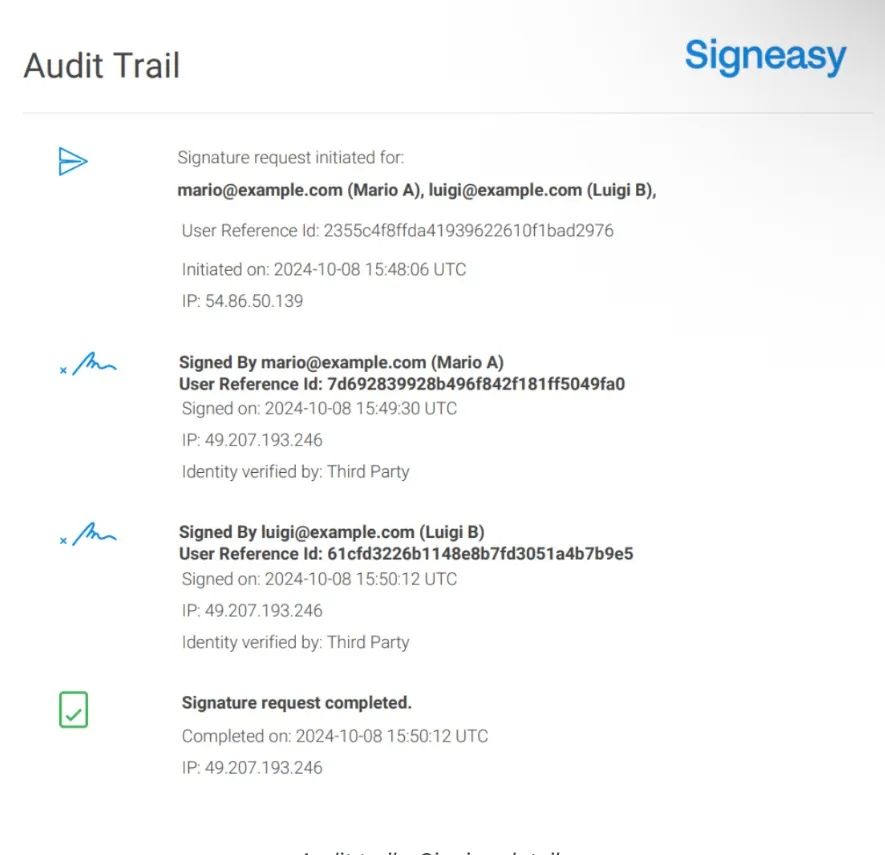
- Signer identity and activity tracking: Each action is recorded with timestamps and signer details. This supports verification and post-notarization audits.
- Centralized document storage: Notarized and signed documents stay in one searchable intelligent contract repository. Teams can retrieve final copies without manual follow-ups.

- Built-in audit trails: Signature certificates and activity logs provide clear evidence of execution, which supports compliance and recordkeeping needs.
- Easy handoff to downstream teams: Completed documents move smoothly into compliance, legal, or finance workflows without re-uploading or version confusion.
- Scales across teams and transactions: The same workflows support occasional notarizations and high-volume use cases without added operational overhead.
Start a free trial to see how Signeasy fits into your digital signing and compliance workflows.