



Ask any developer about their worst API integration experience. The story probably involves unexpected breaking changes or spending hours debugging requests that fail for undocumented reasons.

Source
API contracts solve this by creating explicit agreements about how systems communicate. The contract documents how the API works so developers don't have to figure it out through trial and error. Doing so prevents integration failures from undocumented changes or mismatched expectations.
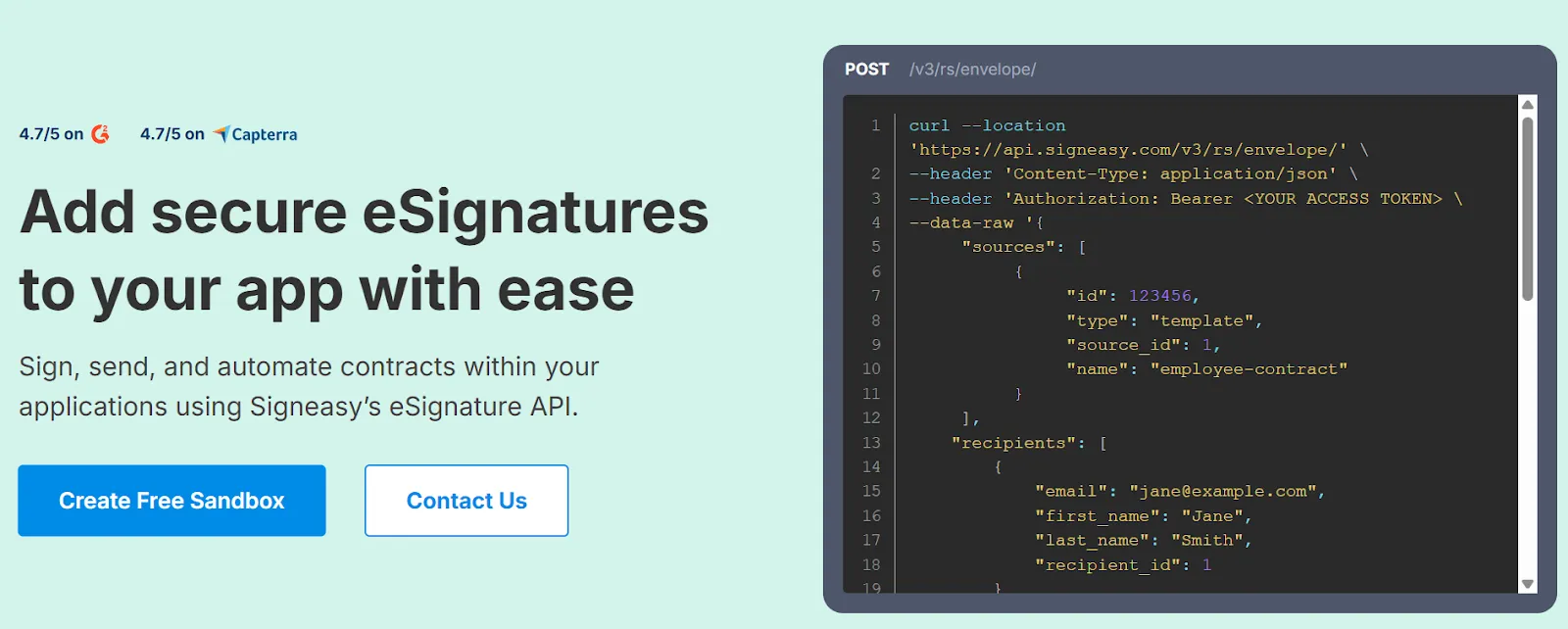
Signeasy's eSignature API uses this contract-first approach. Developers can review the complete specification and understand how integration works before writing any code.
In this guide, you'll learn:
- What API contracts define between services
- Which contract types work for different systems
- Why contract-first beats code-first for reliability
- How to stop contracts from drifting away from code
- Ways to manage contracts without slowing your team down
What is an API contract?
An API contract is a formal agreement that defines how two systems or services communicate with each other. It acts as a handshake agreement between an API provider and its consumers. It specifies endpoints, request and response formats, data types, authentication methods, and error handling procedures.
Well-defined API contract documentation prevents breaking changes that cause production failures. When developers know exactly what to expect from an API, they can build integrations confidently without worrying that a backend update will suddenly break their application.
API contracts make possible parallel development in several ways:
- Frontend teams build user interfaces while backend teams implement server logic simultaneously, without waiting on each other
- Both teams reference the same documented agreement about what data flows between systems
- Mock servers can simulate API responses before the actual backend exists
- Integration testing can begin earlier in the development cycle
In microservices architectures, these agreements are necessary. Distributed systems need reliable communication between services. API contracts provide that foundation by validating that each component uses compatible data structures and protocols.
Contracts come in different flavors depending on what you're building.
Types of API contracts
Each specification type listed below is designed for a specific API architecture. These range from REST APIs used in web applications to event-driven systems that process real-time data streams.
Selecting the most suitable contract format prevents tooling mismatches that cause documentation issues and integration friction over time.
Knowing the types helps, but how do teams actually use them?
How API contracts work (Step-by-step)
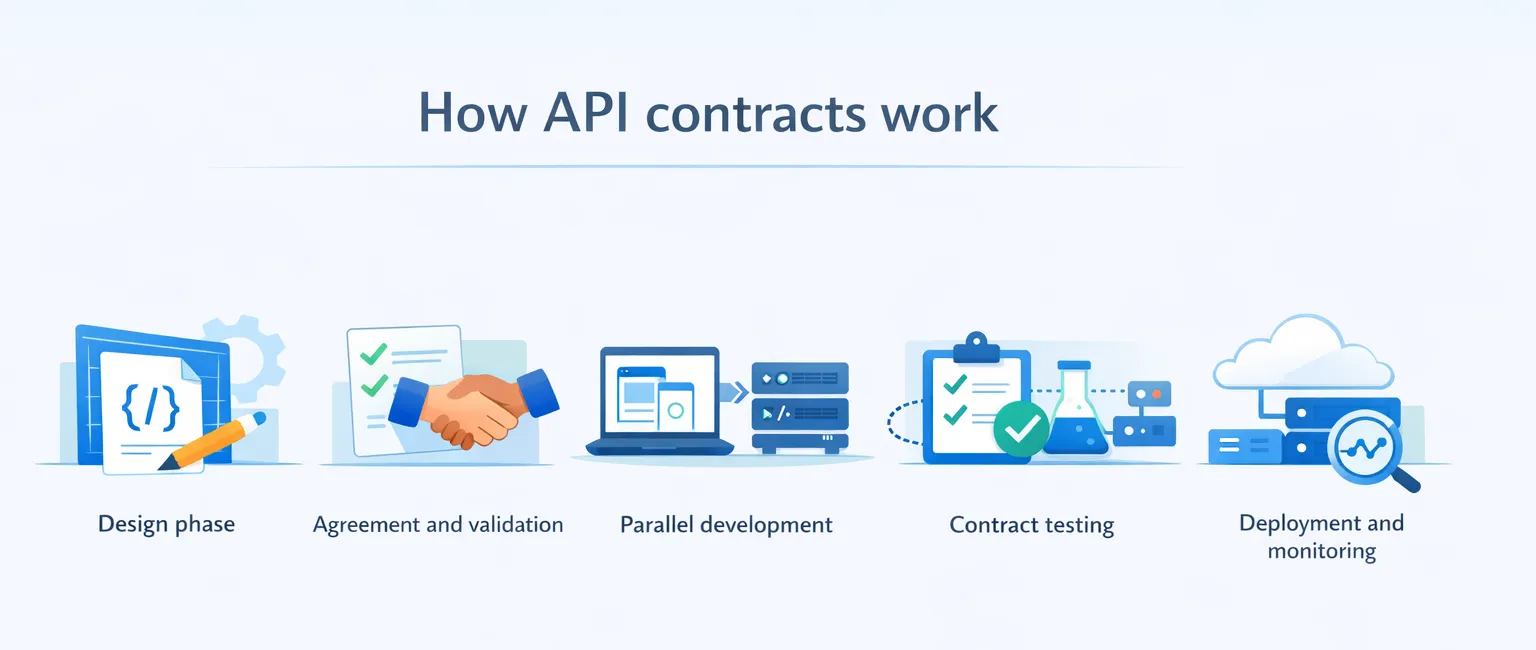
API contracts follow a predictable lifecycle, from early design decisions through validation, parallel development, and production monitoring.
Step 1: Design phase
Teams collaborate to define API requirements before writing code. Architects and developers document endpoints, data models, authentication methods, and error responses.
For example, when designing an envelope creation endpoint, teams specify that it accepts a POST request with recipient details, document sources, and signing parameters. The output is typically an OpenAPI specification or similar contract document that both sides agree represents the expected behavior.
Suggested Read: Build easy eSignature experiences with Signeasy API
Step 2: Agreement and validation
Provider and consumer teams review the contract together. They validate schemas against business requirements and verify that the contract captures all edge cases.
A team can confirm that the envelope endpoint returns a 201 status on success with an envelope ID, or a 400 error with specific validation messages when required fields are missing.
Semantic versioning helps communicate whether changes will break existing integrations. Once approved, the contract becomes the blueprint for development.
Step 3: Parallel development
Backend engineers implement the API according to the contract while frontend teams build against mock servers generated from the same contract.
As one Reddit discussion noted, teams discuss contracts in design sessions before splitting off to implement in parallel. Frontend and backend developers work simultaneously instead of waiting for one side to finish before the other can start. The workflow looks like this:

Source
A mobile team can build their signature request UI using mock responses while the backend team finalizes database schemas and business logic.
Step 4: Contract testing
Postman 2025 State of the API Report shows that only 17% of teams use contract testing, even though APIs change frequently. Contract tests can verify that webhook payloads include documented fields such as event_type, envelope_id, and timestamp.
They can also confirm that invalid authentication headers return a 401 error. When these tests run in CI/CD pipelines, teams can detect breaking changes before they reach production.
Step 5: Deployment and monitoring
The contract becomes the definitive reference for production APIs. Documentation generates automatically from the contract, which keeps API contract documentation aligned with how the system behaves.
Signeasy’s webhook implementation shows how contract-first design improves developer integration. Developers integrating the eSignature API can build with confidence because the contract documents every webhook event.
- Event types: Envelope viewed, signed, declined, or completed
- Payload structure: Consistent field names and data types across all events
- Timing and retries: Clear expectations for delivery patterns and failure handling
Teams avoid the assumptions that lead to brittle integrations. The contract removes ambiguity about system behavior before a single line of integration code gets written.
Now let's talk about the formats that make this workflow possible.
API contract specifications and standards
API contracts need a specification format that both humans and machines can parse. The format you choose influences tooling options, team collaboration, and the ability to validate behavior automatically against the contract.
1. Industry standards
Teams gravitate toward established formats because the tooling ecosystem and community support make implementation smoother:
- OpenAPI 3.x: The dominant standard for REST APIs, providing machine-readable contracts that generate documentation, mock servers, and validation tests
- JSON Schema: Validates data structures independently of any specific API style, useful for maintaining consistent request and response formats
- GraphQL SDL: Self-documenting type system where the schema defines both the contract and the query language
- AsyncAPI: Handles event-driven architectures including message queues and real-time updates.
Suggested Read: What is an eSignature API
2. Emerging protocol
The Model Context Protocol (MCP) represents a shift toward AI-native API contracts. The report cited earlier shows 70% developer awareness, though only 10% report regular adoption.
MCP standardizes how AI agents discover and invoke APIs, which becomes urgent when 89% of developers use AI tools daily but only 24% design APIs that machines can actually consume.
Choosing the right specification
REST APIs benefit from OpenAPI's mature ecosystem and extensive tooling. Real-time systems need AsyncAPI to document WebSocket connections and webhook behaviors.
Signeasy uses OpenAPI specifications for our eSignature API. Developers auto-generate client libraries and run contract tests before integration — 72% of customers go live in under 72 hours because the contract cuts through ambiguity.
The specification you choose should match both your current architecture and how consumers will interact with your API contract documentation.
Let's now discuss the substantial benefits you can unlock for stakeholders.
Benefits of using API contracts
Teams adopt API contracts to reduce rework and remove uncertainty during integration. The cases below show how that choice affects delivery timelines and developer experience.
1. Faster development without waiting
Parallel development becomes possible when both sides work from the same contract.
Backend engineers can implement endpoints while frontend developers build interfaces using mock servers generated from the contract specification. No one waits for the other side to finish before starting their work.
Truepill experienced this firsthand when integrating Signeasy's eSignature API into their UK telemedicine platform:

Doctors could sign prescriptions electronically within seconds, replacing the fax-based workflow that had dominated healthcare for decades.
The report cited earlier reveals that 55% of teams struggle with inconsistent documentation. API contracts define data formats, authentication requirements, and error responses precisely and consistently.
Detailed specifications describe expected system behavior, allowing developers to build integrations with confidence rather than relying on assumptions.
2. Business impact that shows up in metrics
Moreland University cut document turnaround time by 50-70% after integrating Signeasy's API with their custom Learning Management System.
Previously, creating a Memorandum of Understanding meant 15 minutes of manual data entry, converting to PDF, and emailing — followed by up to a week waiting for signatures. Now the system auto-populates agreements and sends them instantly.
Their enrollment process handles 200+ new candidates monthly without the administrative burden that used to accompany paper-based workflows. 43% of their contracts get signed within one hour because candidates are ready to move forward immediately.
The Postman report cited earlier found that 42% of organizations cite reduced engineering overhead as a direct revenue benefit from API contracts. Teams spend less time fixing integration problems and more time building features that customers actually want.
3. Better experience for API consumers
Detailed API contract documentation enables self-service integration. Developers can read the contract, understand requirements, and start building without scheduling calls to clarify ambiguous behavior.
ZenEquity's Engineering Lead, Mayur Virendra, praised how straightforward the integration process became with well-defined contracts.
His team visited our Bengaluru office for initial training, but the comprehensive documentation meant they could complete the entire API integration in just one month without custom development work:

Predictable behavior across API versions means integration code doesn't break unexpectedly. Contracts that use semantic versioning tell consumers whether an update requires code modifications or deploys safely without changes.
LetsVenture saw their customer experience improve by 2-3 times after integrating Signeasy's API.
Their HR team went from delivering physical documents in person to handling hundreds of people with a single click. Users could complete essential paperwork without ever leaving the LetsVenture platform, making the entire process smoother for startups and investors alike.
At some point, every team faces the same fork in the road: design first or code first.
Contract-first vs code-first development
Should you write the contract before the code, or generate documentation from working implementations? The answer depends on your team structure and the level of coordination your architecture requires.
1. Contract-first approach
Contract-first development means designing the API contract before writing any implementation code. Teams document endpoints, data models, and expected behaviors in a specification like OpenAPI, then both provider and consumer sides build from that shared blueprint.
It changes the way teams coordinate:
- Developers get early feedback on API design before investing weeks in implementation that might need rework
- Frontend and backend teams can work simultaneously instead of sequentially
- Cross-team coordination improves when everyone references the same specification
The report found that fully API-first organizations are 43% more likely to generate 25% or more of their revenue from APIs. Contract-first works best for new projects, microservices architectures, and situations requiring coordination across multiple teams.
In a Reddit discussion about contract testing workflows, developers emphasized running contract tests in CI before merging code to catch breaking changes early. Contract-first design supports this by giving teams a specification to validate against throughout development.
2. Code-first approach
Code-first flips the sequence. Developers write implementation code first, then generate API contract documentation from the working system. Some frameworks can auto-generate OpenAPI specifications from code annotations.
Speed is the main advantage. Prototypes and proof-of-concept projects ship sooner without a separate design phase. Solo developers building internal tools can start coding immediately.
This approach comes with some drawbacks:
- Breaking changes that go undetected without contract validation
- Consumers forced to reverse-engineer behavior from implementation details
- Teams working across time zones struggling to coordinate
Code-first suits rapid prototyping, internal utilities, or projects with a small number of consumers who can tolerate API changes.
Which approach should you use?
In a nutshell, let business risk guide the decision. Customer-facing APIs and integrations between teams demand contract-first to prevent expensive coordination failures. Internal scripts and experimental prototypes can skip the ceremony and ship code-first.
Picking an approach is one thing. Executing it successfully is another.
Best practices for API contract management
There are three major challenges when it comes to API contracts, and ignoring any of them turns your contract into unreliable documentation.
Preventing these failures extends to building intentional practices into your development workflow.
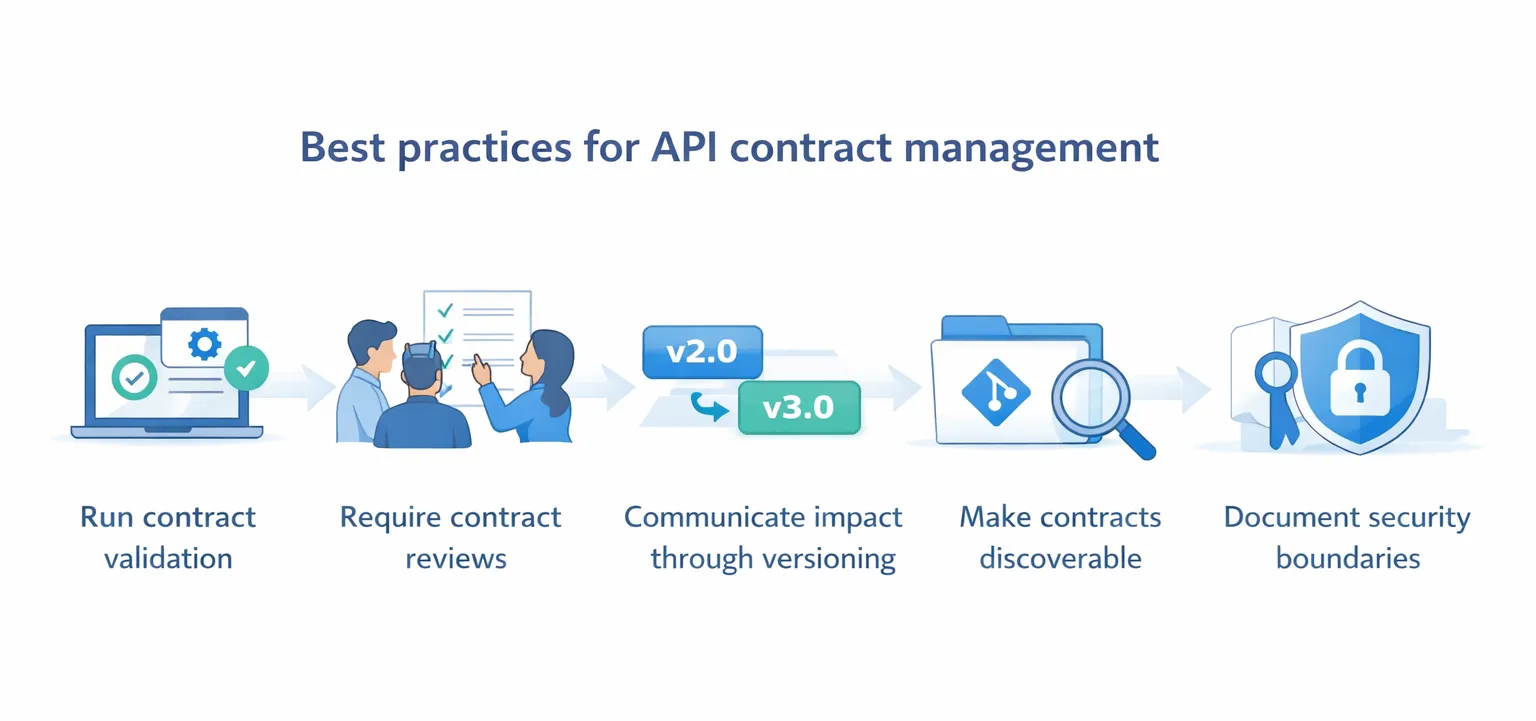
1. Run contract validation before merging code
Automated tests compare what the code really does against what the contract promises. When a developer adds a new field to a webhook payload but forgets to update the specification, the CI pipeline catches it before merge.
Moreland University's integration with Signeasy shows this. Their webhook handlers expect specific fields like event_type and envelope_id. Contract tests verify those fields exist with the documented data types, preventing runtime errors when events fire.
2. Require contract reviews before shipping changes
Code reviews are standard practice. Contract reviews should be too. Someone needs to ask whether proposed changes break existing integrations, whether authentication requirements make sense, and if error responses give consumers enough information to debug problems.
Treating contracts as reviewable artifacts helps catch issues before they reach production. Reviewing contract changes alongside code allows teams to identify breaking modifications or ambiguous specifications early, before they turn into customer complaints or failed integrations.
3. Communicate impact through versioning
Semantic versioning signals what changed and whether existing integrations will break. A jump from v2.1.4 to v3.0.0 indicates breaking changes that require code modifications. A jump to v2.2.0 means new features were added without breaking existing functionality. Minor version updates to v2.1.5 signal bug fixes only.
Teams version their APIs but often skip deprecation timelines. Consumers need to know when older versions will stop working — six months' notice, not six days. Explicit deprecation schedules give developers time to migrate without emergency weekend deployments.
4. Make contracts discoverable
Developers shouldn't hunt through Slack threads or email chains to find the current contract. Centralized storage with Git history provides a complete audit trail of every modification. Integration breaks after a deployment become easier to diagnose — you can trace if the contract changed or the implementation diverged from the specification.
5. Document security boundaries explicitly
Rate limits, authentication scopes, and allowed origins belong in the contract.
Vague statements like "authentication required" leave too much open to interpretation. Signeasy's contract specifies OAuth 2.0 flows, token expiration windows, and which endpoints require which permission scopes. Developers know the security boundaries before requesting their first API key.
What happens when teams finally follow through on these practices?
Build reliable integrations with Signeasy's API contract documentation
API contracts define how systems communicate, yet many teams struggle to maintain them effectively. While 82% of organizations have adopted API-first approaches, 93% still face collaboration issues from inconsistent documentation and vague specifications.
Deliberate API contract management solves these problems. Well-maintained contracts enable:
- Parallel development across frontend and backend teams
- Automated validation that catches breaking changes before deployment
- Specifications that both human developers and AI agents can consume reliably
Teams that treat contracts as living documents see measurable improvements in integration speed and reliability. And how do you get it right?
Choose contract-first design for your next customer-facing API. Set up automated contract validation in your CI/CD pipeline. Centralize API contract documentation so teams access current versions without searching through scattered tools or outdated wikis.
Signeasy’s eSignature API makes contract-first development tangible. Our OpenAPI specifications in the free sandbox environment provide complete contract documentation. Developers can test against documented endpoints and understand integration requirements upfront , start with our breakdown of api signature to understand the foundational signing mechanics before diving into contract specs.
Developers can test against documented endpoints and understand integration requirements upfront. Start free API trial or create your free sandbox account.