



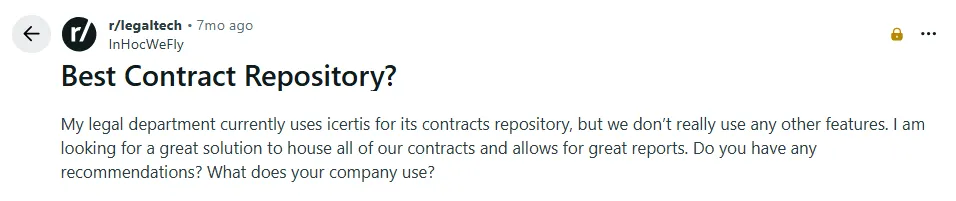
Most businesses face the dilemma of selecting contract repository software. A legal professional shared this in a popular Reddit thread:
Source
This is a problem most government and legal teams run into: their repository does little more than store files, with no real reporting or visibility into what's in them. That's what this guide breaks down, along with which features make the biggest difference.
In this article, we'll cover:
- What contract repository software is and how it works
- Key features that impact operational efficiency
- Tangible benefits and ROI considerations
- Implementation and adoption best practices
- Integration capabilities with existing systems
- Security and compliance standards
What is contract repository software?
Contract repository software provides a centralized digital system for storing and retrieving contracts using structured, searchable data.
Each contract is stored with defined attributes such as key dates, parties, and commercial terms, enabling teams to locate information without opening every file. The repository focuses on secure access and overall contract organization, instead of basic document storage.
File-based repositories (Dropbox, OneDrive) serve primarily as digital archives. They replaced shared drives but depended on manual tagging and individual document review.
Advanced repositories — like Signeasy’s AI contract repository — use intelligent data extraction to identify key contract details and make them searchable across large contract volumes. Teams can answer common questions much more quickly with far less manual effort.
Contract repository capabilities are typically included within contract management platforms.
Some eSignature and legal operations tools also offer repository features, supporting drafting, approvals, renewals, and compliance oversight across the contract lifecycle.
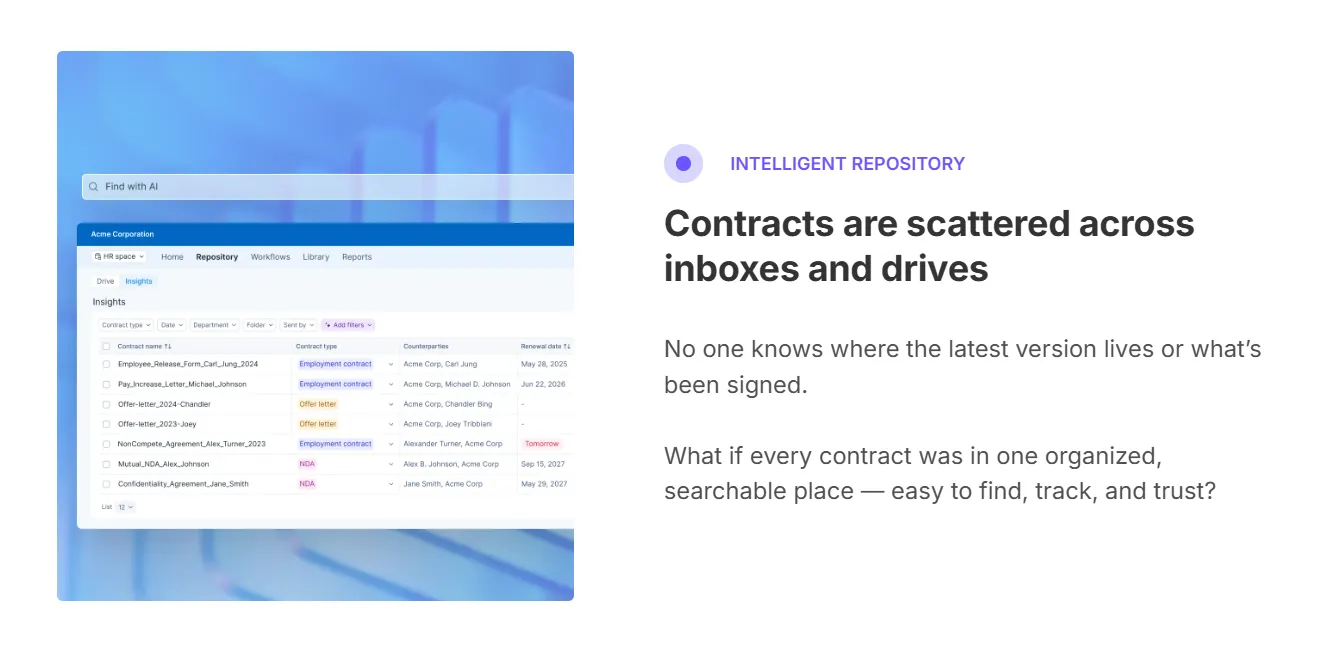
Each feature below addresses a specific pain point in contract management.
Key features and benefits of contract repository software
Contract repository software solves operational problems through specific capabilities. The features below address the challenges teams face when managing high contract volumes — from locating agreements in seconds to preventing missed renewals.
1. Centralized storage and organization
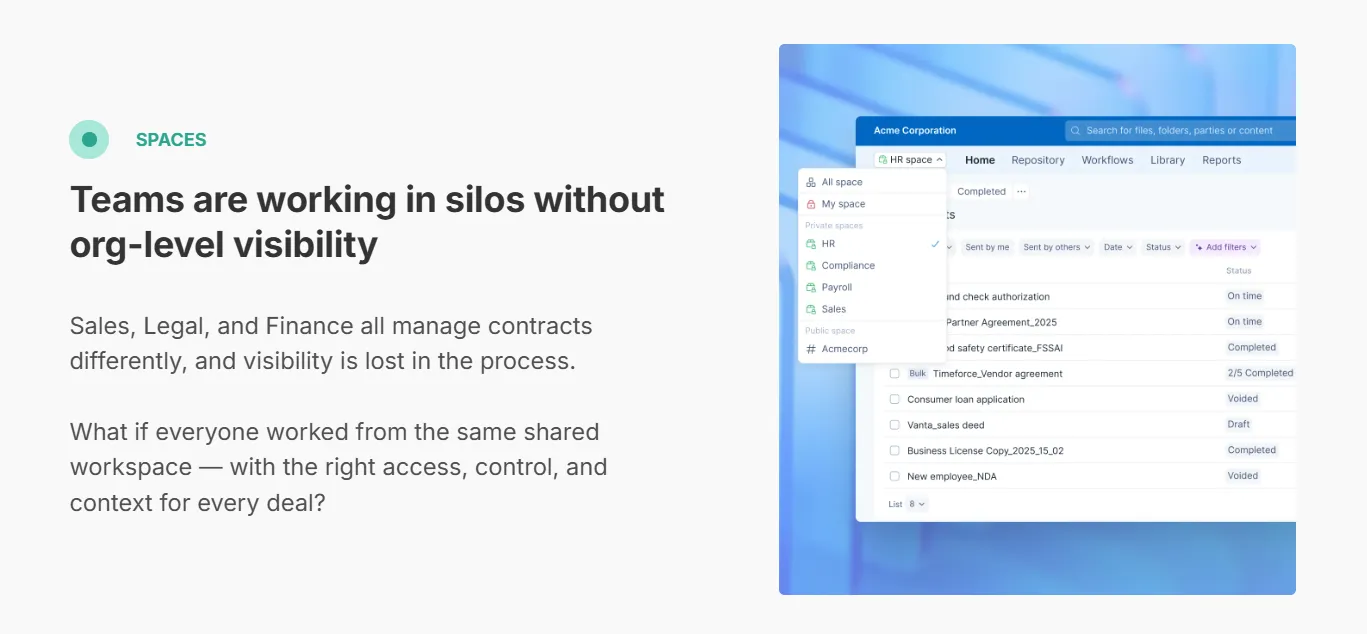
When contracts live across email threads and individual desktops, nobody knows which version is current. Teams waste time tracking down the right file or later discover they've been working from an outdated copy.
A central contract repository fixes this by putting every agreement in one searchable location, with version history that tracks changes automatically. You can organize contracts by department, counterparty, contract type, or renewal date.
Your team can use Signeasy Spaces with role-based access controls — legal reviews every contract while sales accesses only customer-facing agreements.
Benefit #1: Save time and effort
Eliminate manual digging. Contracts are auto-organized and enriched the moment they're uploaded.
Instead of Slack messages asking "where's the latest version of the Acme contract?" or digging through email attachments from three months ago, your procurement manager opens the repository and finds it in under 10 seconds. Contracts upload and organize themselves based on extracted metadata.
Three contract requests that previously took an hour to find can now be completed in five minutes total.
2. Advanced search and metadata extraction
Finding a specific clause in hundreds of PDFs once meant opening files one by one, skimming through pages, and hoping you remembered the right keywords.
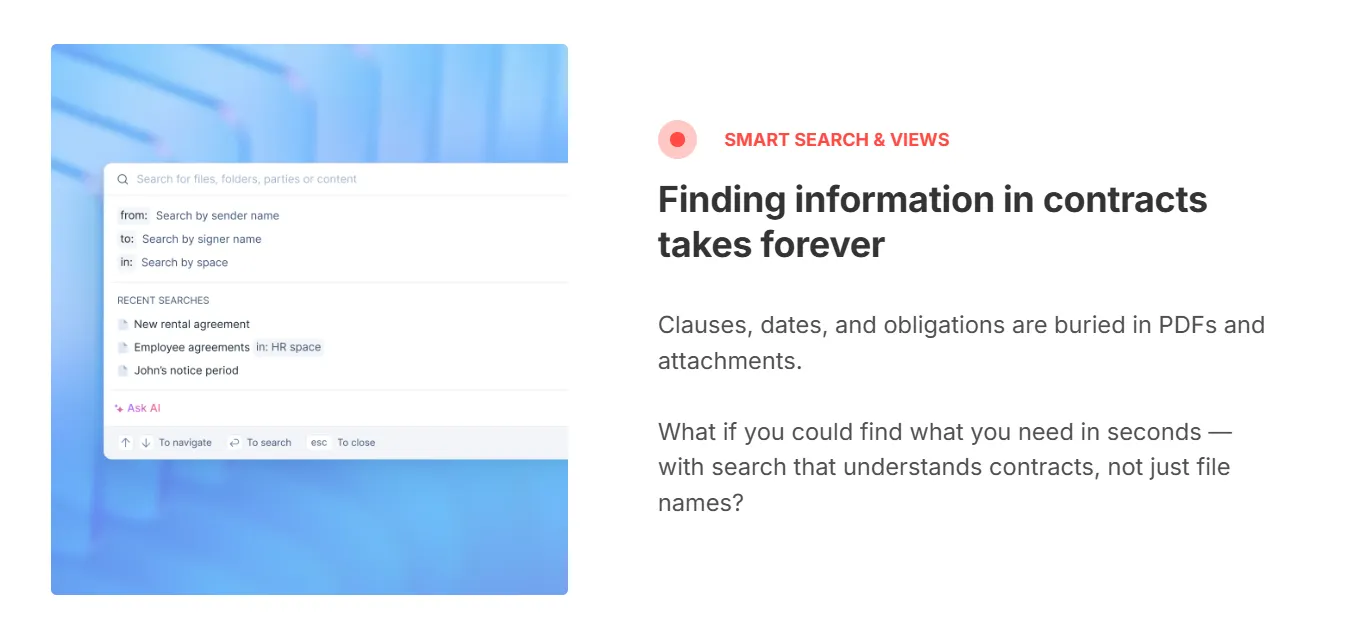
Contract repository software with AI-powered extraction pulls metadata automatically:
- Party names and counterparty details
- Effective dates and expiration dates
- Payment terms and pricing schedules
- Obligations and deliverables
- Renewal clauses and termination rights
Custom fields let you collect the exact information your contracts need. Alongside standard fields like name and date, you can add fields specific to your business, such as employee numbers, addresses, or any other data your team captures at signing.
Signeasy Smart Search understands the contract's content, not just file names. A query such as “net 30 payment terms” surfaces every relevant clause across the contract database.
Benefit #2: Find clauses, dates, and obligations in seconds
When Finance asks about payment terms across all vendor contracts, you produce a complete list in minutes instead of spending half a day manually reviewing agreements.
When Legal needs to audit force majeure clauses, one search replaces opening hundreds of individual files.
Your legal analyst used to spend Tuesday afternoons manually reviewing termination clauses across supplier agreements. Now they run a single search, export the results, and move on to negotiations that actually need attorney judgment.
3. Automated workflows and alerts
A contract that auto-renews without anyone noticing can lock your business into terms you'd have renegotiated — or walked away from entirely. By the time someone catches it, the window to act has already closed.
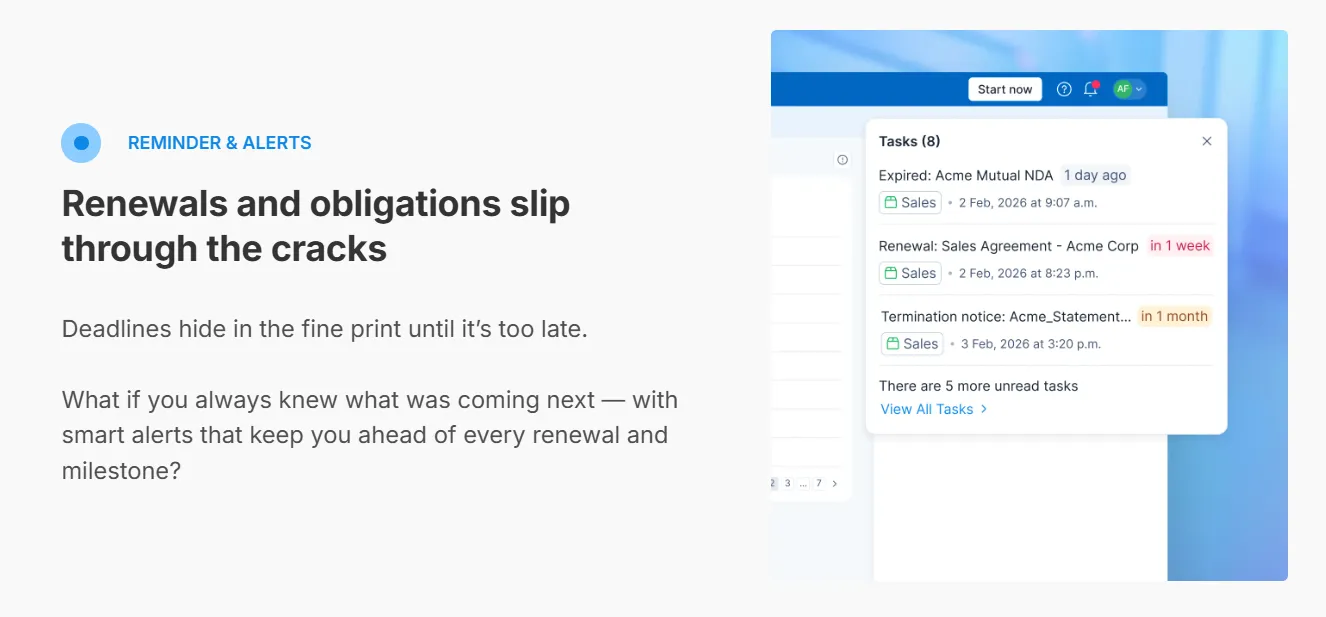
Missed compliance requirements and poor contract oversight cost real money.
A contract repository system with automated workflows helps reduce these risks. The system monitors expiration dates and sends renewal reminders based on your timeline. If you need 90 days to evaluate a renewal, you can configure the reminder once in the system.
Signeasy Reminders & Alerts notify stakeholders proactively about upcoming renewals and contractual obligations.
Benefit #3: Lower costs
Avoid missed renewals and expensive compliance mistakes with proactive alerts.
Your legal team stops maintaining renewal spreadsheets that go stale within a month. Your procurement lead stops setting personal calendar reminders for dozens of contracts.
The system sends a notification 90 days before your $50,000 software license auto-renews. Your team has time to evaluate whether to continue, renegotiate, or cancel.
Now, your procurement manager starts Monday reviewing a dashboard of upcoming obligations instead of panicking when a vendor invoice arrives for a contract they forgot existed.
4. Collaboration tools
Contract work spans departments, with Procurement negotiating commercial terms. Meanwhile, Legal reviews indemnification language, and Finance verifies budget alignment.
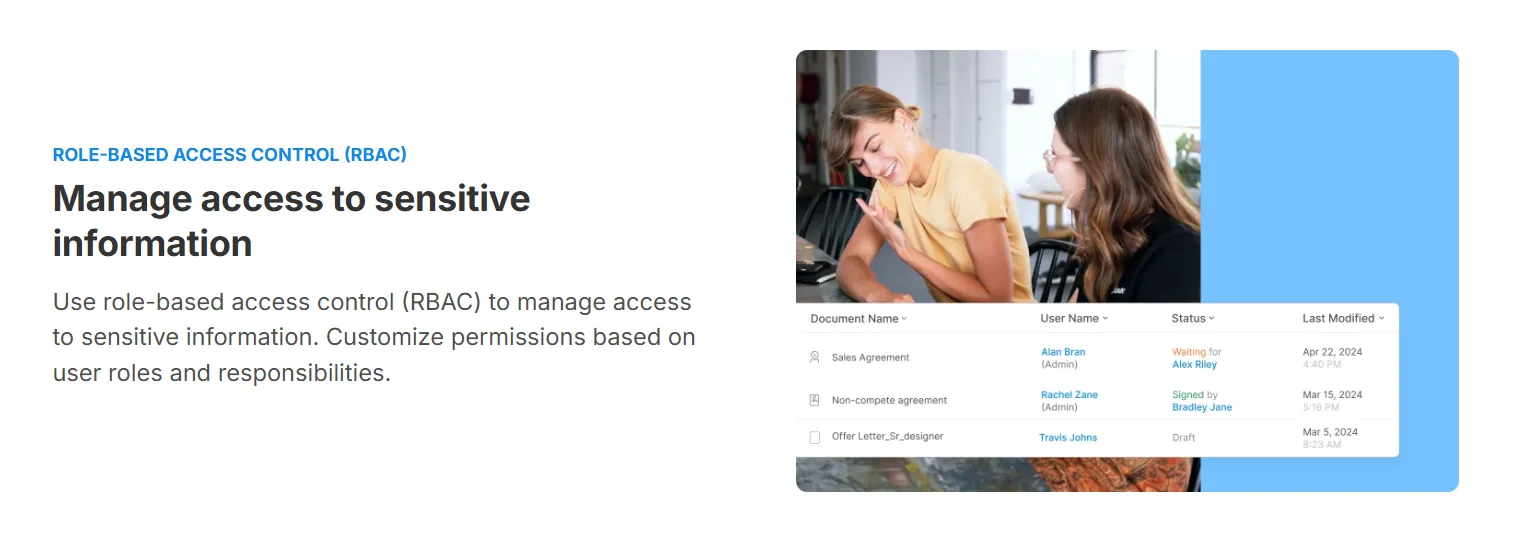
Good luck keeping everyone on the same page when your Head of Sales is working off version 3 and Legal has version 5 with redlines.
Role-based access controls determine what each user can view or modify:
- Sales representatives access customer contracts without editing Legal's master templates
- Finance reviews pricing terms without modifying underlying agreement language
- Executives approve high-value deals with full visibility into negotiation history
Audit trails record contract activity and track changes over time. Signeasy structures workspaces with project and department-level access controls that match how your teams already work.
Benefit #4: Teams work from the same shared workspace
Everyone has the right access and context without constant back-and-forth.
Your Legal counsel spends less time answering "where's the contract?" questions and more time on actual legal work. At the same time, Sales accesses customer agreements directly from the repository, allowing Legal to focus on negotiating new terms for enterprise deals.
Your Finance team reviews contracts in the same system where they were negotiated rather than working from outdated versions someone forwarded last week.
5. Scalability features
Remember AverageJoe068 from the intro? They generate between 750 to 1,000 contracts each year, and their previous tools couldn't handle the volume. This isn't an isolated case.
Research shows that organizations handling thousands of contracts annually can spend over 15,000 hours on manual processing. Rebate analysts dedicate 30% of their time, while pricing analysts spend 35–45% on contract-related work (International Journal for Multidisciplinary Research 2025).
A scalable contract repository system handles volume increases without requiring additional headcount. Bulk upload capabilities become essential when migrating legacy contracts. Instead of uploading hundreds of historical agreements individually, you process them in batches while AI extracts metadata from each.
API integrations sync new contracts automatically from eSignature platforms, so signed agreements enter the repository without manual intervention.
Benefit #5: Handle growth with ease
Manage large volumes of contracts without chaos or additional headcount.
Your team processed 300 contracts last year. This year you're on track for 800. In the old model, you'd be hiring another analyst or watching contract turnaround times stretch from days to weeks. With a scalable repository system, your two-person team handles the increased volume without overtime or bottlenecks.
The system absorbs the growth through bulk uploads and automated metadata extraction. What changes is the number of contracts in your database, not the hours your team spends managing them.
What happens behind the scenes when contracts enter the repository, get processed, and become searchable? The next section answers this question.
How contract repository software works
Contract repository software centralizes agreements and extracts actionable data from them. Signeasy's intelligent repository automates this process across four stages: upload, extraction, integration, and monitoring.
1. Upload and import
Contracts enter the repository through bulk upload for legacy migrations, email integration for agreements sent to designated inboxes, or direct sync from Signeasy's eSignature platform. The system accepts PDFs, Word documents, scanned images, and other common formats.
2. AI-powered data extraction
Once uploaded, Signeasy's AI automatically converts contracts into structured, searchable data:
- Party names and contact details: Identifies all signatories and stakeholders
- Key dates: Captures effective dates, expiration dates, and renewal windows
- Financial terms: Extracts payment schedules, pricing, and commercial obligations
- Clauses and obligations: Maps out responsibilities, deliverables, and compliance requirements
Signeasy's auto-organization and enrichment handle metadata extraction as files enter the repository. No manual tagging or categorization required.
3. System integration
Signeasy connects with your existing business tools.
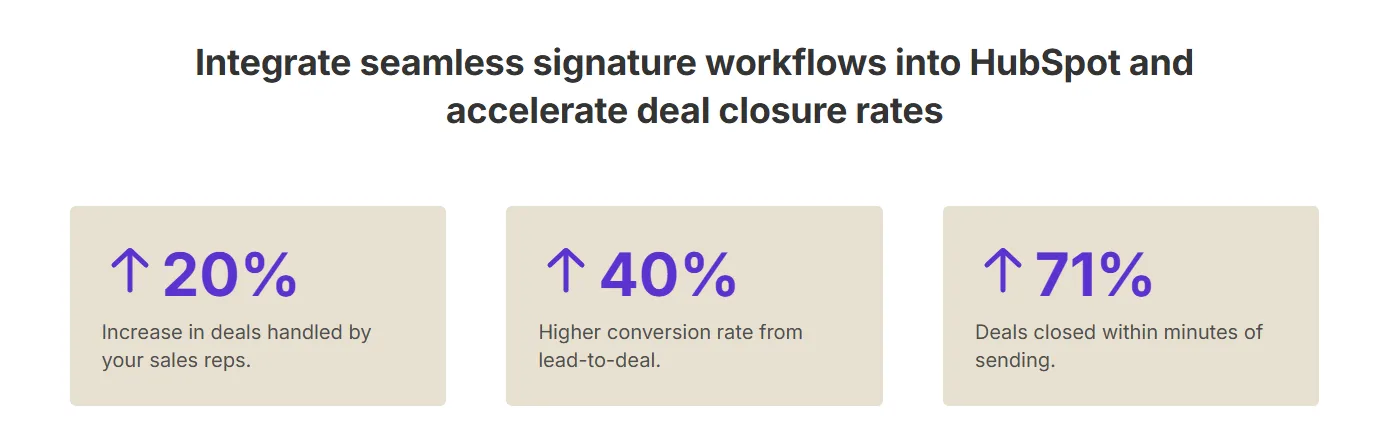
HubSpot integration captures deal terms and contracts directly within your CRM, while Microsoft SharePoint centralizes contract workflows for storage and tracking. Google Workspace lets teams sign and send documents without leaving Gmail, Docs, or Drive.
These integrations allow contract data to flow between systems without duplicate entry.
4. Real-time visibility
Your team stops asking "where are we on that contract?" Dashboards surface contract status and renewal deadlines before they become urgent. Stakeholders know what needs action without digging through spreadsheets or chasing down status updates.
Even the most capable contract repository software can fail to deliver value if implementation is rushed. Successful adoption depends on thoughtful rollout and change management.
Best practices for implementing a contract repository system
Successful contract repository software deployment requires methodical planning and stakeholder alignment. Organizations that rush implementation often face low adoption rates and incomplete data migration. How do you get it right?
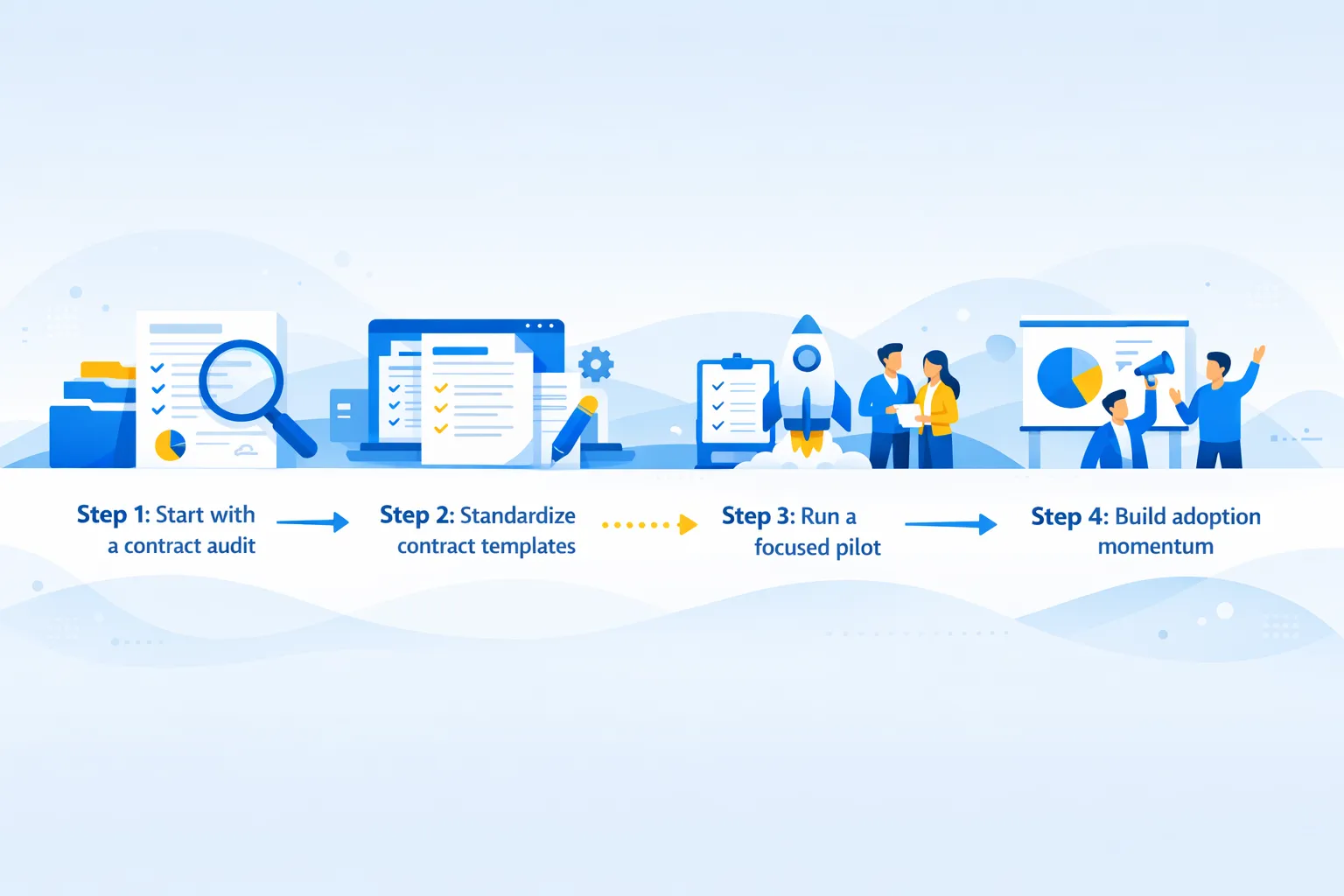
Step 1: Start with a contract audit
Catalog existing contracts by type, volume, and location. Are they in email inboxes? Shared drives? Individual desktops? Paper files in storage?
Define your metadata schema early:
- Which fields are mandatory (effective date, expiration date, counterparty)?
- Which are optional but useful (contract value, responsible department, risk rating)?
- How will you categorize contracts (by type, region, product line)?
This audit reveals the scope of your migration project and prevents surprises later.
Suggested Read: How to perform a contract compliance audit
Step 2: Standardize contract templates
Establish standard templates for your most common contract types before migration. When contracts follow predictable structures, AI extraction works better and teams negotiate more smoothly.
Step 3: Run a focused pilot
After completing step two, limit the initial rollout to low-risk contracts in a single department. Vendor agreements or routine service contracts work well for pilots. Test workflows, validate integrations, and gather user feedback before scaling.
Step 4: Build adoption momentum
Technology alone doesn't guarantee change, so train teams on the specific workflows they'll use daily. Legal needs different training than Procurement. Finance cares about different features than Sales. Account for these nuances and establish governance protocols early:
- Who can upload contracts?
- Who approves metadata changes?
- What's the naming convention?
- How often do you audit for compliance?
Executive sponsorship signals that the contract repository system is a strategic priority. When leadership actively uses the platform and references it in meetings, adoption accelerates across the organization.
If your contracts involve healthcare data, financial terms, or anything regulated, security should be a major deal-breaker when evaluating platforms.
Security and compliance in contract repository software
Contracts contain confidential terms, pricing data, and proprietary information. Organizations in regulated industries face specific security and compliance requirements that their contract repository system must meet.
1. Access controls
Look for platforms with role-based access controls that restrict visibility by department or project. Two-factor authentication and SSO integration ensure only the right people get in.
2. Audit trails and tamper detection
Audit trails track every document action across the repository. Signeasy adds an extra layer through Trust Seals that break if anyone alters a document post-signature.
3. Compliance
Verify your platform supports HIPAA for healthcare data, GDPR for EU data protection, U.S. ESIGN Act, UETA, and eIDAS for legal validity of electronic signatures across jurisdictions, and 21 CFR Part 11 for FDA electronic records.
4. Certifications
Signeasy undergoes regular external audits to maintain SOC 2 Type II certification. For healthcare teams following best practices for healthcare contract management, automated audit trails and immutable logs reduce audit preparation time while keeping your central contract repository compliant.
Let's factor in stakeholder concerns: what's the ROI for a contract repository system?
Contract repository software cost, ROI considerations, and pricing
Pricing models for contract repository software vary widely depending on features, user volume, and whether the repository is part of a broader contract management platform. Compare these models to evaluate total cost of ownership and avoid budget surprises.
1. Contract repository system common pricing models
Most contract repository systems use per-user or tiered pricing. Contract management software pricing ranges from $7 to over $700 per month based on user count, contract volume, and functionality level (Capterra).
2. Hidden costs that inflate total cost of ownership
The initial quote is just the opening bid. Factor in:
- Migration costs: Data extraction from legacy systems, contract digitization, metadata cleanup
- Training expenses: Onboarding sessions, documentation creation, ongoing education as features evolve
- Integration fees: Custom API development, middleware tools, ongoing maintenance for system connections
- Implementation services: Consulting fees, workflow configuration, template standardization
According to Future Processing's data integration cost analysis (2025), data preparation and migration alone can consume 25-30% of implementation budgets.
Hidden expenses like downtime, project management overhead, ongoing maintenance, and user training can add by a wide margin to the total cost of ownership. Ask vendors upfront what's included versus what requires additional investment.
3. ROI timeline: When you'll see returns
A contract repository system typically delivers hard-to-ignore ROI within 6-12 months. The returns come from:
a. Process optimization returns
Research from the International Journal for Multidisciplinary Research (2025) shows that AI-powered contract data extraction and automated workflows can optimize overall processing time by up to 60%, with organizations implementing automation reducing contract processing cycles by more than 50%.
b. Revenue protection
Suboptimal contract management costs companies as much as 9.2% of annual income, primarily through missed milestones, compliance infractions, and delayed implementation. Contract repository systems with automated alerts and tracking prevent these losses.
The financial case takes shape once you factor in saved analyst hours at loaded rates alongside fewer unintended renewals and less legal effort spent on routine requests.
Estimate your savings with our ROI calculator
4. Signeasy pricing vs. enterprise CLMs
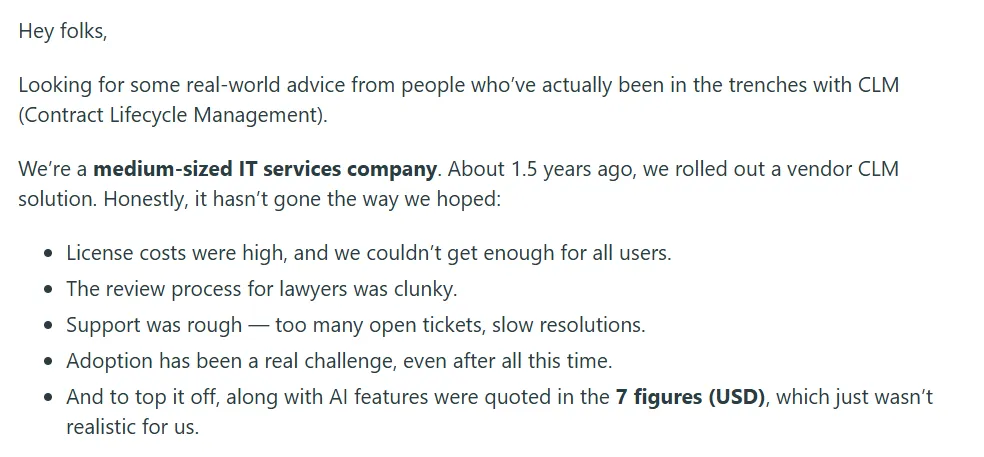
Most contract repository software wants six figures upfront or locks you into bloated CLM platforms where you pay for 40 features and use four. Don't take our word for it — here's a Reddit user explaining how their vendor CLM adventure went:
Source
Signeasy's tiered pricing lets you pay for what you'll actually use. Business plan ($20/month, $14/month annually) includes:
- AI extraction
- Unlimited sending
- Team collaboration
- Core integrations
Everything a team processing hundreds or thousands of contracts needs without the enterprise bloat.
Business Pro adds role management and deeper integrations for $10 more per user monthly. Custom plans handle regulatory requirements and higher volumes.
Migration fees? Not a thing. Integration costs buried in fine print? Also not a thing. Artificial contract limits that force mid-year upgrades? Still not a thing.
The pricing is transparent and the capabilities cover contract extraction, search, alerts, and collaboration. ROI shows up in reduced manual work within three months.
Choosing Signeasy's contract repository software
Contract chaos has a pattern. Your team manages hundreds of agreements across email, shared drives, and desktop folders. Nobody knows which version is current, and most times, renewals get missed.
But with Signeasy’s intelligent contract repository, these issues are bygone.
AI extraction pulls key details automatically. There’s no manual tagging or spreadsheet tracking. And because the app works on mobile (IOS and Android), teams can check contracts from job sites, client meetings, or home offices instead of waiting to get back to a desktop.
Pricing starts at $14/month per user annually — not the six-figure commitments most contract repository systems demand. What you get:
- Repository + management in one platform: Search, eSignature, approval workflows, and renewal tracking work together instead of requiring integration gymnastics
- 24/7 support: Email for Business plan users, priority access for Pro users when deadlines get tight
- No bolt-on complexity: One system handles contract capture, organization, execution, and monitoring
Your contracts become business assets you can query, track, and act on rather than files buried in someone's inbox from 2024.
See how fast you can find any contract term, renewal date, party name, or clause. Start your free trial or schedule a demo of Signeasy's intelligent repository.