



Contracts live everywhere in most organizations. Sales has theirs in the CRM, Legal keeps copies in shared folders, Finance stores invoices and purchase orders in the ERP. When someone needs the signed agreement, it’s often unclear who owns it or whether the version in hand is the one that actually governs decisions.
This is exactly what contract repositories solve. Yet 44% of companies say their current contract management software falls short, while 22% still rely on spreadsheets, according to the 2025 State of Contracts: Navigating the Future with Data-Driven Insights.
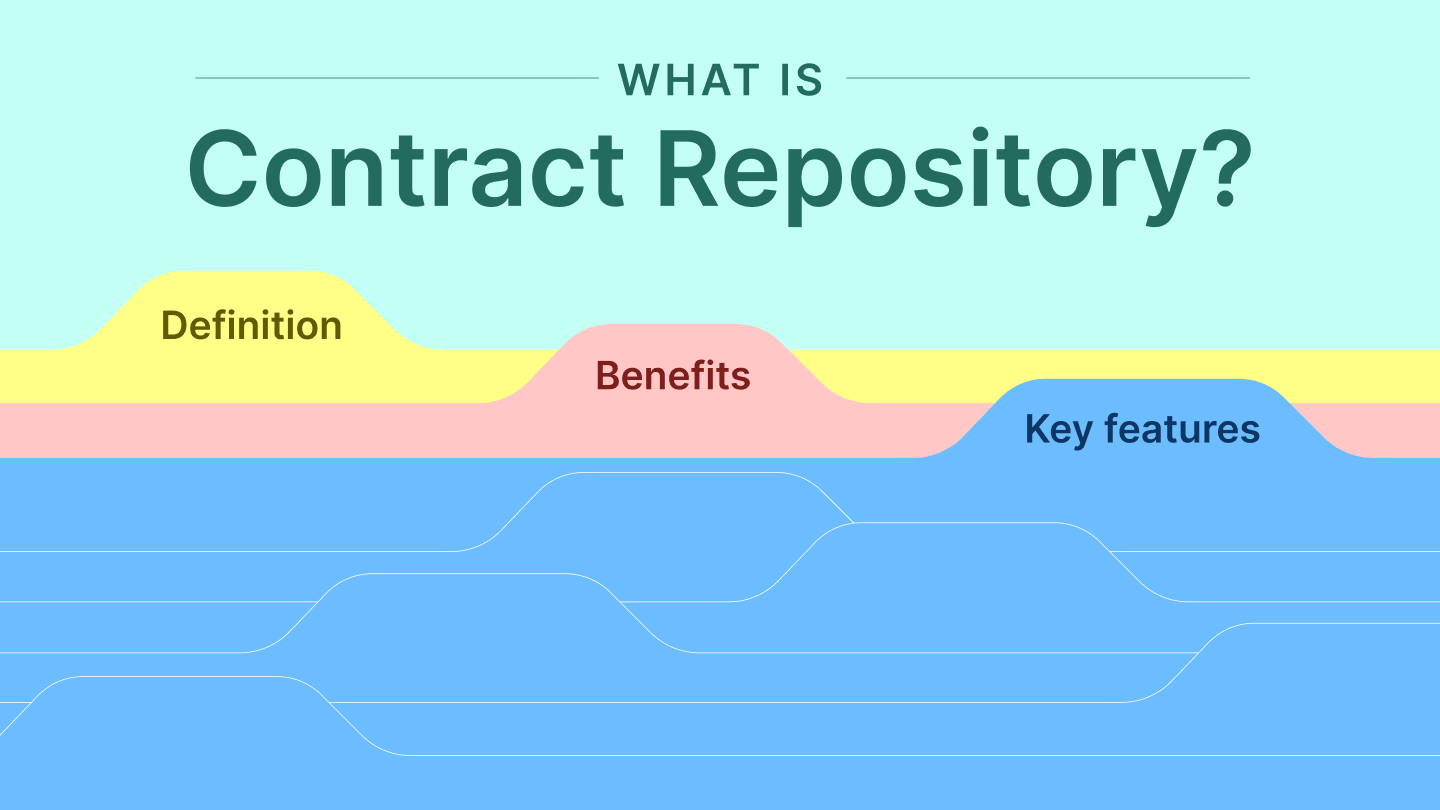
So what makes a really good contract repository? In this guide, you'll learn:
- Contract repository fundamentals and how they work
- Must-have features and tangible benefits
- Selection criteria for the right solution
- Best practices for successful implementation
What is a contract repository?
A contract repository is a centralized digital system designed to store, organize, manage, and retrieve all contracts throughout their lifecycle. Think of it as a dedicated hub where every agreement your organization touches lives in one searchable, secure place.
The real difference from basic document storage comes down to specificity. Google Drive or SharePoint can store contracts alongside presentations and spreadsheets, but they treat every file the same way.
Contract repositories are purpose-built for agreements. They recognize parties, dates, obligations, renewal terms, and payment schedules as structured data, not just text in a PDF. You get:
- Metadata tagging for easy categorization
- Obligation tracking across all contracts
- Automated renewal alerts
- Clause-level search that finds specific terms instantly
Generic storage tools can't deliver these capabilities. We've moved from physical filing cabinets to shared drives to today's intelligent repositories because contract data now supports critical business decisions.
Types of contract repositories
Contract repositories vary widely in how they store, search, and surface data. Here’s how basic systems compare to AI-powered platforms:
A major disparity exists between these two types of repositories.
Signeasy's Intelligent Contract Management centralizes all contracts in one secure location and applies AI to help teams instantly identify governing versions, critical terms, and upcoming obligations instead of manually reviewing documents scattered across systems.
The question has shifted from whether you need a repository to what kind of repository keeps pace with how your team actually works.
How contract repositories work
A contract repository brings structure to contract data that's typically scattered across inboxes and shared drives with no consistent organization.
Signeasy uses AI to organize, classify, and surface the information teams rely on every day.
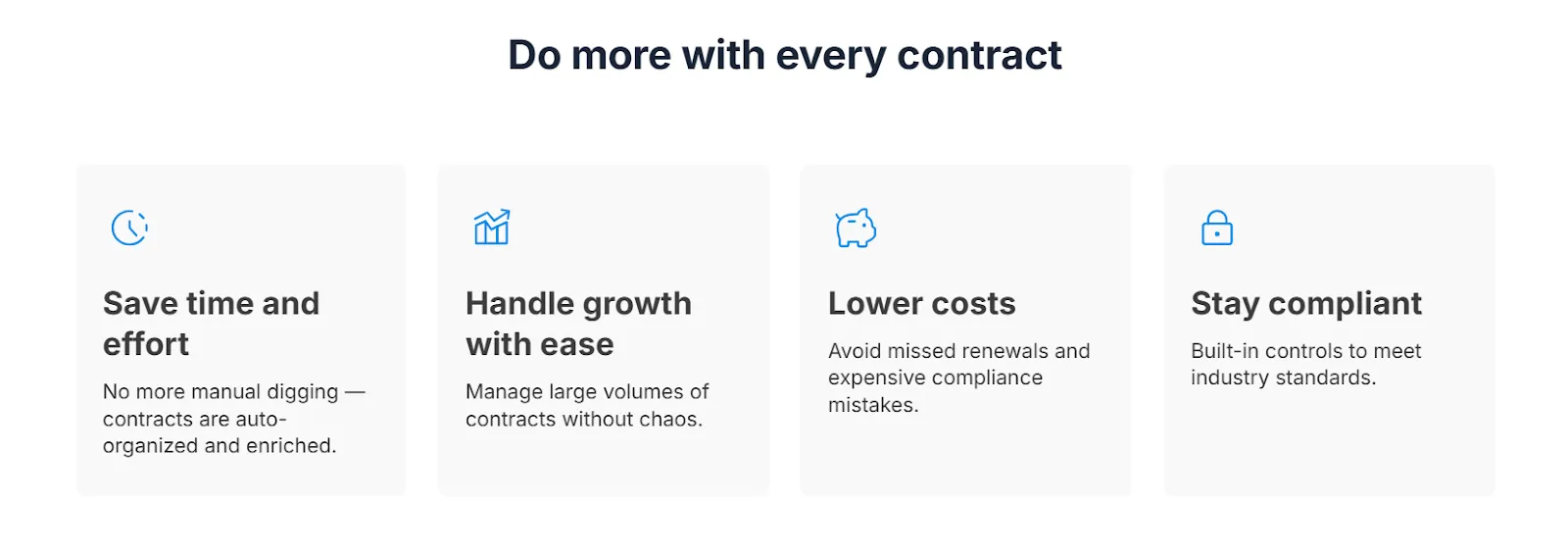
Here’s how:
1. Contract ingestion
The process starts when a team uploads a contract into the system. PDF files, Word documents, and scanned agreements enter the repository through direct upload, email capture, or integrations with tools already in use.
2. AI extraction and metadata indexing
AI then identifies key details such as parties, dates, clauses, and obligations. These data points become metadata that index the contract for fast retrieval. Signeasy captures these details on upload without requiring teams to tag anything manually.
3. Workspace organization
Once extracted, the contract moves into an organized workspace. Teams group documents by department, counterparty, status, or custom categories.
Signeasy’s Spaces feature gives Sales, Legal, Finance, and Procurement shared visibility while keeping permissions tight. Each team sees only what they need with the right context for every deal.
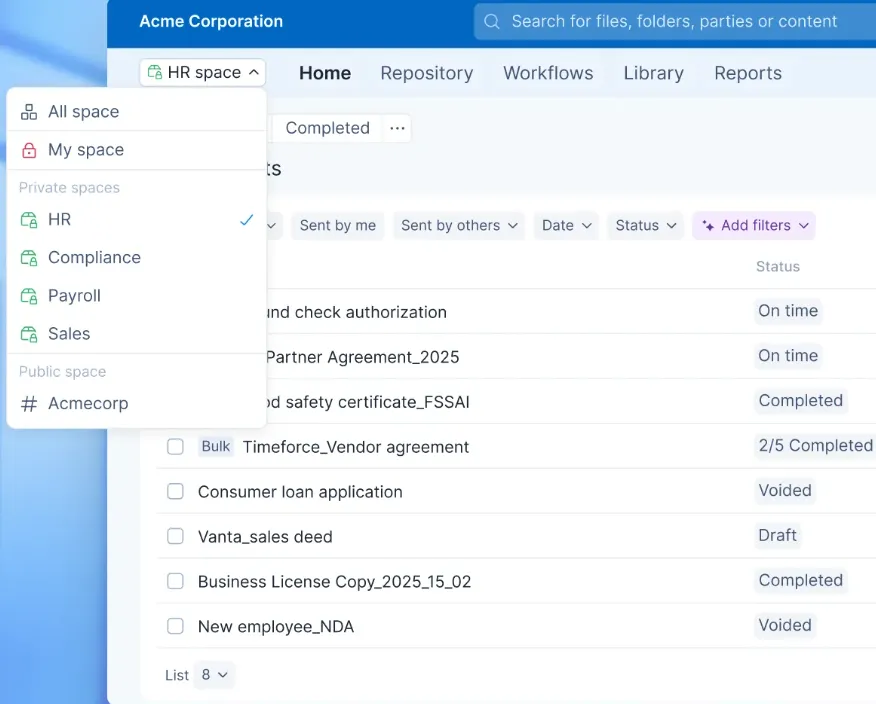
4. Search and retrieval
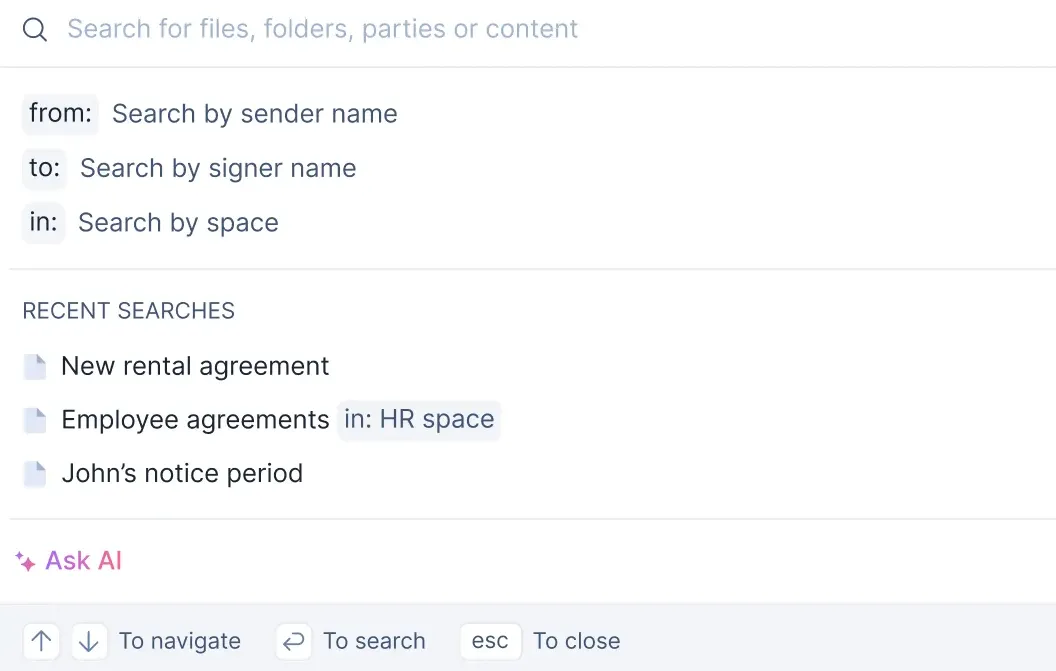
Search and retrieval come next. Users query the repository through full-text search, clause-level search, or natural-language prompts.
Signeasy’s Smart Search and Views help teams locate clauses, dates, or obligations in seconds instead of digging through PDFs.
5. Automated monitoring and alerts
Monitoring happens in the background. Key dates, renewal cycles, milestones, and compliance obligations are tracked automatically.
When an upcoming renewal, payment deadline, or review period approaches, the system sends timely alerts. Signeasy’s Reminder and Alerts feature keeps teams aware of what’s next so nothing time-sensitive gets missed.
6. Integrations with business systems
Most organizations rely on multiple systems, so integration plays a major role. Contract repositories connect with CRMs, ERPs, eSignature tools, document management systems, and communication platforms.
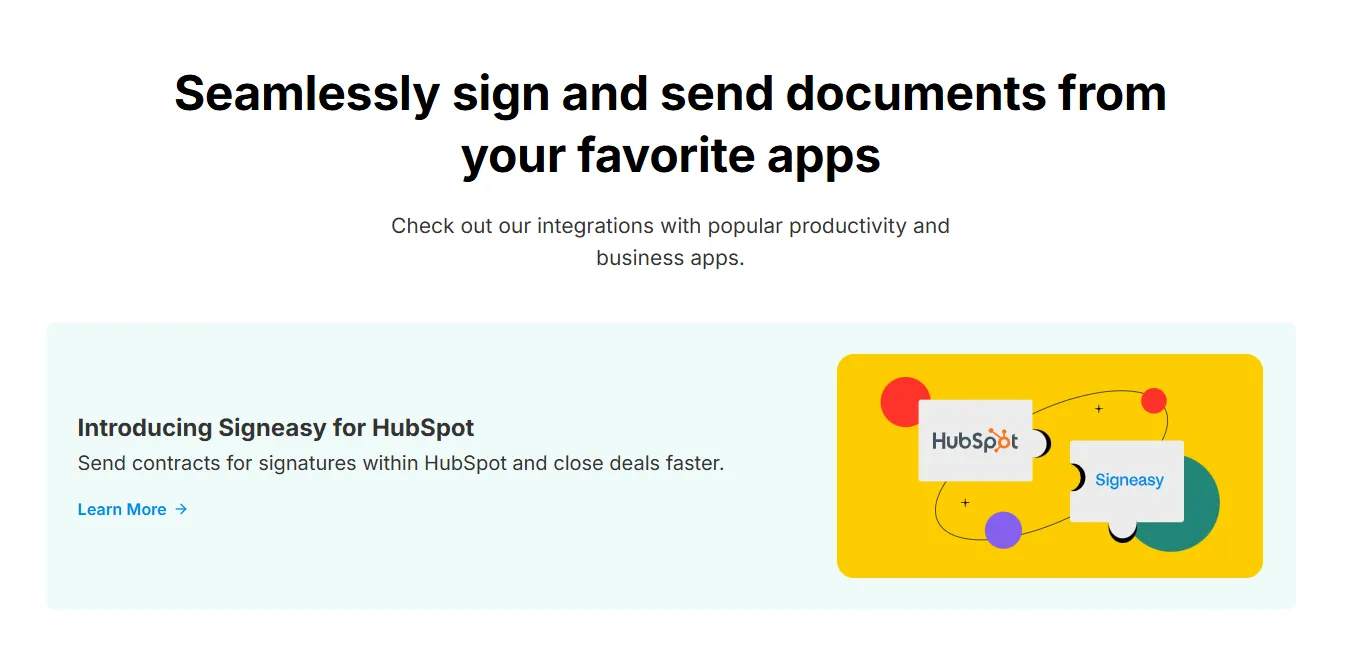
Signeasy’s integrations allow teams to send contracts for signature, including Docusign integration use cases, sync status updates, and move agreements through approval workflows without jumping between apps.
7. Security and access controls
Security controls sit underneath everything. Role-based access, audit logs, encryption, and single sign-on protect sensitive information while making it simple for users to work across shared environments.
The repository becomes the central entry point for every contract. Teams upload, classify, search, track, and act on agreements from one place — turning contract management into a predictable, organized process supported by AI-powered features.
These six features shape a truly capable repository.
Key features of contract repositories
Storage, search, audit trails, and version control form the foundation. Good contract repositories build on those capabilities. The features below separate simple digital filing tools from platforms that actually help you manage contracts, not just archive them.
1. Document storage and organization
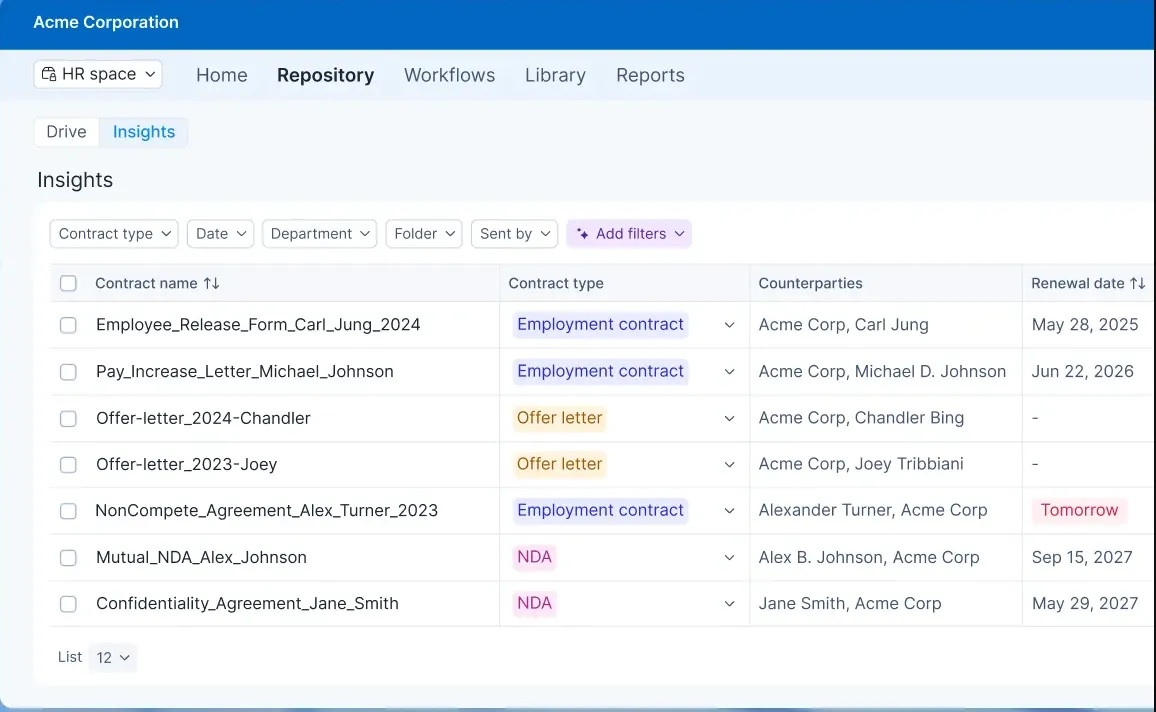
A good repository pulls every agreement into one system where anyone with the right permissions can find what they need. Upload a vendor contract, and the system sorts it by type, department, counterparty, and status automatically.
The centralized approach ends the era of contracts spread across email threads, personal drives, and departmental folders.
Organization happens through hierarchical folder structures, tagging systems, and automatic categorization. Bulk upload capabilities let you migrate thousands of existing contracts at once.
Your repository should capture contract metadata as structured data you can search and report on: parties, effective dates, expiration dates, contract values, key terms.
Signeasy’s Intelligent Contract Repository auto-organizes contracts upon upload, extracting key metadata to replace manual data entry.
1a. Benefit: A reliable contract foundation
- Contracts live in a single, structured system that teams trust as the source of truth
- Legal, procurement, and finance work from the same version of every agreement
- Work no longer depends on personal inboxes, shared folders, or individual knowledge
- Finance verifies pricing and payment terms directly from the contract record
- The organization reduces risk caused by missing, outdated, or inconsistent documents
- Contract management becomes a stable operational foundation rather than a daily friction point
2. Advanced search and filtering
Advanced search turns a contract repository into something more useful than a storage system: answer engines. Full-text search scans every contract end-to-end, while clause-level search zeroes in on specific terms and obligations.
You can even use natural language queries like, “show all contracts expiring in Q2 with auto-renewal clauses,” the way you'd ask a colleague.
Behind the scenes, AI-powered semantic search understands contract context, not just keywords. It knows that "cancellation rights" and "termination provisions" mean similar things. Intelligent document understanding delivers relevant results ranked by how well they match your intent.
Filtering builds on that foundation. Narrow results by date ranges, contract value, counterparty, status, department, custom fields, or tags. Save search views for queries you run repeatedly. Export filtered results when you need to analyze data outside the platform.
File name searches don't work when you need a specific termination clause buried in 50 pages of legalese. With Signeasy's Smart Search and Views, users find specific clauses, dates, and obligations in seconds using search that understands contracts.
2a. Benefit: Speed that changes how teams work
- Contract search returns results instantly instead of requiring manual document digging
- Legal answers questions during negotiations rather than delaying decisions
- Sales confirms terms on customer calls instead of scheduling follow-ups
- Finance reconciles invoices the same day instead of waiting for documents to surface
- Faster access removes bottlenecks between teams and shortens deal and payment cycles
- Teams move from reactive searching to proactive, real-time decision-making
3. Audit trails and audit logs
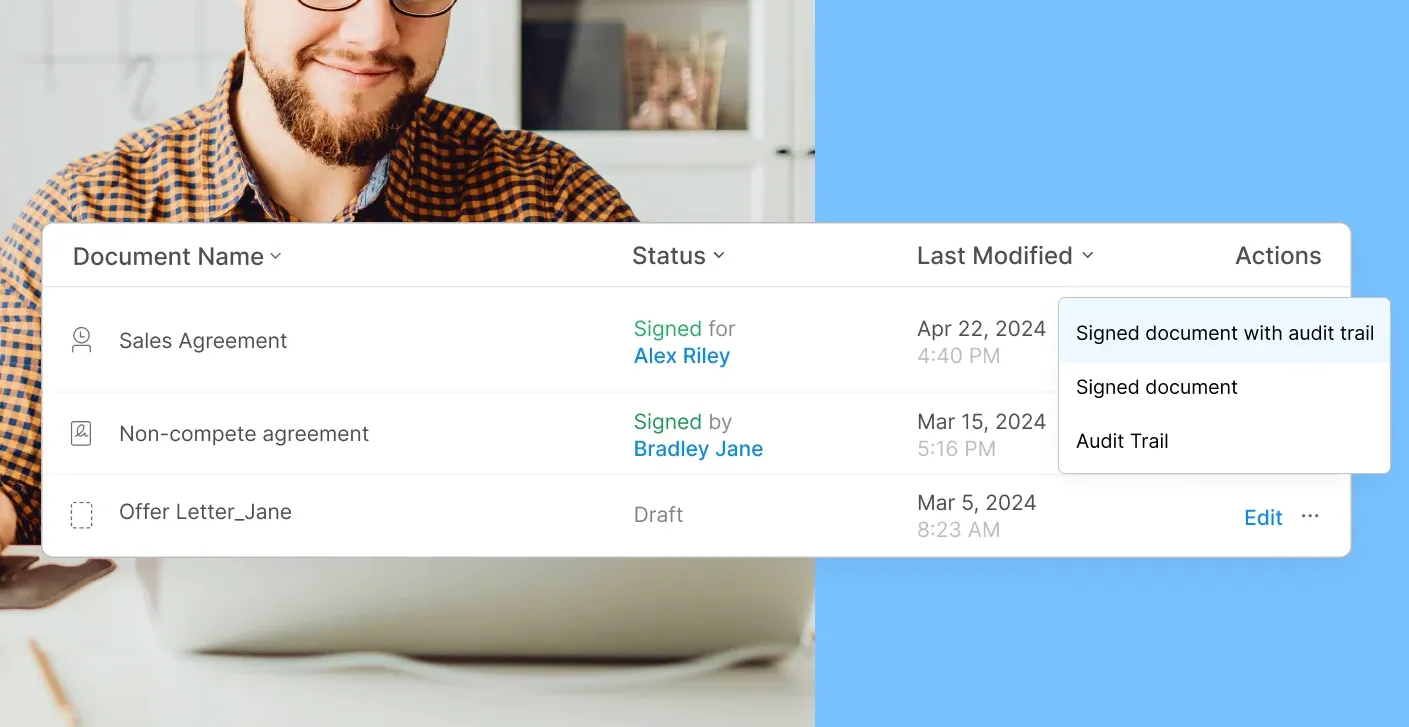
Audit logs track every action taken on a contract with timestamped records of who accessed, modified, or approved each document.
A complete audit trail captures every change throughout the contract lifecycle, while detailed logs show exactly what happened and when. This documentation proves critical for compliance and dispute resolution.
Contract negotiations involve multiple stakeholders and approval stages. Without audit logs, teams struggle to reconstruct who approved what or when decisions were made.
Full audit trails serve compliance and dispute resolution. When regulators ask about contract terms or a vendor disputes what was agreed, you have documentation.
Integration with eSignature tools maintains complete signing audit trails from first draft through executed agreement and subsequent amendments.
3a. Benefit: Built-in audit evidence reduces compliance and dispute risk
- Every contract change, approval, and signature is automatically recorded with clear timestamps.
- System-generated audit histories replace manual tracking spreadsheets and email reconstruction.
- Compliance teams access complete, defensible records for audits, investigations, and regulatory reviews.
- Legal, procurement, and finance rely on verified evidence to resolve disputes and demonstrate policy adherence.
- Audits and mediations are handled with preparation and confidence, reducing legal exposure and business risk.
4. Integration capabilities
Integration capabilities determine whether your contract repository works seamlessly with the tools your teams already use every day. When systems connect properly, contract data flows automatically between platforms without manual re-entry or constant switching between applications.
Modern repositories offer both pre-built integrations and API access. Pre-built integrations provide immediate connections to commonly used tools, while API capabilities allow custom integrations for specialized systems or unique workflows.
Common integration points include:
For sales and customer contracts:
- CRM systems like HubSpot
- eSignature tools for execution workflows
For procurement and vendor management:
- ERP systems like SAP and Oracle
- Financial systems for payment tracking
For cross-functional collaboration:
- Document management systems like SharePoint and Google Drive
- Communication tools like Slack and Microsoft Teams for notifications
Contracts touch every part of your business. Sales needs contract data in the CRM. Procurement needs it in the ERP. Finance needs payment terms flowing into accounting systems. Integration capabilities determine whether your repository becomes a bottleneck or an accelerator.
According to PwC's 2024 Digital Procurement Survey, 94% of organizations use source-to-pay (S2P) platforms. Contract management integration isn't optional at that scale. It's required infrastructure.
Signeasy integrates with tools like HubSpot, Google Workspace, Microsoft Outlook, and more to keep contracts flowing seamlessly through your existing workflows.
4a. Benefit: Integrations remove workflow friction
- Contract data syncs automatically with CRM, procurement, and finance systems as part of existing processes.
- Teams complete contract-related work without leaving their primary operating tools.
- Sales workflows continue uninterrupted while contract terms are enforced in connected systems.
- Procurement approvals are triggered by system rules tied to contract values and policies.
- Finance processes payments using contract-linked data flowing directly into financial systems.
5. Security and compliance features
Data security starts with end-to-end encryption for data at rest and in transit. Look for SOC 2 Type II compliance, GDPR and CCPA adherence, and regional data privacy compliance.
Role-based access controls (RBAC) determine which users can view or edit specific contracts. Multi-factor authentication (MFA) and single sign-on (SSO) integration add layers of protection. Data sovereignty options let you choose where data is hosted. Backup and disaster recovery plans protect against data loss.
Contracts contain sensitive information — pricing terms, intellectual property clauses, personal data, competitive strategies. Security failures expose your organization to financial loss, regulatory penalties, and reputational damage.
Good repositories also track regulatory requirements embedded in contracts, alert you to compliance obligations and deadlines, and generate compliance reports for audits.
According to the 2025 State of Contract report cited earlier, 33% of respondents need better systems to flag compliance issues, and 16.51% remain cautious about contract AI specifically due to security concerns.
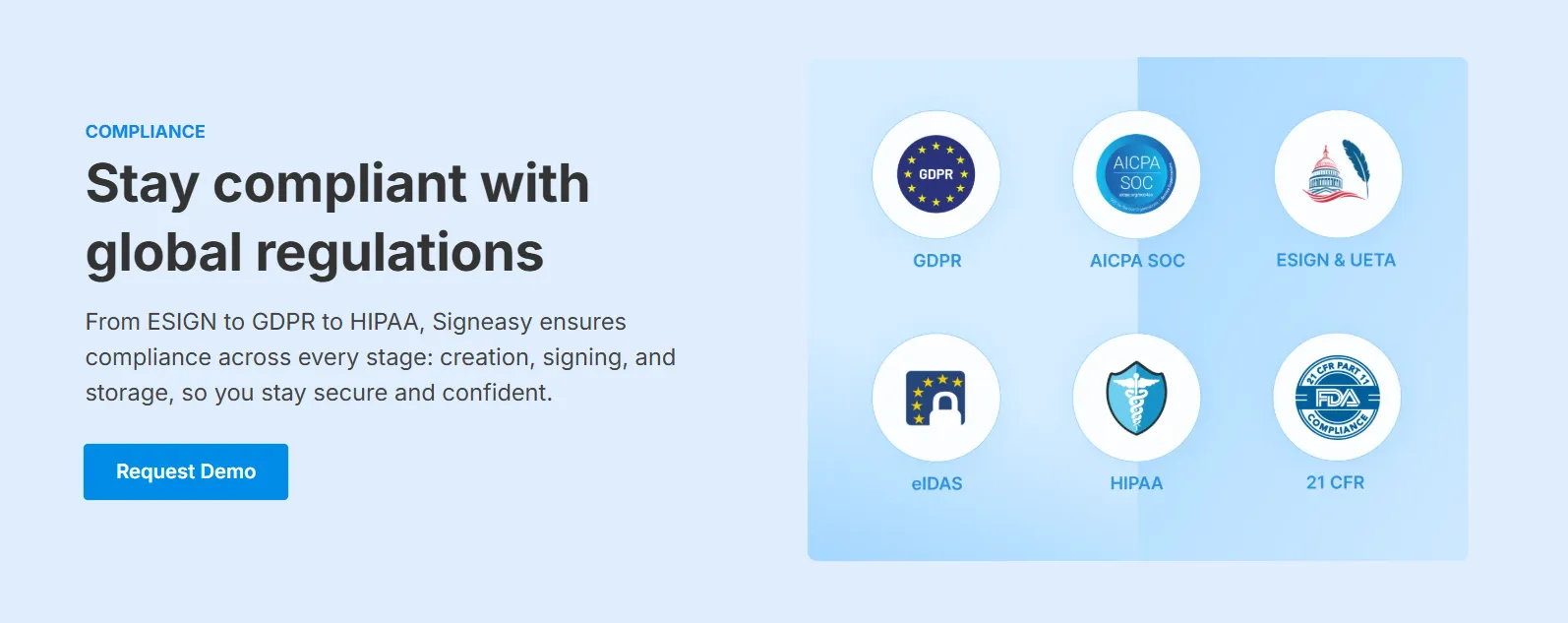
Signeasy treats enterprise-grade security as a baseline requirement, with built-in controls that meet industry standards.
5a. Benefit: Strong security prevents costly breaches
- Access to contract data is controlled by role and policy, limiting exposure of sensitive terms.
- Security rules are enforced automatically instead of relying on manual permission management.
- Legal defines access boundaries once, without handling individual permission requests.
- IT applies authentication and access policies centrally, without maintaining tracking spreadsheets.
- The organization reduces breach risk and compliance fallout by keeping contract data protected by default.
6. Automated notifications and alerts
Critical contract dates often get buried in long agreements, causing missed renewals, overlooked payments, or compliance deadlines arriving too late.
Signeasy’s automated notifications surface these obligations at the right time. Teams receive alerts for upcoming renewals, payments, milestone deadlines, or compliance reporting through email, in-app messages, SMS, or Slack and Teams.
Escalation workflows send overdue items to the right person, while dashboards highlight upcoming obligations at a glance. Assignment features route contract-related actions to the responsible team member.
Legal teams review contracts before early termination windows close. Finance submits payments without chasing approvals. Procurement avoids auto-renewing contracts for unused services. Alerts reach teams where they work, so actions happen proactively rather than reactively.
The 2025 State of Contracts survey confirms this: 35% of contract professionals want better communication for expiration tracking, and 22.94% cite missed deadlines as a top challenge with current systems.
Timestamped reminders and intelligent routing reduce oversights and help teams manage obligations consistently across hundreds of contracts.
6a. Automated alerts prevent expensive oversights
- Contract-driven alerts surface upcoming deadlines and obligations before action windows close.
- Legal teams address termination and renewal clauses in time to avoid unwanted commitments.
- Finance teams receive advance reminders for invoicing and payment milestones.
- Compliance teams meet reporting and filing deadlines without last-minute escalation.
- Procurement identifies renewals and unused services early, preventing unnecessary spend.
The next obstacle is tackling the hurdles that come with these features.
Common challenges in contract repository implementation and how to overcome them
Many organizations hit the same roadblocks during contract repository implementation. Adoption issues, fragmented data, system integrations, and metadata inconsistencies can slow progress if they’re not addressed early.
The table below outlines the most common challenges and the contract repository best practices that help teams move past them.
With what can go wrong mapped out, the focus shifts to choosing the right solution.
How to choose the right contract repository
Each organization has its own workflows, contract volume, and compliance needs, so the best choice depends on how well the system supports your daily operations.
The checklist below helps you evaluate contract repository solutions with clarity and confidence.
1. Define your requirements first
Assess your current pain points and workflows before you look at any platform. Survey stakeholders across legal, procurement, sales, and finance to capture different perspectives on what's broken.

According to the report cited earlier, only 30.28% of users love their current contract management software. Proper requirements gathering prevents you from joining the dissatisfied majority.
Document must-have features separately from nice-to-have ones. Consider your contract volume, complexity, and growth projections over the next three years. Factor in regulatory and compliance requirements specific to your industry. Write this down. Reference it every time a vendor demo tries to dazzle you with features you don't need.
2. Evaluate core functionality
Focus on capabilities that directly address your documented requirements.
Essential features include:
- Content creation and authoring tools
- Workflow automation and approval routing
- Comprehensive search and reporting
- Integration capabilities with your existing tech stack
- AI and machine learning for auto-extraction
- Security and compliance certifications
- Mobile accessibility
According to the 2025 State of Contract report above, 42% of users prioritize auto-redlining capabilities, 25% need full audit trails, 22% require numbered version control, and 11% want clause ownership features. Use these benchmarks, but weigh them against your own priorities.
Balance breadth of features with usability. Platforms stuffed with every possible capability often sacrifice user experience. Feature bloat kills adoption faster than missing features.
3. Assess AI and automation capabilities
Check that the repository can extract clauses, perform semantic searches, flag risk signals, detect auto-renewals, and track obligations. These features reduce time spent digging through PDFs and improve visibility across the lifecycle.
Some teams remain cautious about AI, so look for vendors offering strong data privacy protections and explainable AI that shows how decisions get made. Signeasy's Intelligent Contract Repository addresses these concerns with AI-powered organization and smart search built on secure, compliant infrastructure.
Start with contract automation that delivers immediate value, then expand as teams become more comfortable with AI-driven workflows.

4. Consider scalability and total cost
Ask whether the system can handle 10x your current contract volume without performance degradation. Test search speed and bulk operations during your evaluation — before you sign anything.
Account for costs in addition to the listed price. Implementation fees, training programs, customization work, and data migration services often double the initial quote. Get a complete cost breakdown upfront, including per-user fees, per-contract charges, and tiered pricing thresholds.
Budget appropriately. According to PwC's 2024 Digital Procurement Survey, organizations investing in digital procurement transformation spend an average of $783k for small and medium-sized companies and $1,902k for large enterprises.
Contract repository implementation represents a significant portion of that investment, therefore plan for the full lifecycle cost from day one.
5. Evaluate vendor stability and support
Research how long the vendor has been in business and whether they're growing or contracting. Check their funding status, customer retention rates, and any recent leadership changes that signal instability.
Customer support quality determines whether your team actually uses the platform. Look for:
- Comprehensive training resources and structured onboarding programs (22.94% of survey respondents cite systems being "too complicated")
- Multiple ongoing support channels including phone, email, and chat
- Dedicated implementation services and success management
- Active user community and detailed documentation
Review the product roadmap to understand where the platform is heading. Request customer references from organizations similar to yours in size and industry.
Plan your exit strategy upfront. Confirm data portability options if you need to switch providers later. The 2025 State of Contract report shows users asking "What happens to contracts if switching providers?" Answer that question before you sign.

6. Request trials and demos
During trials, upload real contracts (anonymized if needed) and involve users from multiple departments — not just the system administrator — to test workflows and performance.
Evaluate the training and onboarding process as part of your trial. Assess how responsive the vendor is when you ask questions or have issues. Compare multiple vendors using consistent evaluation criteria so you're making an apples-to-apples decision.
Check implementation timeline estimates. Unrealistic promises about going live in two hours usually mean the vendor doesn't understand the complexity involved.
Choosing a contract repository following these best practices positions you for successful implementation.
Platforms like Signeasy offer modern capabilities including AI-powered organization, smart search, team Spaces, and automated alerts that address the core challenges contract professionals face.
Request demos from multiple vendors, test them against your documented requirements, and choose the one that fits how your team really works.
All of this leads to the next evolution in contract management: AI-driven repositories.
Experience AI-powered contract repository management with Signeasy
A modern contract repository centralizes every agreement with AI-powered search, automated reminders, and structured data that supports better decisions across the lifecycle. Signeasy's Intelligent Contract Repository goes further with capabilities designed for how teams actually work.
AI Summary condenses long agreements instantly. Smart Search understands contract context and answers questions in natural language. Key Terms Extraction surfaces critical clauses automatically. Spaces give teams shared visibility while maintaining role-based access control.
Security comes standard with SOC 2, HIPAA, 21 CFR, GDPR, and eIDAS compliance. SSO, 2FA, audit trails, and tamper-detection Trust Seals protect contracts at every stage. Data stays encrypted both at rest and in transit.
Native integrations with Google Workspace, Microsoft SharePoint, Outlook, Teams, and HubSpot prevent context switching. Contracts flow through existing systems without duplicate data entry.
The path forward starts with clear requirements, prioritizes user adoption, and focuses on platforms offering robust AI and integration capabilities. Implement in phases. Measure success through defined KPIs that prove ROI.
If spreadsheets or outdated systems still handle your contracts, Signeasy delivers the intelligence modern teams need. Request Demo.