

.webp)


Your contract repository management might be costing you more than you think. But before looking at best practices and solutions, let's figure out what a broken system is really draining from your business.
Do the math. Say your legal team spends 6 hours weekly hunting for contracts across 24 different systems. That’s 312 hours annually, nearly 40 working days per person. At $50/hour for legal time, one person represents $15,600 in search costs alone.
Multiply by your team size. Now add missed auto-renewals, compliance failures, and duplicate vendor agreements signed by different departments.
Organizations lose almost 9% of annual revenue through poor contract repository management (World Commerce & Contracting, 2025). The drain separates companies that treat contracts as files from those that wield them as strategic assets. Closing that drain, however, requires more than better folders. We'll walk through:
- What modern repositories do
- The cost of scattered contracts
- Smart features vs. glorified folders
- Building a system that pays back
- Where implementations usually fail
What is contract repository management?
Contract repository management is the systematic approach to storing, organizing, and extracting operational and commercial value from your organization's contracts throughout their entire lifecycle. It goes way beyond simple document storage.
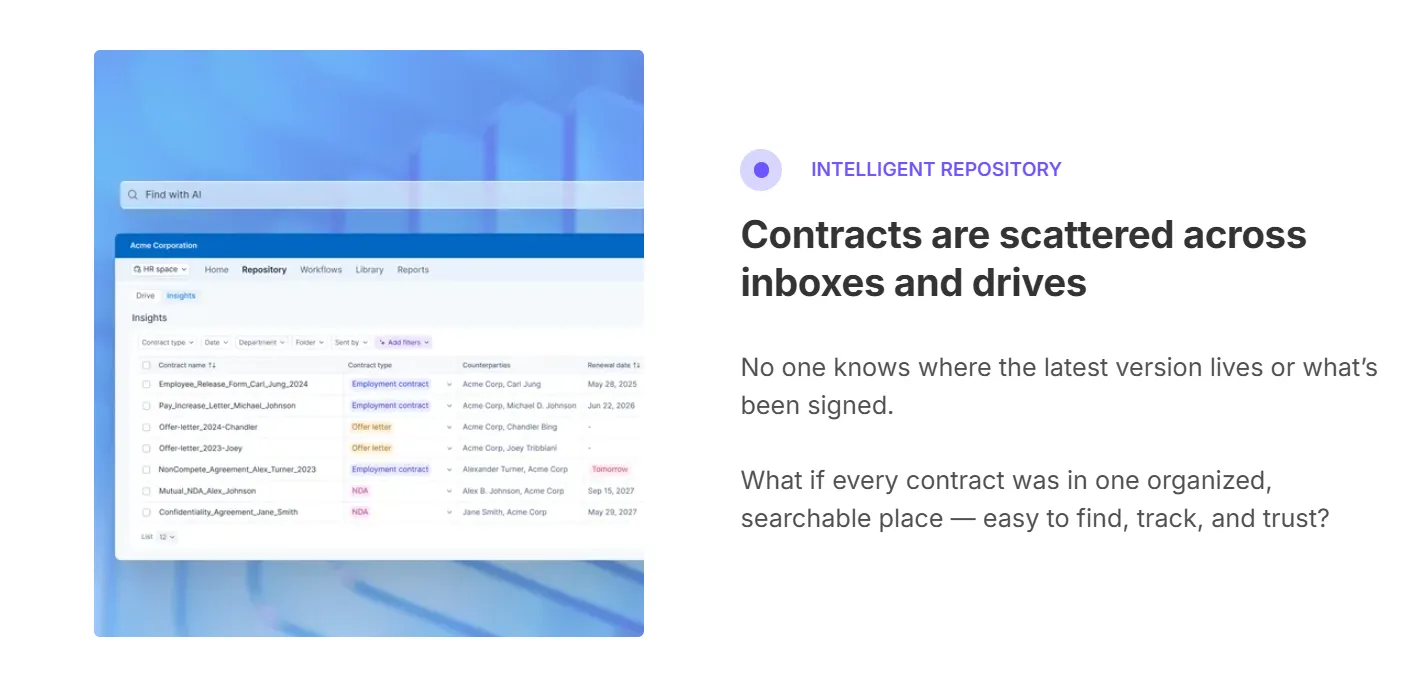
Think of it as the difference between throwing receipts in a shoebox versus having an intelligent financial system.
A basic repository just holds files. Contract repository management turns those files into usable business intelligence by extracting key dates, obligations, and terms and making them easy to search and act on.
Advanced contract repositories centralize agreements that typically scatter across email inboxes, shared drives, filing cabinets, and individual desktops. They provide role-based access so sales, legal, procurement, and finance work from the same source without compromising security.If you're rolling this out across multiple departments, our guide on contract management for teams covers how to structure access, ownership, and workflows for each function.
Most importantly, they flag pending obligations and critical clauses before you need to go looking. Get this right, and contracts stop being documents you file away and start being resources that add business value.
Great. So what does getting this wrong really cost you?
Costs of poor contract repository management
We mentioned the 9% revenue leak earlier. Building on that, you can see the impact in daily operations:
- Sales negotiates a renewal while finance works from outdated terms in a different folder
- Auto-renewals trigger at rates nobody approved because notifications got buried
- Legal burns billable hours reconstructing agreements because signed versions live apart from negotiation threads
- Procurement signs vendor contracts, unaware that another department already has a deal with the same company
- Compliance teams can't produce documents during audits because contracts are scattered across multiple locations
Manual tracking works for, say, fifteen contracts. Past a hundred active agreements, spreadsheets become liabilities. Updates don't get shared. The "master list" is whatever version someone last emailed around.
The best performers keep erosion at around 3% by treating contract repository management as infrastructure. The worst lose 15% or more. For mid-sized companies, that twelve-point spread represents millions in protected value.
Now you know what's at stake. Time to see what the other side does differently.
What modern contract repository management looks like
The gap between companies losing 15% or more of contract value and those keeping erosion under 3% comes down to capabilities. Not just where you store files, but what your system can do with them.
1. Intelligent organization (not manual filing)
Platforms like Signeasy automatically identify document type, extract party names, pull key dates, and categorize everything without anyone creating folders or typing metadata. The system reads contracts the way a person would, then files them accordingly.
Manual classification breaks down at scale. You might tag twenty contracts properly, but with two thousand, someone skips the process, and six months later, critical contracts disappear into the pile.
Signeasy's Intelligent Contract Repository handles this without human input; contracts organize themselves the moment they're uploaded.
2. Universal search that understands contracts
Filename search finds documents. Contract-intelligent search finds answers.
You need to know which agreements have force majeure clauses covering pandemics. Or which vendors you've granted audit rights. Or what liability caps you typically negotiate with SaaS providers.
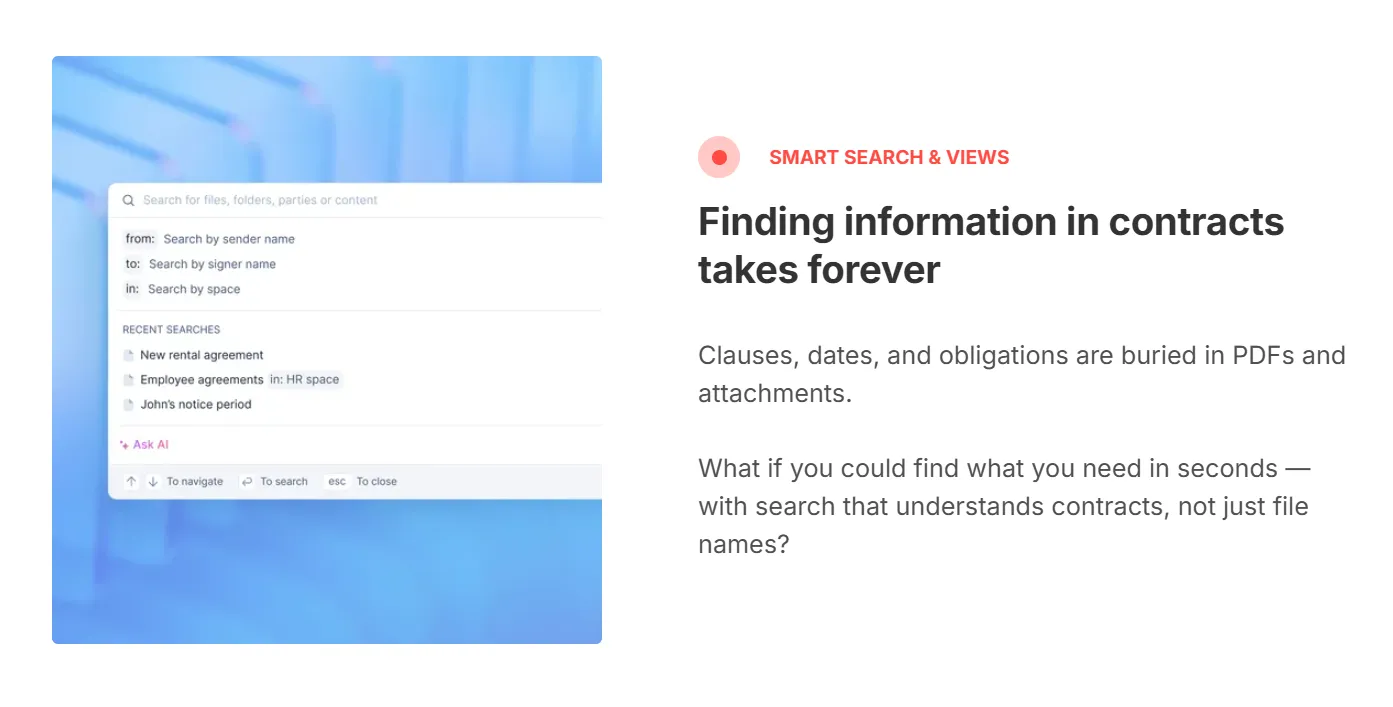
Modern repositories index the actual contract content and surface specific clauses in seconds, not the document that probably contains what you need if you read all 47 pages.
When you're managing hundreds of agreements, this stops being a nice-to-have. It becomes the line between informed decisions and educated guesses.
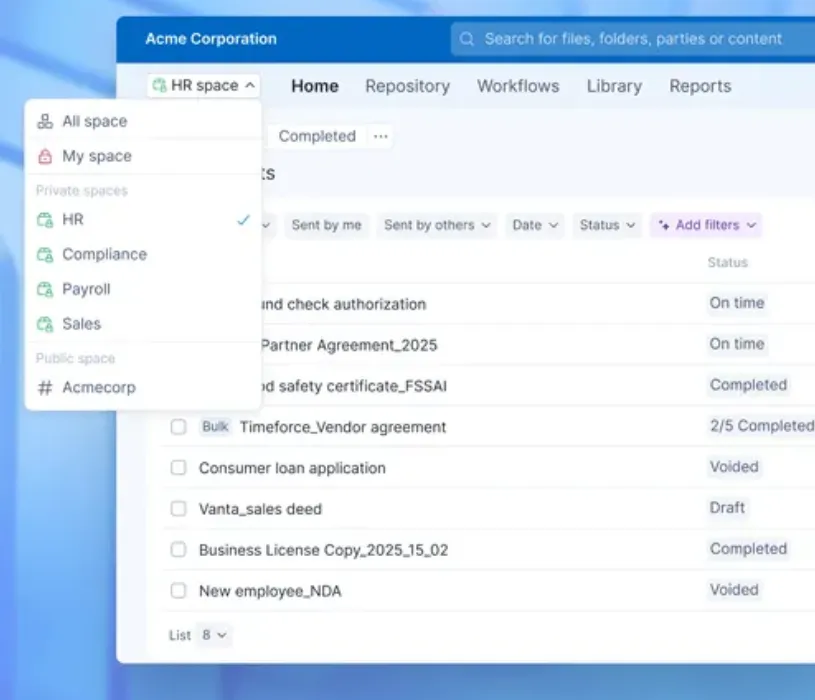
3. Cross-functional visibility with governed access
Different teams need different information from the same contracts:
- Sales needs pricing terms and discount structures
- Legal requires full agreement, access, and amendment history
- Finance tracks renewal dates and payment obligations
- Procurement monitors vendor performance clauses
Everyone working from different copies creates the scattered data problem and wasted search time we calculated earlier. Today’s contract repository management provides shared workspaces with role-appropriate permissions.
Sales sees what they need without accessing confidential legal terms. Finance tracks obligations without accessing contracts they shouldn't modify. Everyone works from the same source, but security and confidentiality stay intact.
Signeasy Spaces shows how teams can get organization-wide visibility while keeping security intact.
4. Proactive tracking and alerts
With contract data scattered across an average of 24 systems, visibility becomes the primary challenge. Modern repositories solve this by telling you what's coming instead of waiting for you to check.
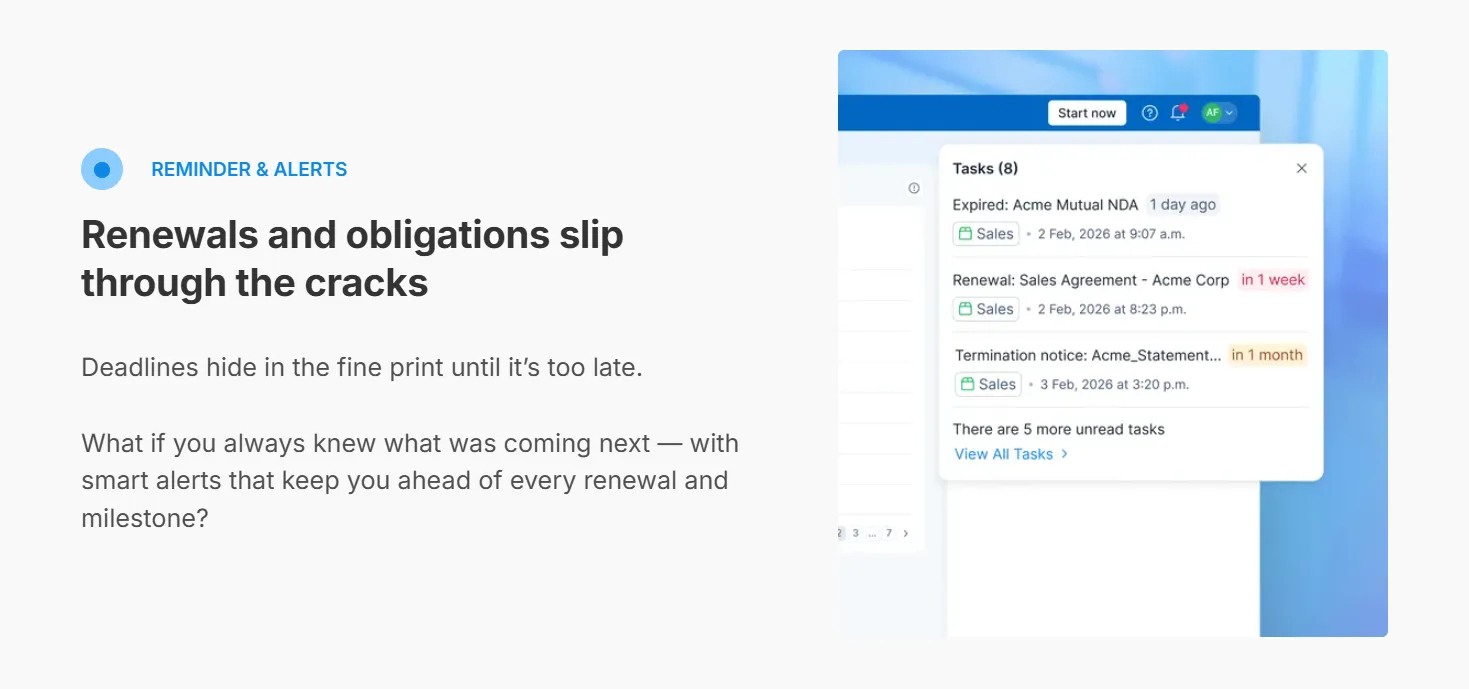
Renewals trigger notifications 60 days out. Performance milestones get flagged automatically. Contractual obligation due next quarter? Already on your radar.
Spreadsheet tracking fails because someone has to remember to look. Calendar reminders get dismissed. Contract management repositories monitor obligations continuously and surface upcoming deadlines before they become urgent.
5. Automatic audit trail
Contract changes get timestamped. All versions remain accessible, and every access attempt gets logged.
This happens automatically in modern platforms, not through manual version naming ("contract_final_FINAL_v3_USE_THIS_ONE.pdf") or change logs someone forgets to update.
During disputes or audits, you produce a complete history immediately instead of reconstructing events from memory and email archives.
Now that you know what modern repositories should do, here's how to build one for your organization.
Building your contract repository management system
Building an effective contract repository comes down to three key phases: understanding your current state, choosing the right intelligence capabilities, and migrating strategically. Let's break down each phase.
Step 1. Assess your current state
Before evaluating solutions, map your current reality. Pull finance, legal, sales, and procurement into a room and ask: where do our contracts actually live?
You'll likely discover 20+ locations. Email attachments. Shared drives with overlapping folders. The CRM where sales stores executed agreements. Individual desktops where people save "their" contracts. That one filing cabinet in legal.
Now identify your highest-risk gaps:
- Which contract types represent the most revenue or spend?
- Where have renewals slipped through in the past year?
- What agreements would paralyze operations if you couldn't find them during an audit?
Use a simple test: which contracts represent the most value and the biggest current gaps? A $5 million supplier agreement lost in email poses far greater risk than properly filed routine purchases.
Step 2. Choose intelligence over simple storage
All contract repository management platforms can hold files. That's table stakes. What separates functional contract repository management from expensive file cabinets is what happens after upload.
Does the system read your contracts and extract dates, parties, and obligations automatically? Can you search for specific clause types across your entire portfolio? Do teams share workspace with appropriate access controls? Will renewals and obligations surface proactively?
Signeasy's Intelligent Contract Management treats these capabilities as standard functionality, not add-ons. The system should work for you by reading contracts, extracting key terms, surfacing upcoming obligations, and organizing everything automatically, without requiring your team to become system administrators.
Integration is just as important. Contracts don't exist in isolation. Your repository should connect with (or have native) signature tools, accounting systems, and CRMs.
Step 3. Migration and adoption strategy
Migration done well means starting fresh with clean data and smarter processes.
Start with one high-value contract category. Maybe SaaS subscriptions where renewals catch you off-guard. Or vendor agreements where negotiated terms get lost. Pick something important enough to justify the effort but contained enough to finish quickly.
Clean as you migrate. That expired 2019 NDA? Archive it, don't migrate it. Duplicate versions scattered across systems? Identify the executed copy first. The goal is a system that works from day one.
The team that used to spend Friday afternoons tracking down contract terms now has answers before lunch. They tell colleagues. Usage spreads organically because the alternative becomes unthinkable.
Repeat the process with another contract category. Over time, checking the repository becomes reflexive.
After setting up a stellar system, expect these results.
Measuring repository management success
Track these metrics to gauge whether your contract repository is delivering value:
- Time savings: How long does it take your team to locate a specific contract or clause? Best-in-class organizations retrieve contracts in under 60 seconds.
- Obligation compliance: What percentage of renewals, deadlines, and performance milestones are you catching proactively versus discovering after the fact?
- Value erosion reduction: Measure the gap between expected and actual contract outcomes. Top performers keep this below 3%, while poor systems leak 15% or more.
- Contract cycle time: How long from initiation to signature? The best performers operate nearly 4 times the speed of the worst.
- System adoption rate: What percentage of contract-touching teams use the repository as their first resource instead of reverting to email and shared drives?
To see how these metrics translate to real results, look at Oncode Institute, a cancer research organization in the Netherlands. They used to lose days chasing signatures across multiple institutions. Multi-party agreements for collaborations and data-sharing sat in email threads while researchers waited to start projects.

After centralizing contracts in Signeasy with real-time tracking, their turnaround dropped from days to hours.
They stopped operating in the dark about document access. Automated notifications showed exactly where agreements stood at any point. Wrong email addresses got flagged immediately, before they could delay the process for weeks.
Second on the list is Ruwacon, a construction company managing complex multi-party projects across field and office locations.

Contract visibility used to be a constant struggle. Project agreements and subcontractor documents scattered across email threads and individual devices created delays and miscommunication.
After implementing Signeasy, field teams access agreements instantly from job sites while office staff track obligations without chasing physical copies. Contract retrieval that once took hours now happens in seconds.
Better contract repository management means better business outcomes. Not because they negotiate better terms, but because they can find those terms when decisions need to be made.
But it's also important to be aware of common mistakes companies make when implementing contract repositories.
Where contract repository management efforts usually go wrong
You can buy the best contract repository management tool on the market and still end up with low adoption and stale data. These four mistakes explain why:
The core problem behind most failures is that organizations treat contract repository management as an IT project instead of a business transformation. Get leadership involved early, focus on making users' jobs easier, and build maintenance into the process right from the start.
Getting contract repository management right for your business
Your contracts hold the answers. Volume discounts from last quarter's negotiations. Termination clauses protecting you from underperforming vendors. Payment terms that improve cash flow. But if your team can't find these when making decisions, they might as well not exist.
This article covered what separates functional repositories from basic document storage. Modern systems read and categorize contracts automatically, without manual tagging.
They understand legal language.
You search for specific clauses and get answers in seconds, not hours spent reading PDFs. Sales, legal, finance, and procurement work from shared workspaces without compromising security. Automated alerts catch renewals before accounting discovers unexpected charges.
Contract repository management turns negotiation work into searchable, actionable records your team can pull up when they need answers.
Map where your contracts live today and calculate what their invisibility costs. Then look at platforms built for intelligence, not simply storage. Signeasy's Intelligent Contract Management shows what modern repositories have to offer.
Request Demo and turn buried agreements into accessible business resources.