



PandaDoc reviews praise proposal creation and eSignature, but also mention formatting problems, feature restrictions, and pricing concerns. Those experiences affect teams differently depending on whether they build sales proposals or send finished contracts.
This PandaDoc review examines current plans and customer feedback, explains which PandaDoc reviews highlight problems worth testing, and shows when Signeasy fits a signing-focused workflow.
If you're already considering a switch, the PandaDoc alternatives guide compares 13 options for eSignature, proposal creation, and document workflows.
How did we review PandaDoc?
To assess PandaDoc reviews, we compared current pricing, plan features, and help documentation with customer feedback from G2, Capterra, and TrustRadius. We used publicly available sources for this review and checked feature availability separately from individual customer experiences.
Instead of treating one positive or negative PandaDoc review as a product-wide conclusion, we organized the feedback around the work a user actually performs: creating a document, reusing a template, collecting signatures, tracking a send, and building a quote. We also checked current plan access before describing a feature as unavailable.
PandaDoc currently holds a 4.7/5 G2 rating and a 4.5/5 Capterra rating.
What is PandaDoc and what are its main features?
PandaDoc is a document platform for creating, sending, signing, and tracking business documents. Its feature set is especially relevant to sales teams that want to build a proposal or quote, send it to a customer, follow engagement, and collect the signature without moving the document between several tools.
PandaDoc includes a drag-and-drop editor, reusable templates, eSignatures, Quote Builder, tracking, approval workflows, content libraries, CRM integrations, web forms, and sales workflow tools. However, PandaDoc’s core features are distributed across different plans. Full Quote Builder, approval workflows, and content libraries require Business or Enterprise, while web forms, Bulk Send, and some document automation workflows carry additional charges.
PandaDoc reviews often praise how sales reps can create proposals, add pricing, send documents, and track customer engagement in one place. That convenience comes from its document generation and sales workflow features, which HR and operations teams sending finished contracts may rarely use.
Already receiving finished contracts from Sales or HR? We'll show you how Signeasy adds signer fields, sends the document, and tracks completion without a proposal editor.
What do PandaDoc reviews say about its document editor?
PandaDoc’s editor brings text, media, pricing, fields, and signatures into one workspace. It can help sales teams produce editable contracts and proposals with minimal manual formatting when the layouts are straightforward.
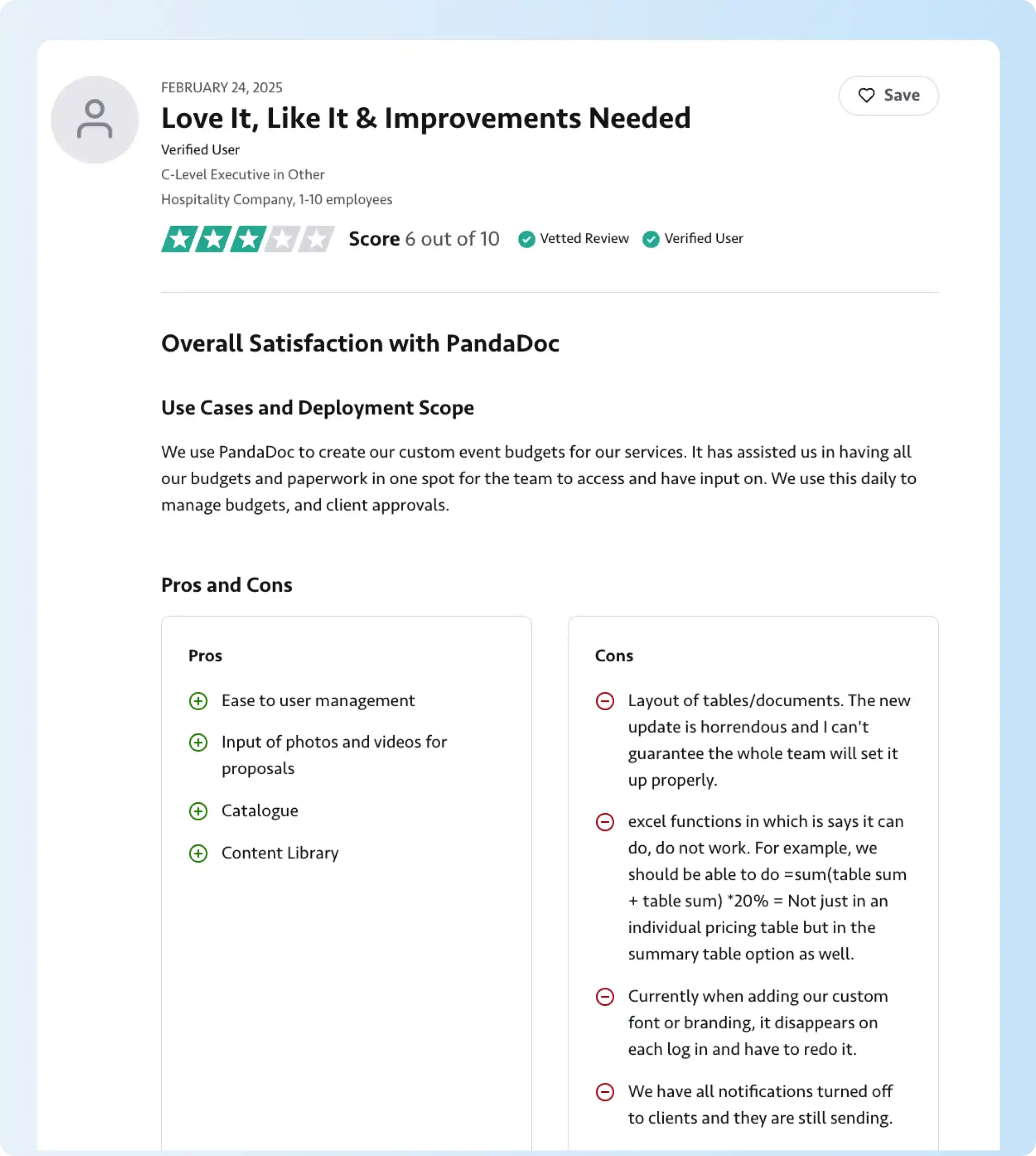
More involved documents expose the rougher edges. One team using PandaDoc for event budgets liked having content, media, and client approvals together, but ran into problems with table layouts, calculations, branding, and page breaks. Tables could overlap when moved, while custom fonts sometimes had to be added again after logging back in.
Test the editor with the sales documents your team actually prepares, especially files containing complex pricing tables and branded layouts. Check whether you can make corrections inside PandaDoc or need external tools to finish the job. Teams working with prepared documents can also create a fillable PDF and add signing fields without rebuilding the document in a proposal editor.
Pros
- Create proposals and customer documents in one workspace.
- Add media and reusable content without moving between tools.
- Keep document preparation and approval work together.
Cons
- The reviewer had to adjust tables and page layouts manually.
- One reviewer reported problems combining totals across multiple pricing tables.
- The reviewer had to reapply custom fonts after logging in.
Are PandaDoc templates useful for recurring documents?
Yes. PandaDoc reviews describe reusable templates as useful when teams repeatedly send the same contracts, forms, or sales proposals. Reusing a template reduces the need to prepare each first draft from scratch, although template limits and formatting problems can still create manual work.
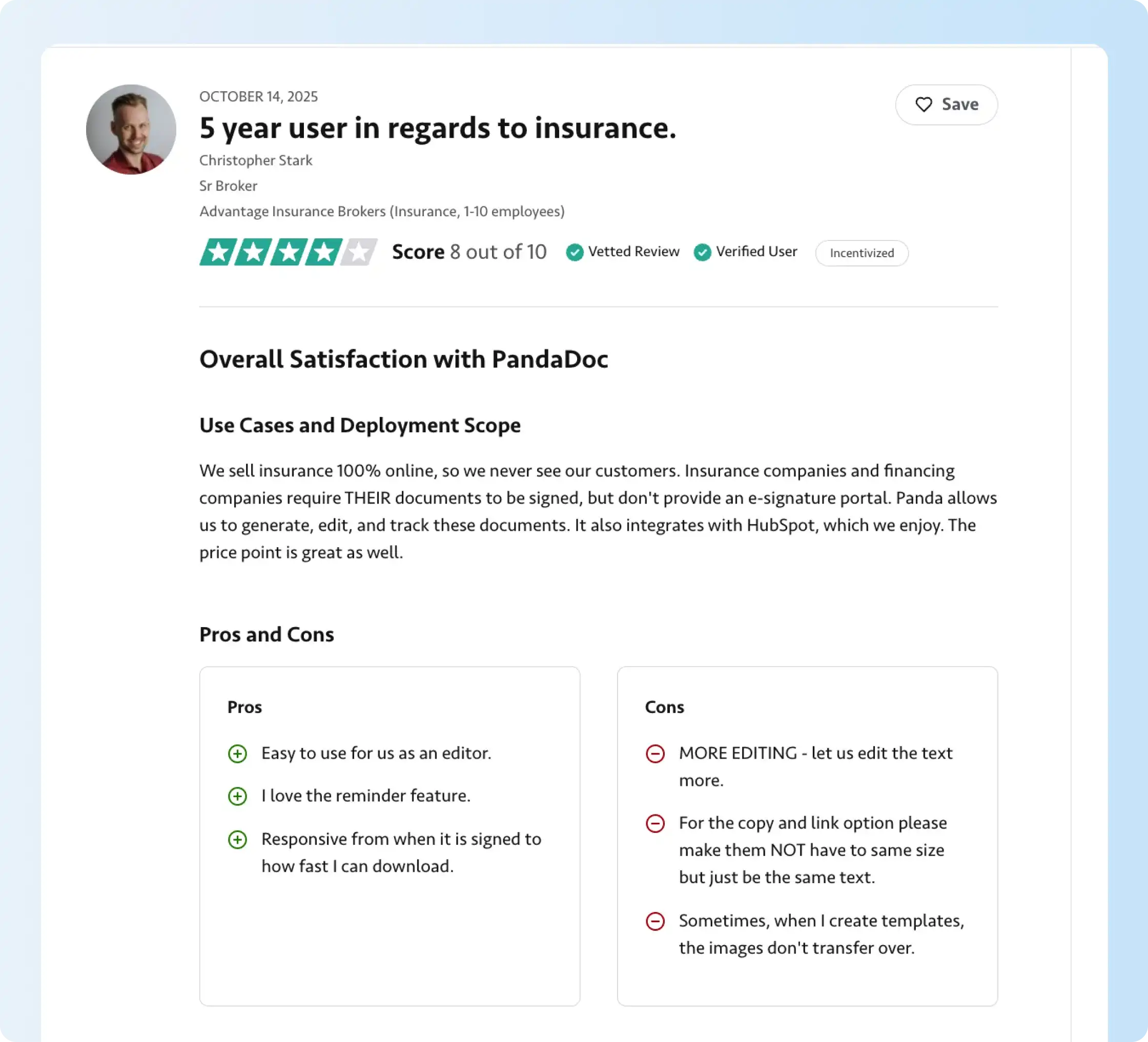
That reuse still needs testing with the content inside the template. In one long-term workflow, templates helped speed up repeat document creation, but images did not always carry over as expected and the user wanted more flexibility when editing text.
Build more than one template during the trial. Compare a simple agreement with dynamic contracts that include images, changing clauses, and customer contact details.
Pros
- Reuse recurring documents instead of rebuilding them.
- Reduce preparation time across repeat sends.
- Keep common content available for the team.
Cons
- Templates needed checking for missing images.
- A reviewer reported that images sometimes failed to transfer into new templates.
- The reviewer wanted more flexibility when editing template text.
Sending the same contracts each week? We'll demonstrate Signeasy templates, including saved signer fields and signing order, with one of your actual files.
Does PandaDoc handle eSignatures well?
Yes. PandaDoc reviews describe an everyday signing workflow for outgoing documents: teams can prefill forms, send them by email or link, and collect signatures remotely. For legal contracts with different security needs, check signer identity options, audit trails, and applicable signature requirements to reduce legal risk.
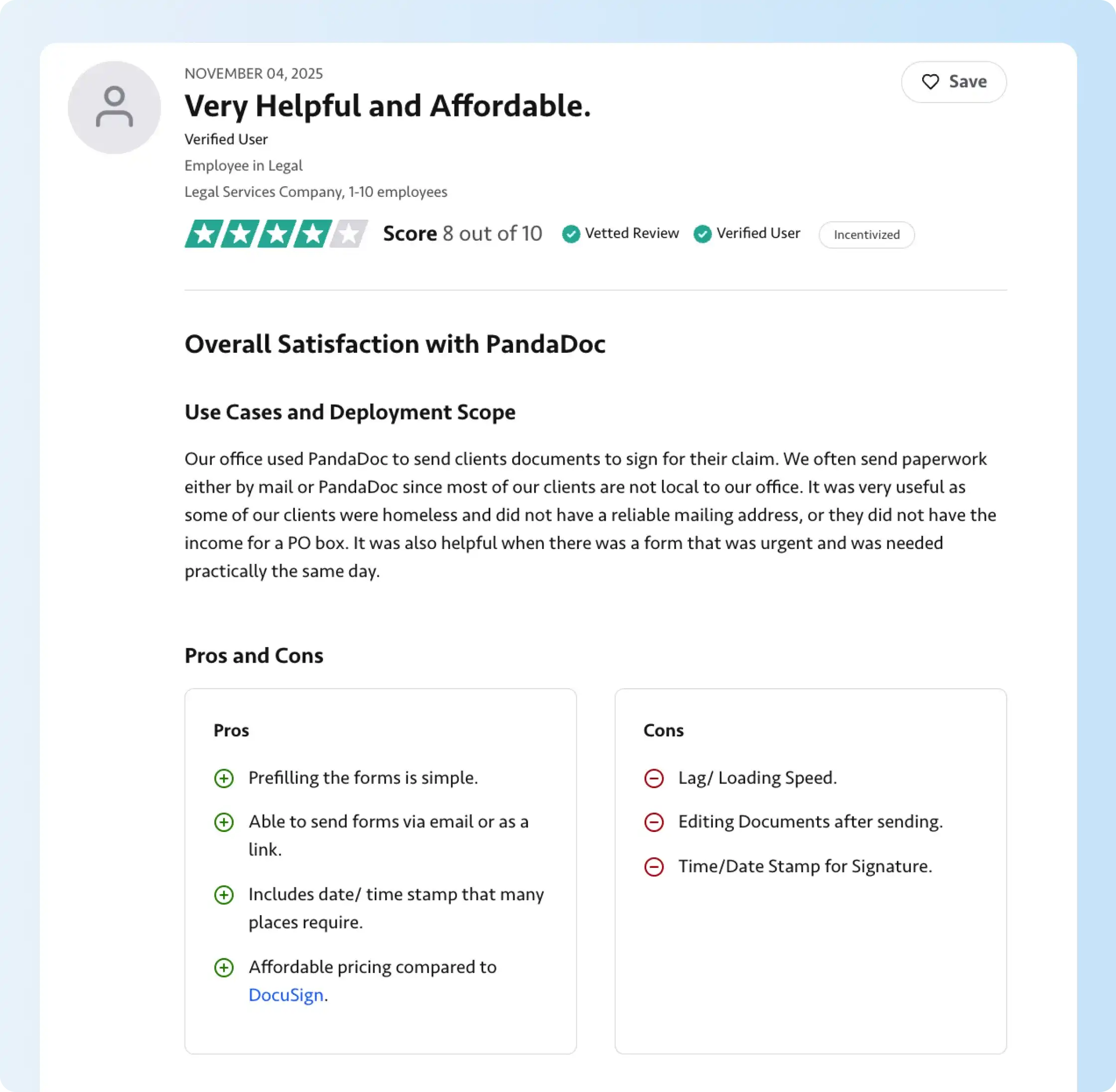
Editing a document after sending can be difficult. A legal-services team found PandaDoc useful for urgent paperwork but reported slow loading and difficulty making changes to sent documents. The team also stopped using it for a Social Security workflow after encountering a requirement for the time and date to appear with the signature in a specific way.
Teams with specific signature requirements or frequent last-minute corrections should test those situations before rollout. For sensitive contracts, check signer verification and the electronic signature standards applicable to your documents. If the file is already prepared and only needs signatures, our guide to electronically signing a PDF covers that process without proposal-building software.
Pros
- Prefill forms before sending.
- Send documents through email or direct links.
- Handle urgent signature requests without physical paperwork.
Cons
- The reviewer found editing documents after sending difficult.
- The reviewer reported slow loading.
- Workflow-specific signature requirements need testing.
Are PandaDoc tracking and notifications useful?
Yes. PandaDoc reviews describe tracking as useful for seeing when outgoing documents are opened, signed, or left pending. That helps sales teams prioritize follow-ups. If you also need renewal tracking across an entire contract portfolio, test that separately from signature-status tracking.
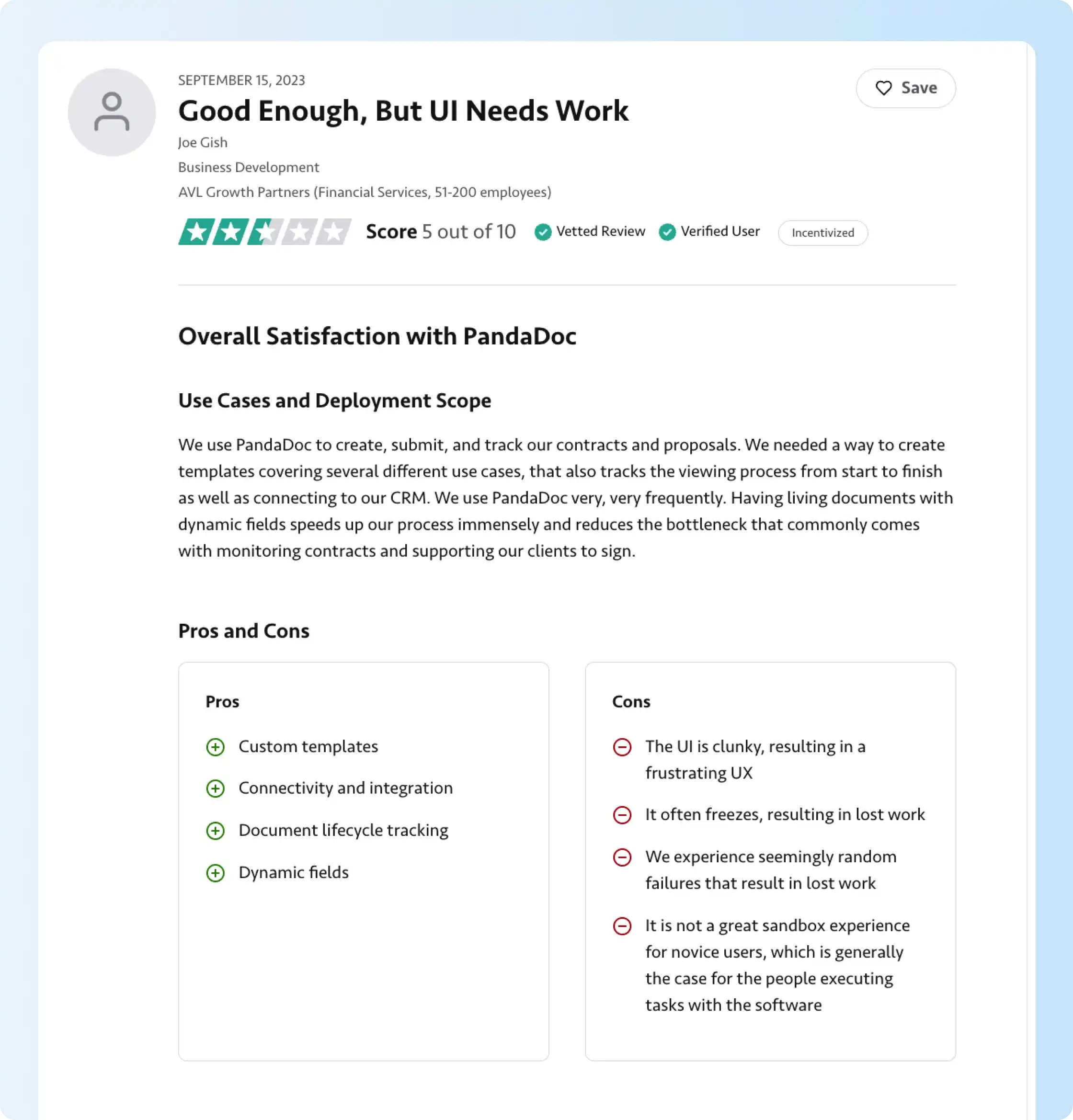
One 2023 reviewer appreciated PandaDoc's document tracking, dynamic fields, and integrations but also reported interface freezes that caused lost work. The experience highlights a workflow worth testing, although an older review doesn't establish how reliably the product performs today.
Test tracking as deals progress. Send several sales documents, make a correction, trigger a reminder, and check whether the activity history follows each file through signature. Send a proposal, make a correction, involve an approver, trigger a reminder, and check whether those steps work inside PandaDoc or still require external collaboration tools. When comparing electronic signature software, check how each product handles those steps instead of relying only on document-open notifications.
Pros
- Follow documents through the signing lifecycle.
- Use reminders to bring recipients back to pending documents.
- Connect tracking with dynamic document workflows.
Cons
- Editing friction can slow the workflow around tracking.
- The reviewer reported freezes and lost work.
- More involved documents can require additional training.
Want to see how Signeasy handles signature tracking and reminders? Bring a document your team regularly sends, and we'll walk you through the workflow.
How well does PandaDoc handle quotes and pricing?
PandaDoc is useful for sales teams building proposals with customer-specific pricing. Quote Builder brings product listings and pricing tables into the document, so sales reps can prepare quotes and collect signatures in the same workflow. During the trial, test how pricing changes and quote revisions appear as deals progress toward approval. Teams mainly uploading completed contracts may have little use for these features.
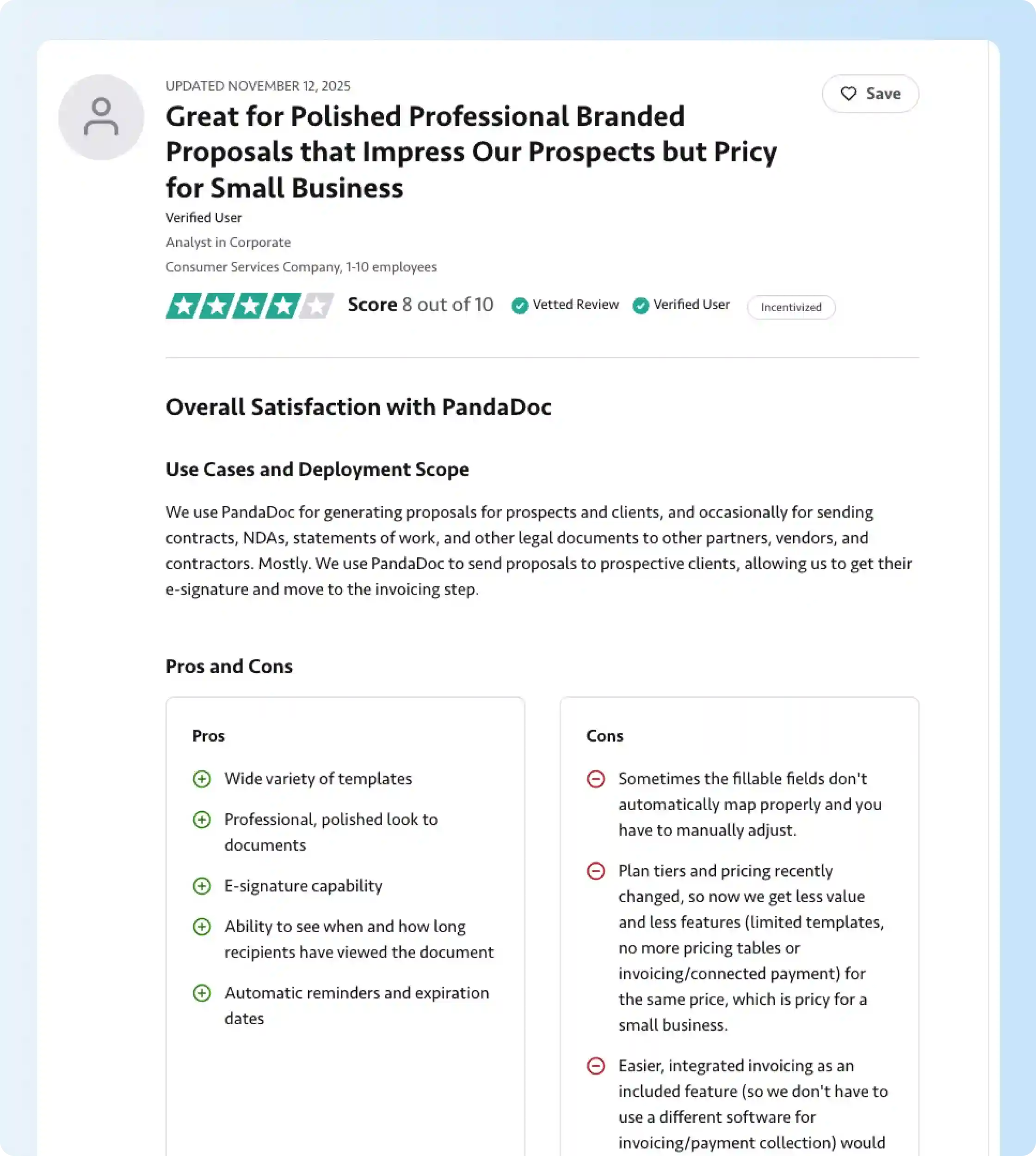
A 2025 PandaDoc review described this cost problem directly. The user liked the branded proposals, templates, document tracking, and reminders but felt that plan changes had reduced the features available at the same price. The reviewer specifically mentioned template limits, pricing tables, and connected invoicing. PandaDoc has since changed parts of its quoting experience, but full Quote Builder and product catalogs remain Business and Enterprise features.
A sales team preparing custom quotes can benefit from document automation, especially when pricing changes during long procurement cycles. Teams receiving completed legal contracts from another system may struggle to justify the same subscription cost.
Already preparing contracts elsewhere? We'll show you how Signeasy handles signer fields, signature requests, and tracking.
Pros
- Build priced proposals and collect signatures in one workflow.
- Track buyer engagement after sending.
- Reuse proposal content across deals.
Cons
- Full Quote Builder, unlimited templates, and product catalogs require Business or Enterprise.
- The reviewer reported losing access to features after changes to PandaDoc's plans.
- PandaDoc's higher tiers include proposal and quoting features that signing-focused teams rarely use.
Is PandaDoc easy to use?
Yes. PandaDoc is easy to use for common document creation, sending, signing, and tracking tasks, while more involved layouts, quote configuration, and connected sales workflows take more setup.
That balance appears throughout PandaDoc reviews. Users repeatedly praise the interface, document editor, eSignatures, and templates. G2 currently gives PandaDoc an ease-of-use score of 9.2/10 in several relevant categories, while Capterra lists ease of use at 4.4/5.
A useful trial should test the people who will work in the product after rollout, not only the person evaluating it:
- Set up one document your team already sends.
- Ask another sender to find the template, edit it, and send it without help.
- Correct a real document error and check how quickly the user recovers.
- Find the completed copy and confirm that the next person in the workflow can locate it.
- Test a quote or CRM-connected workflow if those features are part of the reason for buying PandaDoc.
Those checks tell you more about how PandaDoc will work for your team than relying only on PandaDoc reviews or watching a polished demo. Test the intuitive user interface alongside the harder tasks, including editing detailed documents, correcting fields, and working with CRM-connected templates.
Rolling signing out to several employees? We'll show how Business Pro handles repeat templates, internal approvals, and team permissions so you can test the sender experience.
Does PandaDoc pricing match the features you get?
PandaDoc pricing is easier to justify when proposal generation is a regular part of preparing sales documents, alongside quoting, internal approvals, and CRM-connected workflows. Teams mainly sending approved contracts should compare that broader feature set with the cost of a signing-focused workflow.
PandaDoc's current plan comparison lists 5 documents per month on Free, with up to 2 recipients per document. Some older Free accounts may have a 60-document annual allowance, so check which limit applies to your account. PandaDoc Starter costs $19 per user per month with annual billing or $35 with monthly billing. PandaDoc Business costs $49 or $65 per user per month on those respective billing terms, while PandaDoc Enterprise uses custom pricing.
Business adds full Quote Builder, CRM integrations, custom branding, content libraries, approval workflows, and reporting. That $49 per-user monthly rate does not include every feature in the product. Web forms, Bulk Send, redlining, and content locking can require additional charges. External automations also have separate pricing on Business, while Enterprise includes broader legal workflows, SSO, and team workspaces. Some CPQ and automation functions still use paid add-ons or usage credits. If you need full control over product tables, approval routes, or pricing strategies, confirm which features are included in your chosen plan.
A $19 Starter seat and a $49 Business seat support different approaches to document preparation. Business adds quoting and CRM-connected features that can be useful during long procurement cycles. HR, finance, and operations teams mainly sending finished contracts should check whether the upgrade is worth the added cost.
When is Signeasy a better PandaDoc alternative?
Signeasy fits growing businesses that mainly need to send, sign, and track prepared contracts. For teams reading PandaDoc reviews because of price changes, template issues, or editing frustrations, that focused eSignature workflow avoids paying for proposal-generation features they rarely use. If your team also needs drafting, negotiation, and renewal management, evaluate those requirements separately from the eSignature workflow.
Sales, HR, finance, procurement, and operations teams can use Signeasy to upload prepared legal contracts, add signer fields, set signing order, and track outgoing documents. They keep full control of drafting in their existing tools while Signeasy handles signing. Through Google Drive, they can also work with contracts without repeatedly downloading and uploading files between systems.
Signeasy Business costs $20 per user per month with annual billing and includes unlimited document sending, five reusable templates, reminders, and team administration. Business Pro costs $30 per user per month with annual billing and adds unlimited templates, roles and permissions, usage reports, recipient verification, approval workflows, and SharePoint integration. HubSpot is available on Business Pro for an additional $20 per user.
PandaDoc reviews show why proposal-heavy sales teams value its editor, quoting, and engagement tracking. Those are legitimate strengths. For teams creating proposals in external tools, compare how smoothly each platform handles the finished contract and its signature request.
Here is the comparison at the workflow level:
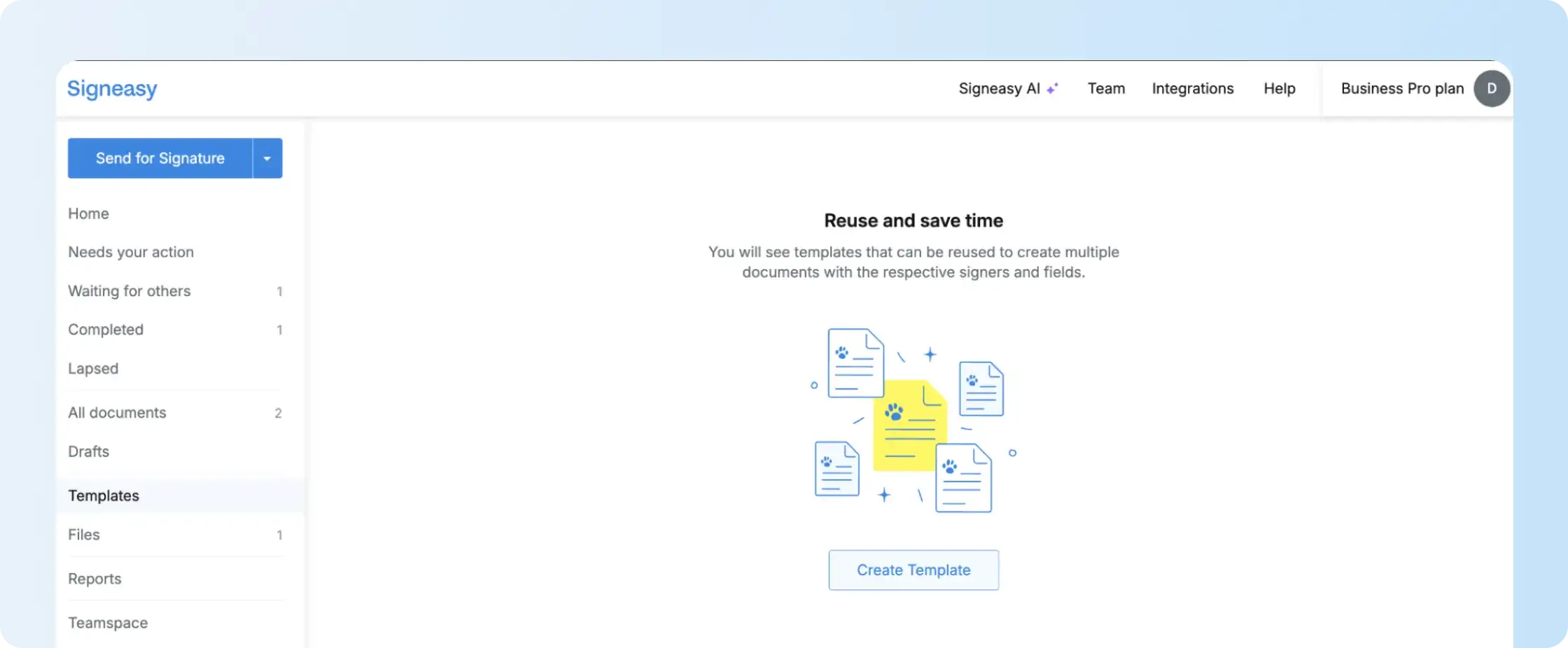
Signeasy's reusable templates help teams send recurring contracts without setting up signer fields and signing order each time. Business users can create up to five templates, while Business Pro supports unlimited templates.
For a closer comparison of pricing, features, and team workflows, see our Signeasy vs. PandaDoc comparison. You can also read Signeasy reviews to see customer feedback on usability, pricing, and support.
Already using PandaDoc? We'll help you switch
Switching platforms takes planning when your team has existing templates, signing workflows, and integrations. Signeasy offers white-glove migration assistance and a competitor contract buyout program for qualifying switches. Eligibility and coverage depend on your current contract. If your team uses PandaDoc for drafting or negotiation, plan where those steps will happen after migration.
If you use PandaDoc's proposal editor or Quote Builder, those workflows will still need a separate tool. We'll walk you through the migration process, explain what the buyout covers, and help you plan the switch.