



Two companies just paid $7.5 million each — in separate settlements — because their contract review processes missed critical automatic renewal clauses.
HelloFresh and Chegg both failed to catch compliance issues that AI contract review software is specifically designed to detect. HelloFresh missed inadequate consent mechanisms in their automatic renewal clauses, while Chegg overlooked non-compliant cancellation terms.
Their legal teams weren't negligent. They were buried under hundreds of contracts while regulations kept changing. Manual review at 3-4 hours per contract simply can't keep pace when compliance rules shift across different states and countries.

Source
The best contract review AI tools can cross-reference contracts against current regulations, flag non-compliant language, and surface risks that human reviewers miss under time pressure.
But which contract review AI tools actually deliver reliable legal analysis? We compared 10 platforms to find out.
What you’ll get:
- What AI contract review software is and how it works
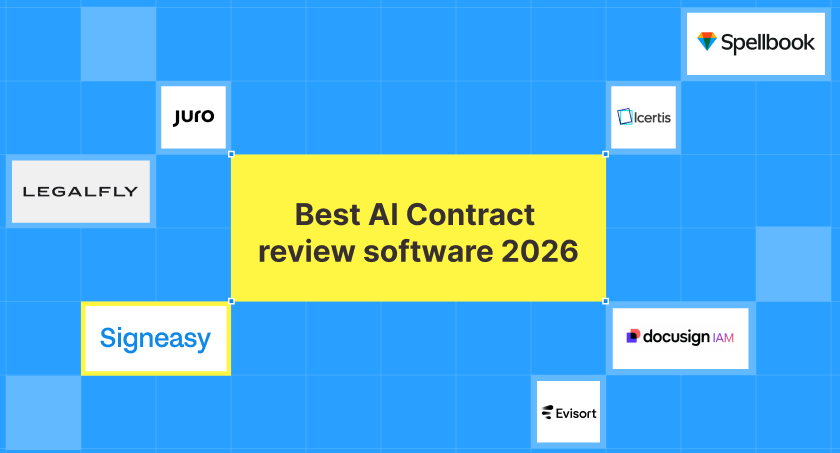
- Top 10 AI contract review platforms for 2026
- Key benefits and realistic challenges of using AI for contract review
- How to choose and deploy the right platform for your legal team
What is AI contract review software?
AI contract review software uses artificial intelligence to analyze, extract, and evaluate information from legal agreements. These contract review AI tools automatically identify key clauses, flag potential risks, and suggest revisions based on your company's standards and legal requirements.
Manual contract review requires lawyers or compliance teams to read every line of a document - a workload that quickly becomes unmanageable without enterprise contract management built for high contract volumes. AI contract review software scans the same documents in seconds. And with tools that let you create digital signature online, reviewed contracts can move straight to execution without delays.
The technology uses natural language processing to understand contract language, compare terms against your playbook, and highlight clauses that need attention. AI learns from your previous reviews, becoming more accurate at spotting problematic clauses and suggesting redlines that match your preferences.
This works across all common agreement types — from NDAs and vendor contracts to employment agreements and SaaS terms.
But how does this technology analyze contracts so quickly?
How AI contract review software works
AI contract review software uses natural language processing, machine learning, and your company’s contract standards to process agreements in seconds instead of hours. It follows six steps that turn uploaded documents into useful contract intelligence:
1. Document upload and processing
You upload contracts in various formats (PDF, Word, or scanned documents). The AI uses optical character recognition (OCR) to convert documents into machine-readable text.
2. Natural language processing (NLP)
The software analyzes contract language to understand context, identify clauses, and extract key terms like payment schedules, termination conditions, and liability limits.
3. Smart extraction and summarization
The AI automatically extracts critical terms and generates summaries, giving you instant visibility into agreement details.
4. Intelligent Q&A
Ask questions in natural language about your contracts and get instant answers, eliminating manual document searches.
5. Contract repository and tracking
Contracts are organized in a searchable repository with automated renewal reminders and milestone tracking - exactly what contract renewal management is built to handle, keeping expiry dates from slipping past unnoticed.
6. Learning and improvement
As you accept or reject suggestions, the AI learns your preferences and becomes more accurate over time, adapting to your specific review patterns and risk tolerance.
Note: Feature availability varies by platform. Review specific product capabilities to ensure they match your requirements.
How we sourced our data
To provide accurate recommendations, we reviewed each platform's official website, technical documentation, security certifications, and AI capabilities. We analyzed verified user reviews from G2, Capterra, and Trustpilot, examining feedback from legal teams, compliance officers, and procurement professionals.
We also studied Reddit discussions from r/legaltech, r/Lawyertalk, and r/procurement to understand real-world implementation challenges and user experiences beyond curated testimonials.
Our evaluation focused on AI accuracy, integration capabilities, ease of use, pricing transparency, and data security. This approach saves you hours of research and helps you find contract review AI tools that meet your legal, compliance, and operational requirements. If cost is your starting point, our guide to contract management software pricing breaks down the models and the fees vendors don't advertise.
Now let's compare the platforms that do this best.
Top AI contract review software for 2026
We evaluated AI contract review platforms based on accuracy, integration capabilities, pricing transparency, and verified user feedback from legal teams. Here's how the top 10 solutions compare across key criteria:
Over to the full breakdown in no particular order.
1. Signeasy AI
Signeasy AI combines intelligent contract review capabilities with comprehensive workflow management, perfectly suited for midsize to enterprise businesses that need more than just document analysis.
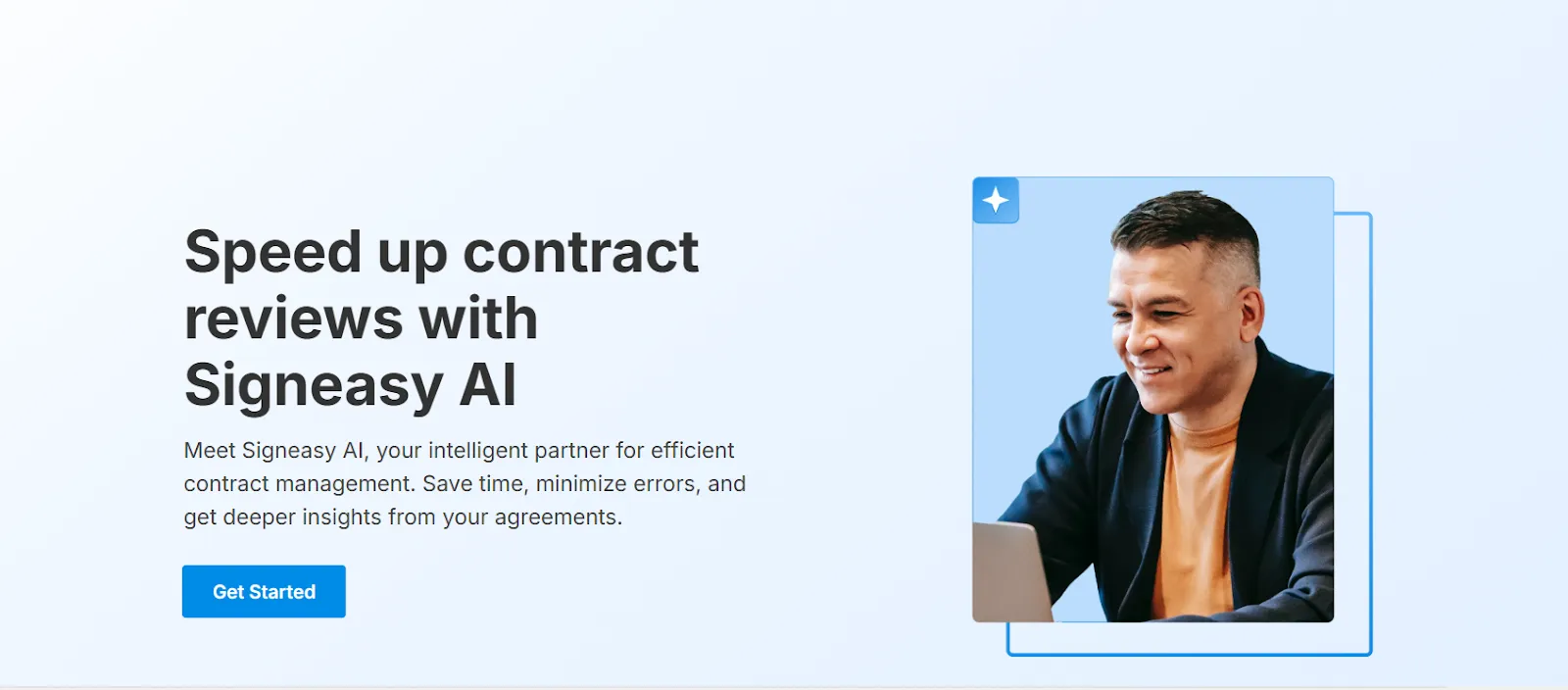
The platform extracts key contract terms, answers contract-specific questions through AI-powered Q&A, and manages the entire agreement lifecycle from creation to signature.
Signeasy’s key features:
- Smart Q&A for instant contract insights — search contracts by clauses, dates, and obligations in seconds, not hours
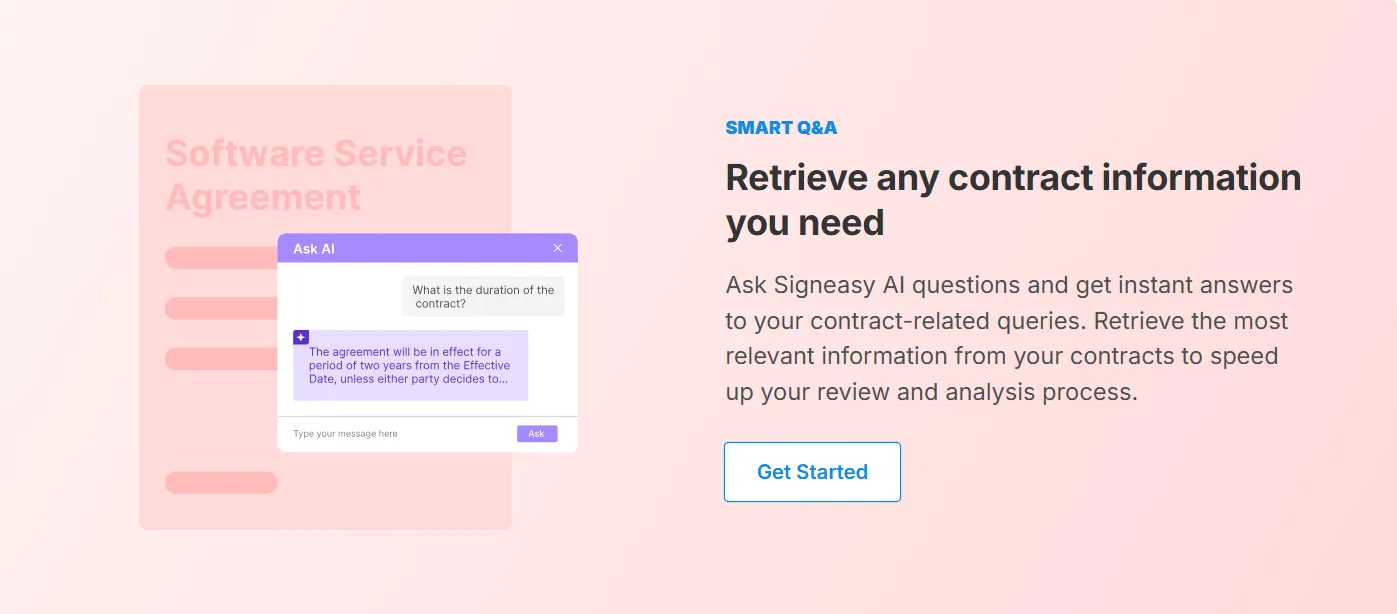
- AI-powered key terms extraction and contract summarization
- Native embedding in Google Workspace and Microsoft 365 workflows
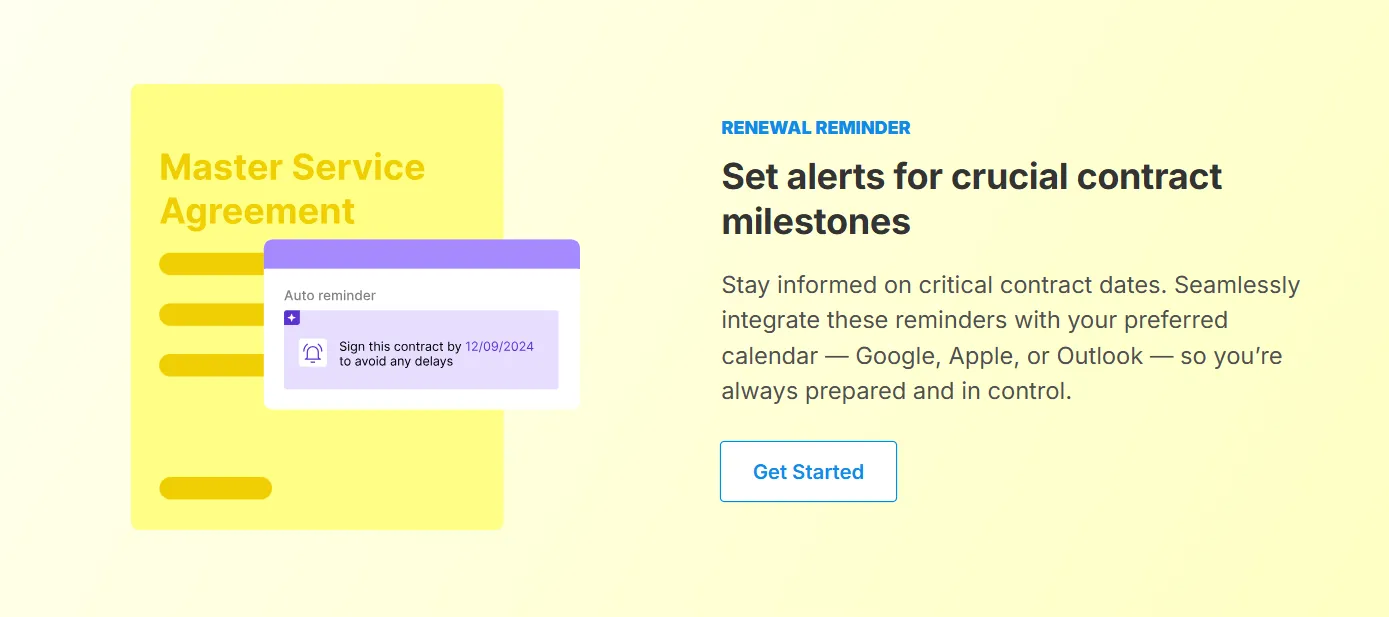
- Automated renewal reminders with Google, Apple, and Outlook calendar integration
- Secure document management with Trust Seal for tamper detection
- Multi-document envelope support for complex agreements
- Mobile-friendly access across iPhone, iPad, and Android devices
Signeasy’s pros:
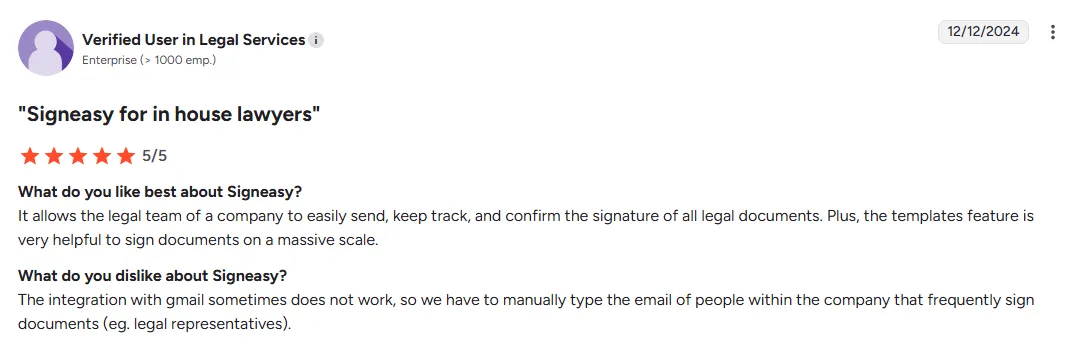
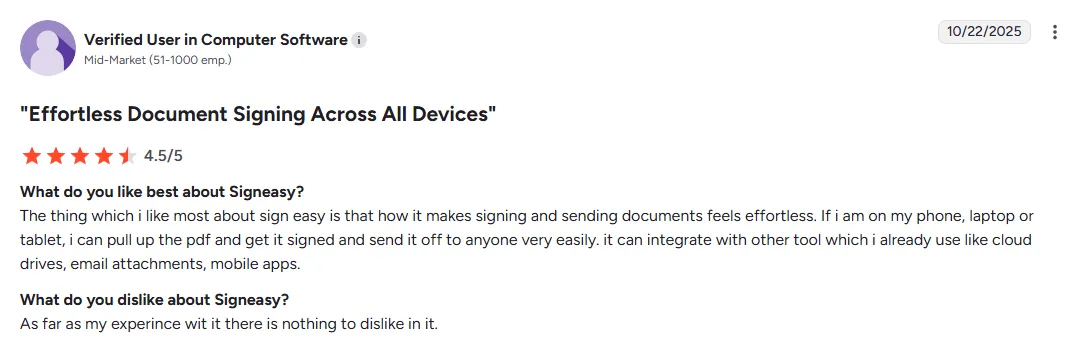
- Users praise the platform's ease of use, with one legal team member noting it "allows the legal team to easily send, keep track, and confirm signatures"
Source
- Users highlight the exceptional value proposition, with the platform combining eSignature and AI review at $20/user/month, significantly less than enterprise alternatives.
- Teams appreciate the strong mobile capabilities, noting that the full-featured iOS and Android apps enable signing and reviewing documents on the go.
Source
- Users report responsive support, with 24/7 email assistance and quick resolution times.
- The platform offers flexible deployment, with users experiencing quick setup — often same-day — without extensive IT involvement.
Signeasy’s cons:
- Some users note that Gmail integration occasionally requires manual email entry for frequent signers

Source
- The platform has fewer enterprise workflow features, with users noting it's less robust than dedicated CLM platforms for complex approval chains or bulk operations.
Signeasy’s pricing:
Signeasy structures its pricing around complete contract management workflows, with AI contract review capabilities available starting at the Business tier.
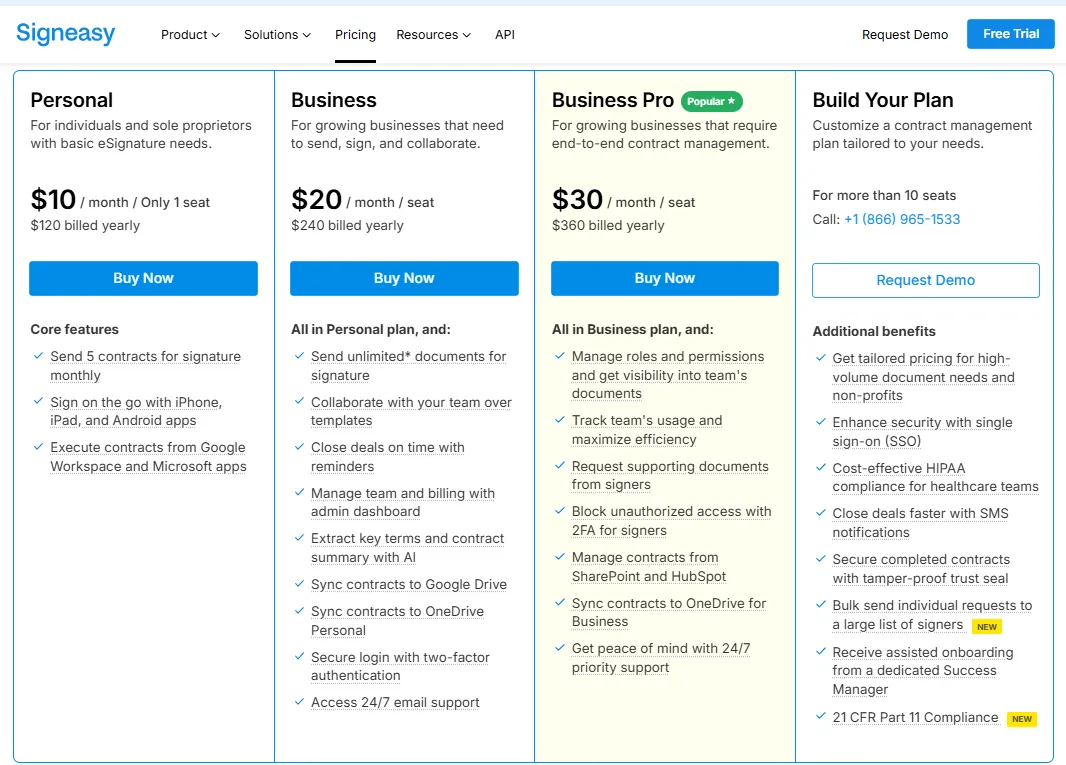
a. Business plan at $20/user/month (billed annually):
- AI-powered key terms extraction and contract summarization
- Smart QA for instant contract insights with natural language queries
- Team collaboration on contract templates
- Automated renewal reminders with calendar integration
- Admin contract management dashboard for contract tracking and oversight
- Google Drive and OneDrive sync for centralized document management
- 24/7 email support
b. Business Pro plan at $30/user/month:
- All Business plan AI and contract features
- Role-based permissions for legal team access control
- Usage analytics to track contract review efficiency
- SharePoint and HubSpot integrations for enterprise document workflows
- Request supporting documents during contract review process
- Automated approval workflows for multi-stage contract reviews (add-on)
- Priority 24/7 support with faster response times
c. Enterprise "Build Your Plan" pricing:
For legal teams with specialized requirements:
- High-volume contract processing with custom document limits
- HIPAA compliance for healthcare agreements
- FDA 21 CFR Part 11 compliance for life sciences contracts
- Single sign-on (SSO) for enterprise security standards
- Bulk sending for mass contract distribution
- Dedicated Success Manager for implementation and training
- Non-profit pricing with exclusive discounts
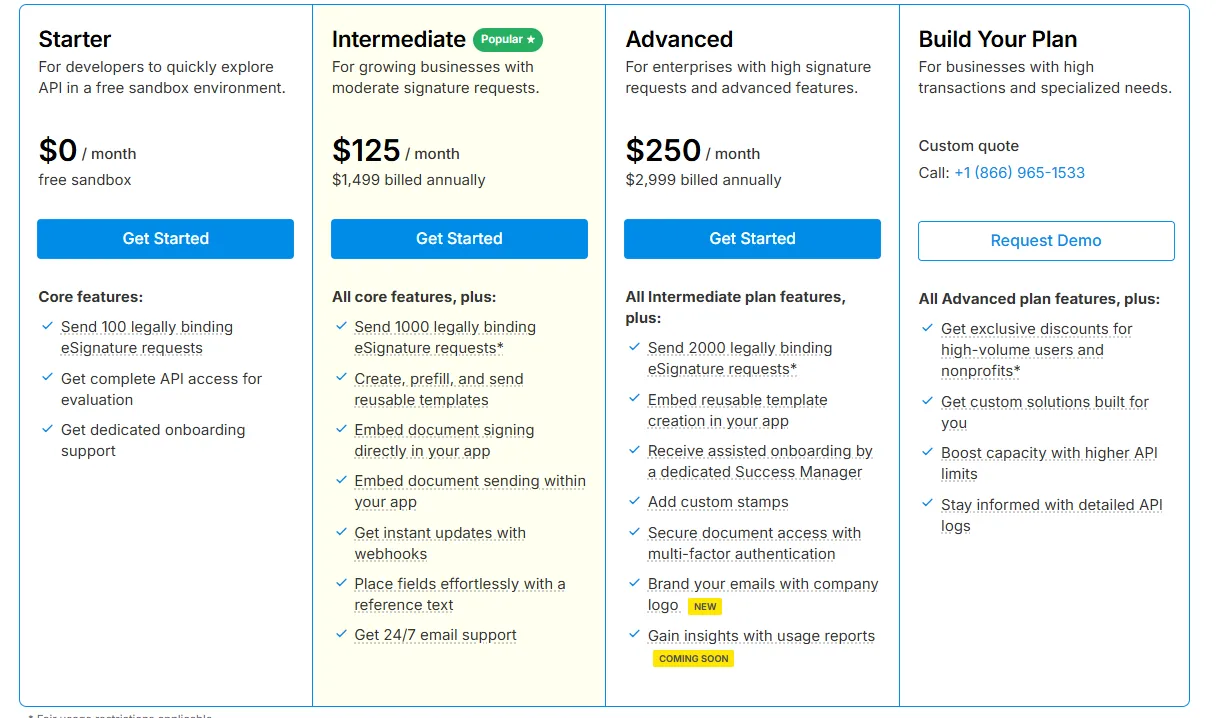
API access is available for organizations building AI contract review directly into existing legal tech stacks, with plans starting at $125/month for 1,000 requests.
All plans include a 100-day money-back guarantee, allowing legal teams to test AI contract review capabilities risk-free before committing long-term.
Best for:
Midsize organizations seeking an end-to-end contract management platform that combines AI review, collaboration, and eSignature without juggling multiple systems.
Why it stands out:
Signeasy AI goes beyond point solutions focused solely on AI review by delivering complete contract management.
You can review contracts with AI, collaborate with teams, send for signatures, and manage renewals — all within one intuitive platform that users consistently rate as "effortless" and "easy."
For example, SOHAR Port and Freezone reduced contract processing time by 80%, with IT Applications Officer Said Al Mamari noting:
"Signeasy helped us save time and manage our documents more efficiently. We streamlined the signing process across all levels — departments, managers, CEOs."
2. LEGALFLY
LEGALFLY is a secure, agentic AI workspace built specifically for in-house legal, compliance, and procurement teams.
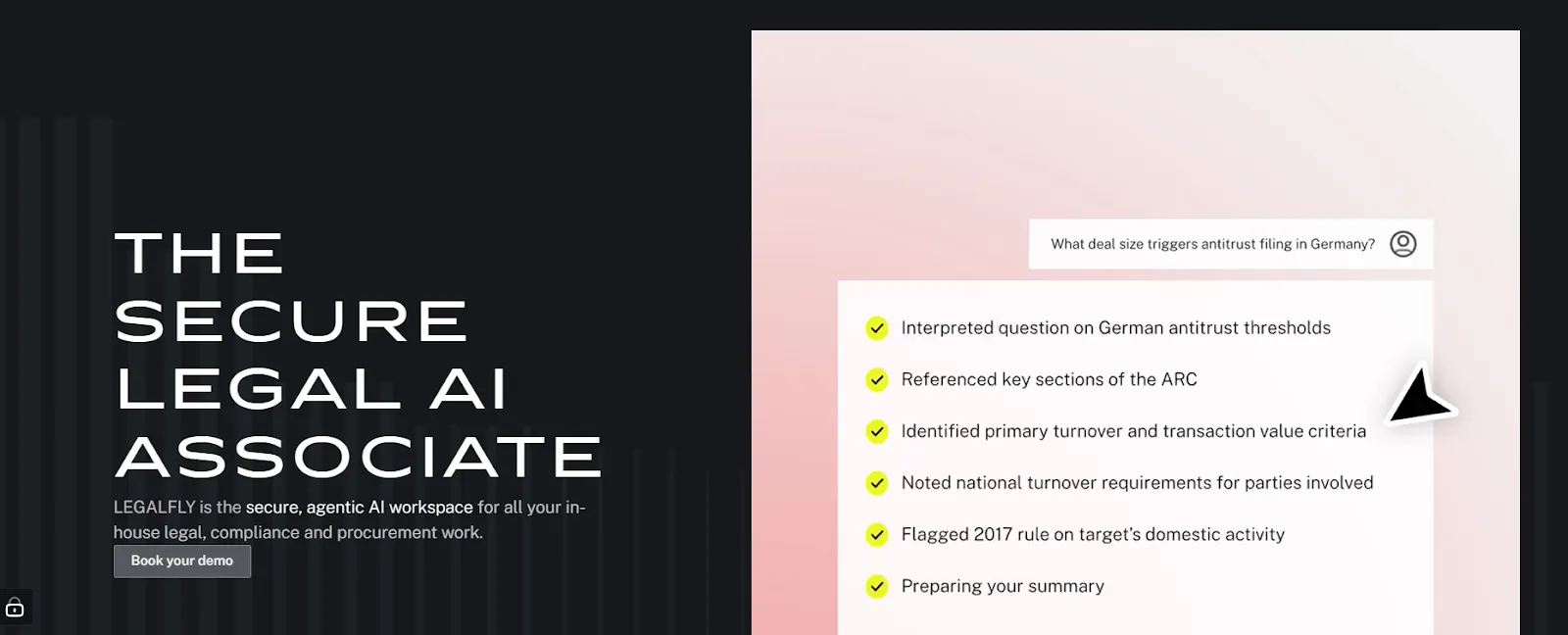
LEGALFLY's standout feature is its data anonymization capability that removes sensitive information before AI processing begins, which keeps confidential data away from large language models.
LEGALFLY’s key features:
- Contracting agents for document review, drafting, and comparison
- Compliance agents with multi-review functionality and legal radar monitoring
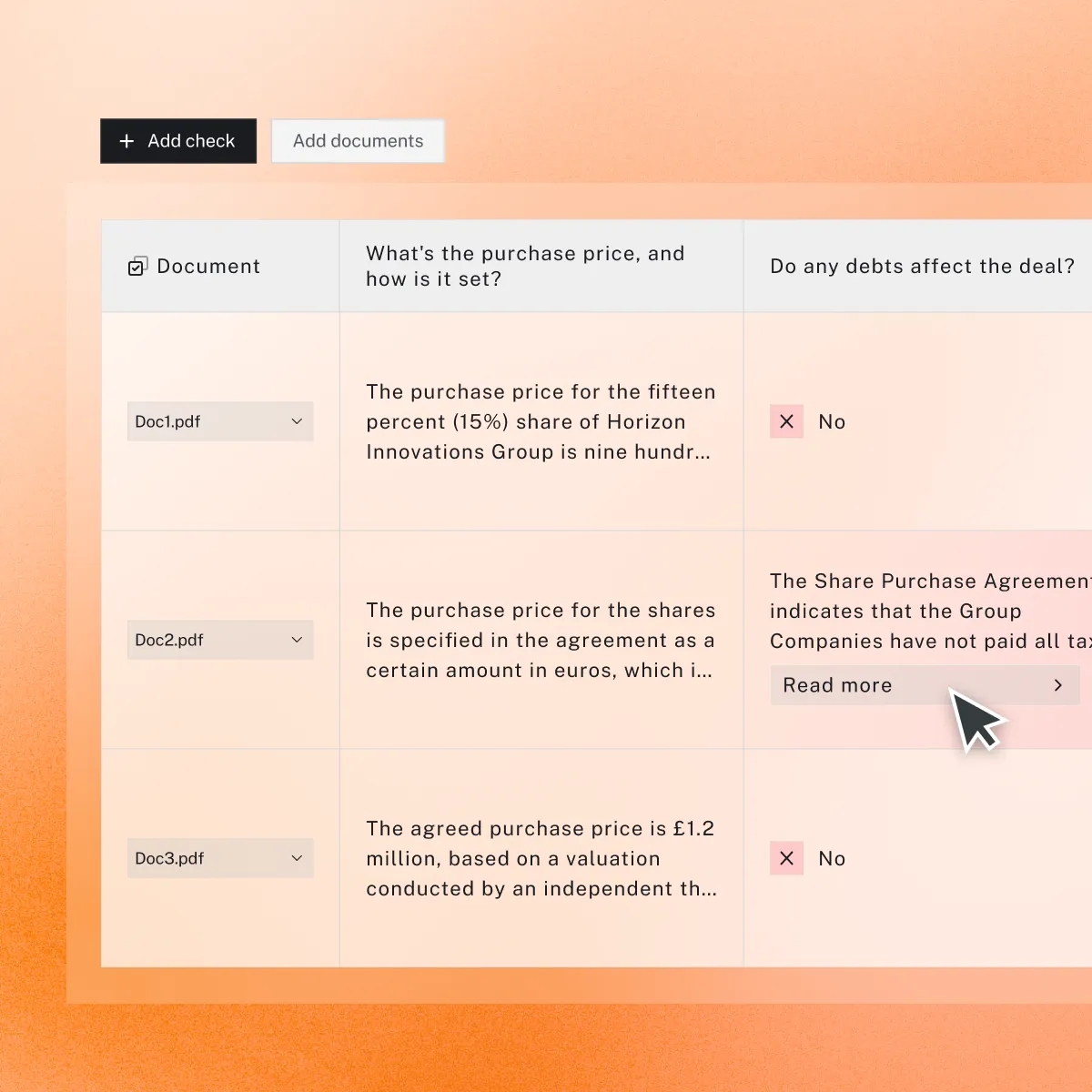
- Discovery tool for querying internal policies and external law with cited sources
- Custom agent creation for specialized workflows
- Native anonymization that protects confidential data during AI processing
- Microsoft integration with Copilot, Word, SharePoint, Outlook, and Teams
LEGALFLY’s pros:
- Purpose-built for in-house teams rather than law firms, with workflows designed for corporate legal departments
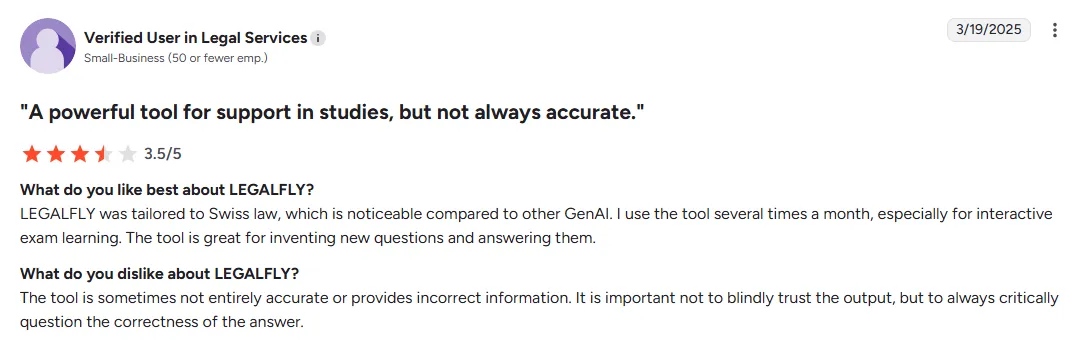
- Users report the platform is "great for inventing new questions and answering them" and interactive learning
Source
- Responsive support team that actively listens to customer feedback
LEGALFLY’s cons:
- References to legislation sometimes cite outdated versions or incorrect articles
- Tool occasionally struggles with precise jurisdictional information and deadlines
- Translation service still in beta and needs refinement
LEGALFLY’s pricing:
Custom pricing based on team size and requirements. Contact sales for demo and quote.
3. LegalOn
LegalOn addresses a critical pain point in AI contract review: the "garbage in, garbage out" problem.
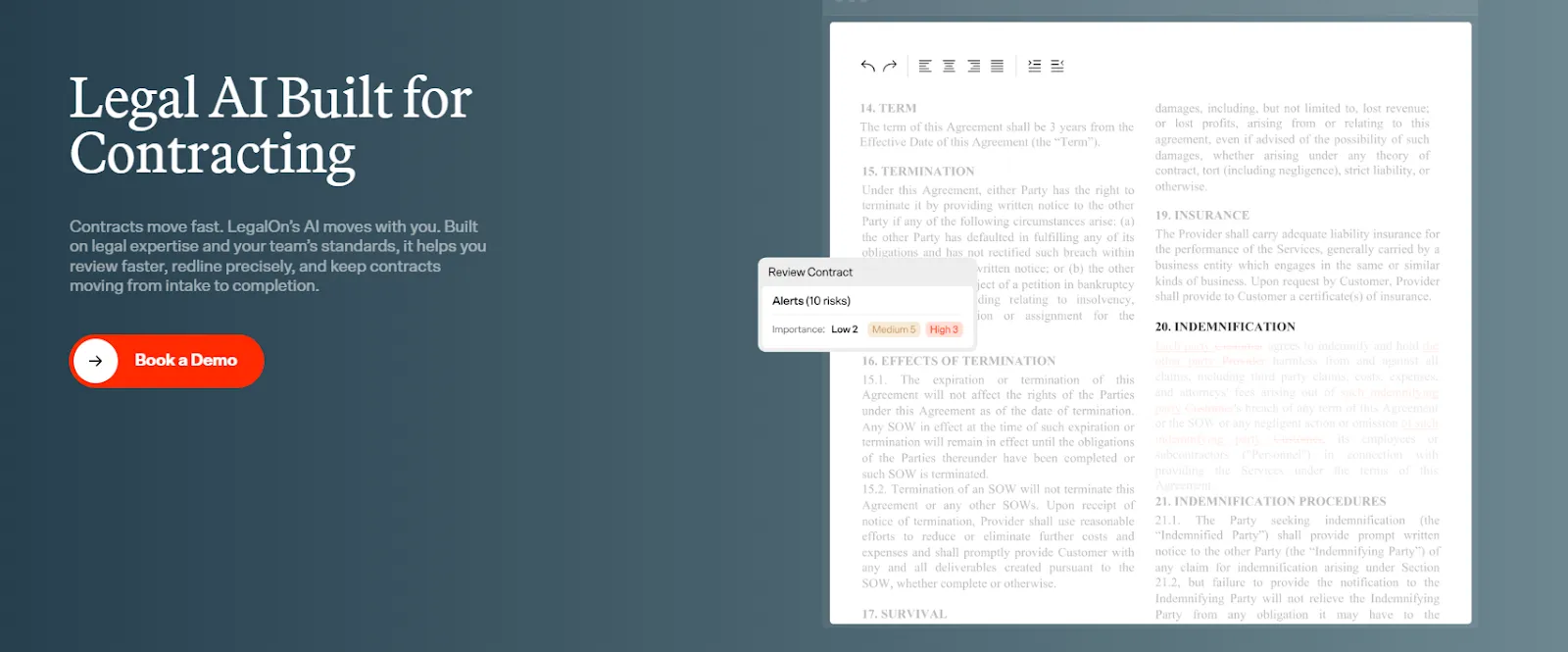
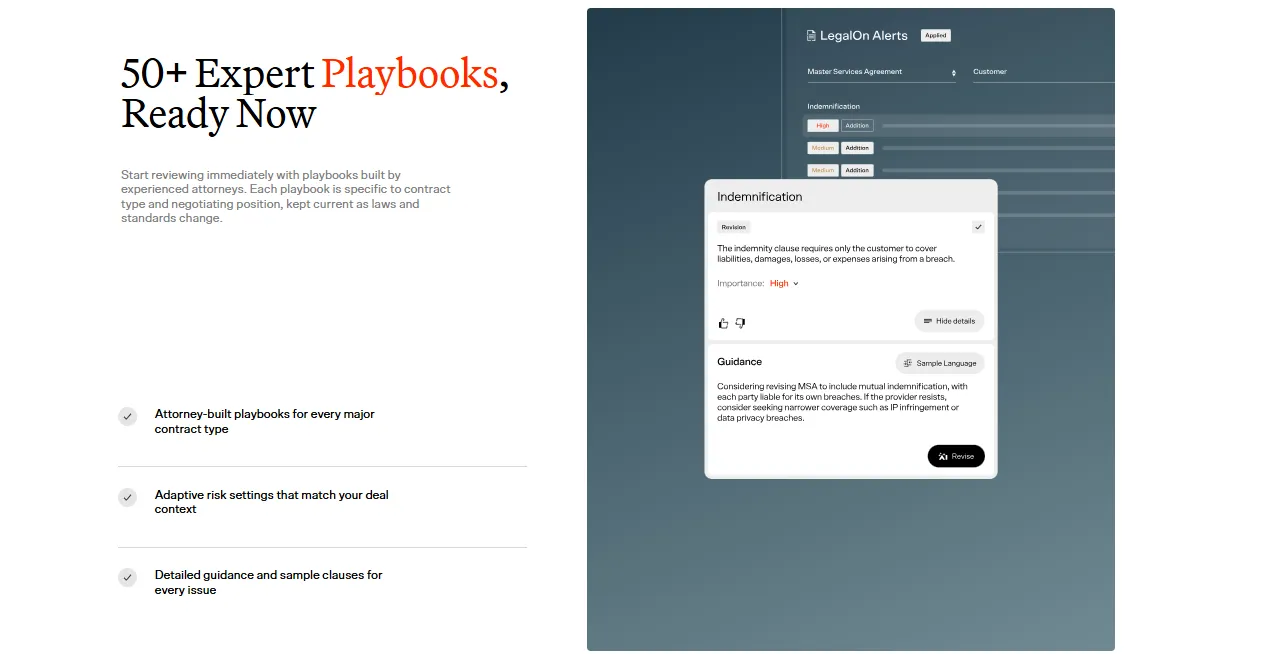
The platform comes with over 50 pre-built contract playbooks created by experienced attorneys, allowing accurate reviews from day one without months of training the AI on your standards.
LegalOn’s key features:
- 50+ attorney-written playbooks covering common contract types including NDAs, MSAs, SaaS agreements, and employment contracts
- Native Microsoft Word integration for seamless redlining and review
- Contract assistant that answers questions based on uploaded agreements
LegalOn’s pros:
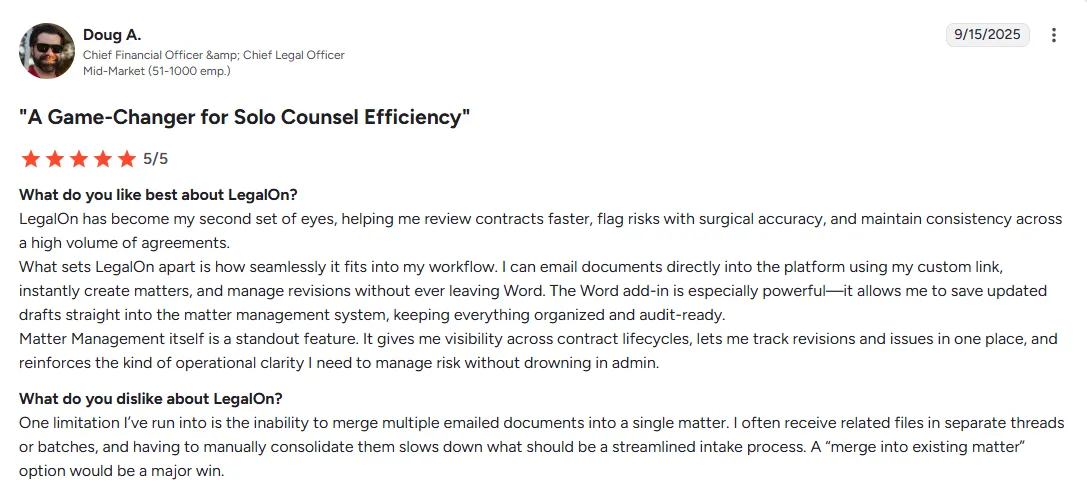
- Users report it provides a "second set of eyes" that catches risks with "surgical accuracy"
Source
- Word add-in allows lawyers to work in their preferred environment without platform switching
- Strong focus on legal accuracy, with all AI guidance anchored in attorney-created content
LegalOn’s cons:
- Limited ability to merge multiple emailed documents into a single matter
- Primarily designed for transactional work rather than litigation
LegalOn’s pricing:
Custom pricing based on organization size and needs. Enterprise and law firm packages available.
4. Spellbook
Spellbook takes a different approach by embedding AI contract review directly into Microsoft Word, where most transactional lawyers already work.
Spellbook has processed over 10 million contracts for 4,000 legal teams, making it one of the most battle-tested AI review tools available.
Spellbook’s key features:
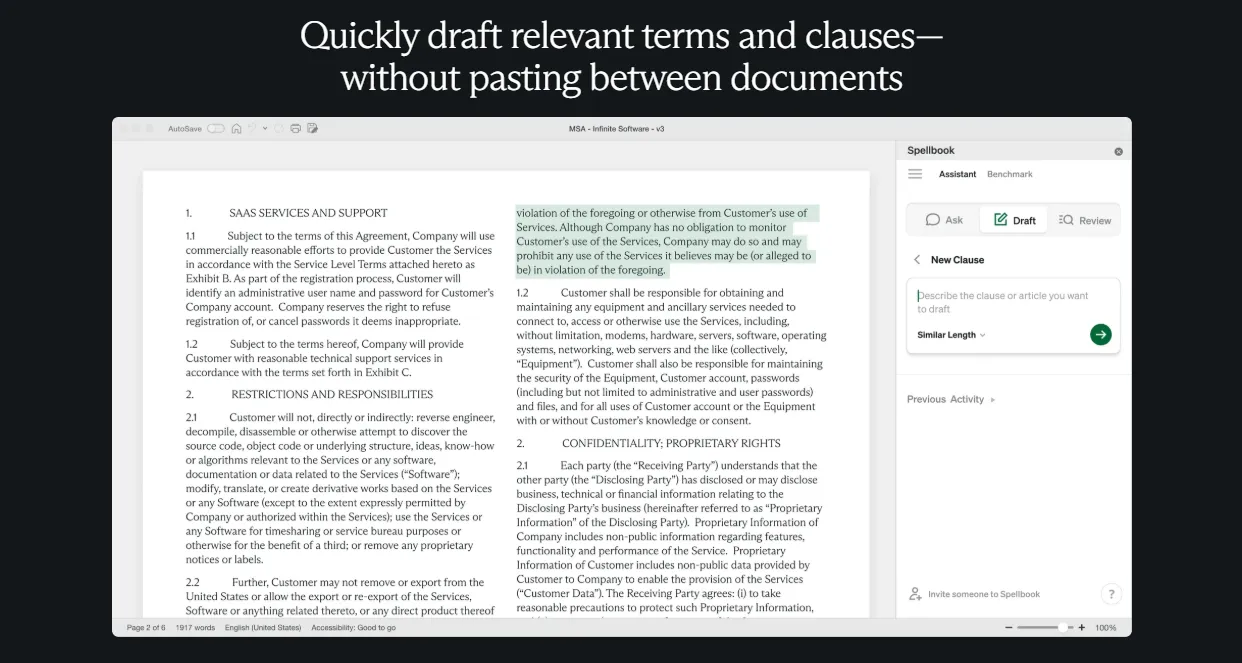
- Native Word plugin that suggests redlines directly in documents
- Review function that identifies risks and proposes specific language changes
- Drafting capability that generates clauses from scratch or your saved libraries
- Ask feature for instant answers to complex contract questions
- Benchmarks tool comparing your contracts to 2,000+ industry standards
- New AI agent that handles multi-step document workflows
Spellbook’s pros:
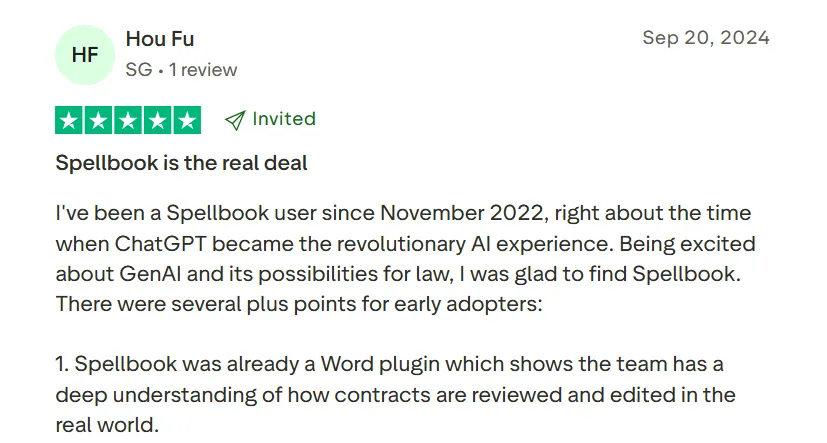
- Word integration means no learning curve for lawyers already comfortable with traditional contract workflows
Source
- Powered by OpenAI's GPT-5 for sophisticated language understanding
Spellbook’s cons:
- Primarily focused on transactional law, less useful for litigation work
- Requires Word as your primary contract editing tool to get full value
Spellbook’s pricing:
Spellbook offers a 7-day free trial. Custom pricing for larger teams.
5. Docusign IAM (Intelligent Agreement Management)
Docusign has introduced a full intelligent agreement management platform.
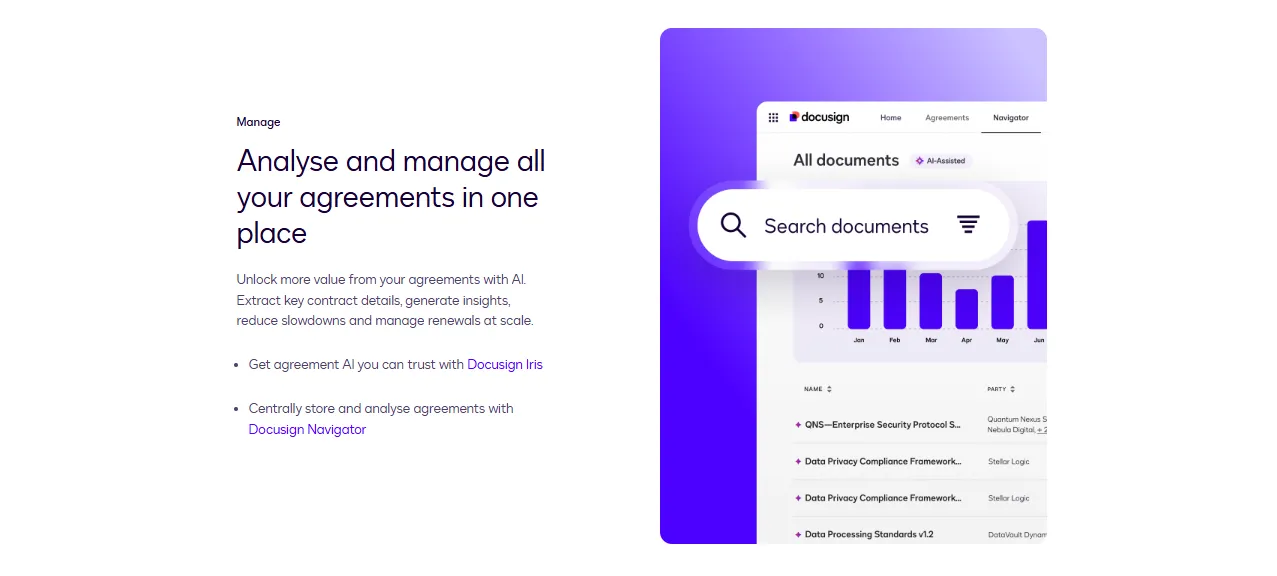
The IAM suite combines unlimited envelope sending with AI-powered contract analysis through Docusign Navigator, a strong fit for teams managing high signing volumes.
Suggest Read: Signeasy vs. Docusign
Docusign’s IAM key features:
- Unlimited eSignature envelopes sent through the web app (IAM Standard and above)
- Docusign Navigator for AI-powered agreement search, management, and analysis
- Automated workflow creation without coding (3-10 workflows depending on plan)
- Agreement preparation tools and document visibility controls
Docusign’s IAM pros:
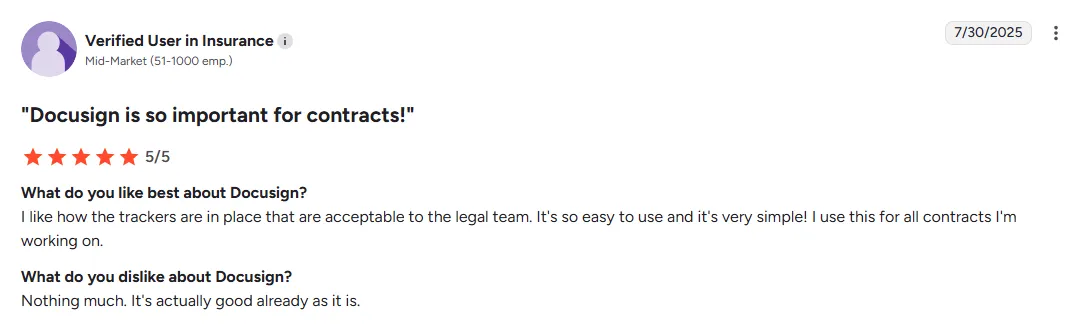
- Users appreciate how the platform keeps contract trackers in place that are "acceptable to the legal team" for managing all contracts they're working on
Source
- Strong integration ecosystem with 1,000+ pre-built connectors
Docusign’s IAM cons:
- Customer support quality is inconsistent, with complaints about "strict policies" and unhelpful responses
- Advanced features can feel "complex to set up" compared to simpler contract management tools
Docusign’s IAM pricing:
IAM Starter at $40/user/month (100 envelopes annually), IAM Standard at $45/user/month (unlimited envelopes), IAM Professional at $75/user/month. Enterprise pricing available for 50+ users.
6. Ironclad
Ironclad delivers complete contract lifecycle management with a documented 314% ROI according to a Forrester study.
Trusted by a third of the Fortune 100, the platform handles contract analytics, operations, and performance in one unified system.
Ironclad’s key features:
- Complete CLM covering contract creation, negotiation, approval, execution, and post-signature management
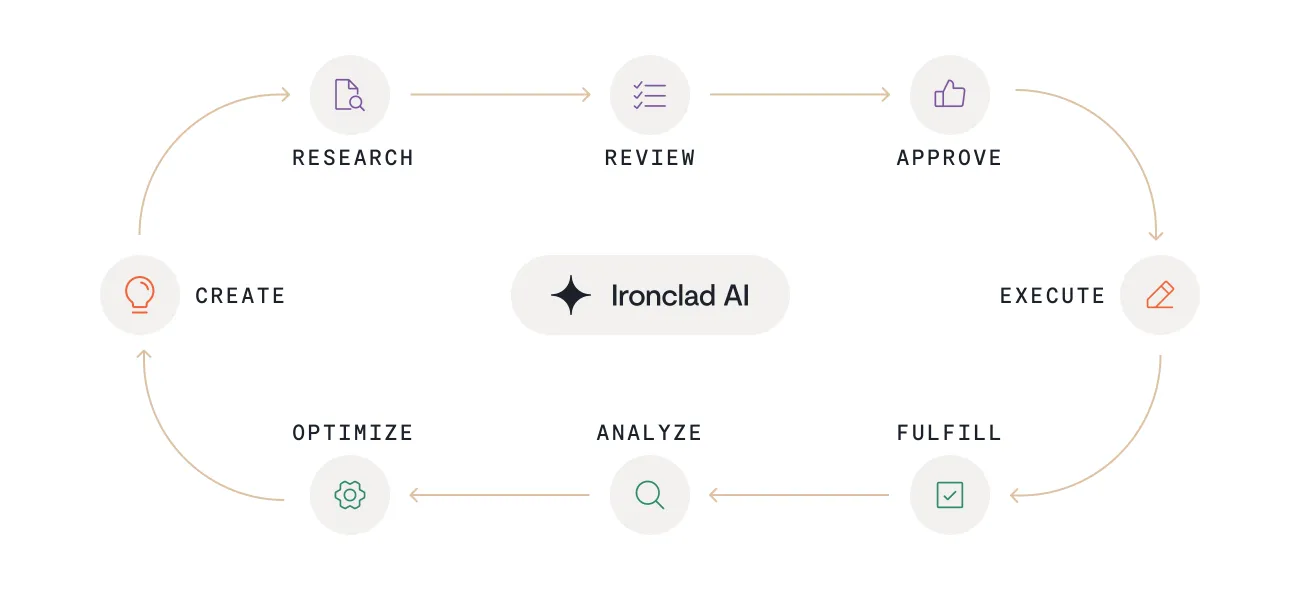
- Jurist AI assistant for contract analysis and risk identification
- Centralized repository with version control and activity feed tracking
Ironclad’s pros:
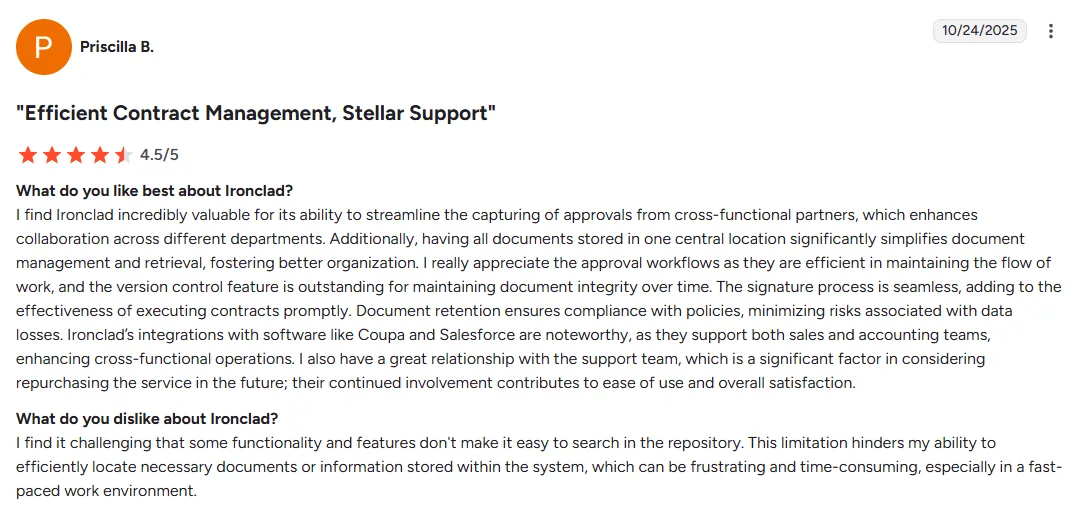
- Users praise "the ability to streamline capturing approvals from cross-functional partners"
Source
- Strong analytics and data management capabilities for enterprise reporting
Ironclad’s cons:
- "Setup process for Ironclad very challenging" without proper resources or consultant support
- Search and reporting features "still have room for improvement"
Ironclad’s pricing:
Custom pricing based on organization size, contract volume, and required features. Enterprise and mid-market packages available.
7. Knowable
Knowable specializes in post-signature contract intelligence, solving the problem most CLM platforms ignore: understanding what's in your executed agreements.
The platform achieves 90% time reduction in finding contract answers and delivers 5-10X average annual ROI.
Knowable’s key features:
- Post-signature contract analysis and intelligence extraction
- Contract organization with de-duplication and complete lineage tracking
- Real-time data streaming to ERP, CRM, and CLM systems
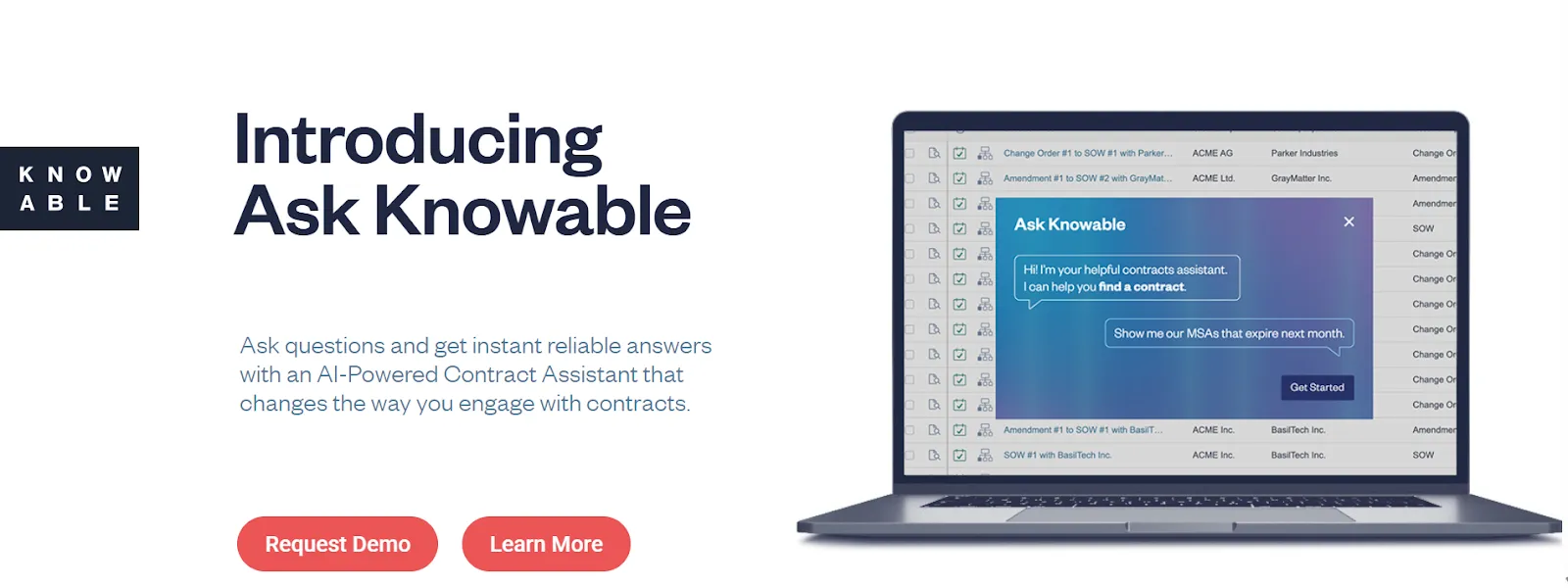
- Ask Knowable feature for instant contract queries with summarized answers
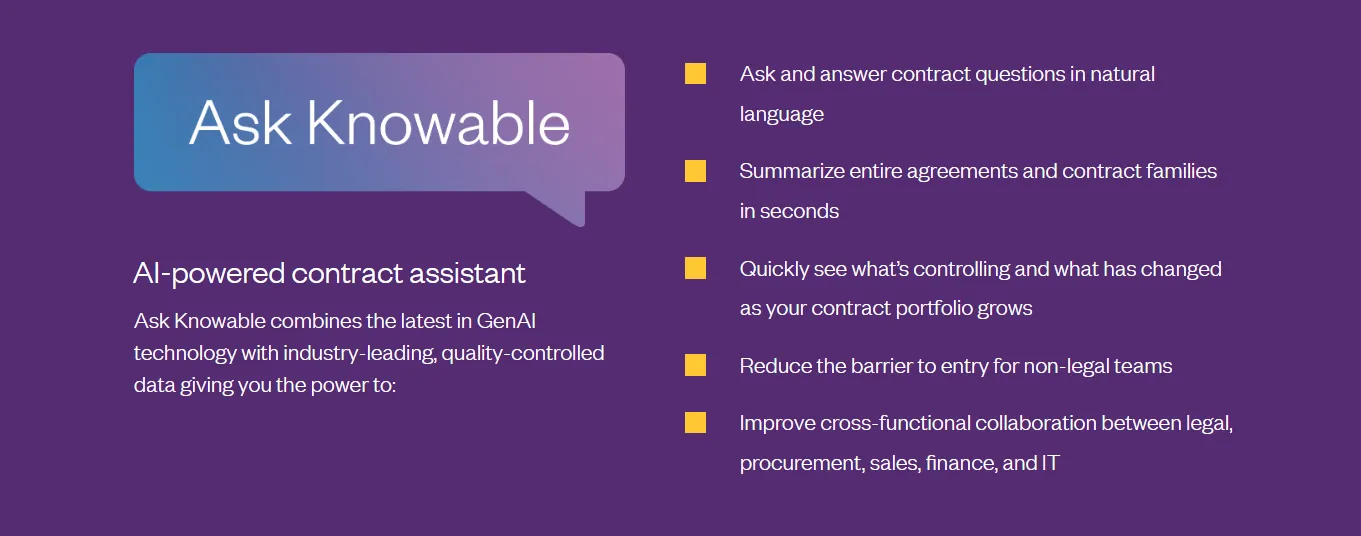
- Purpose-built for analyzing large volumes of legacy contracts
Knowable’s pros:
- Specializes in the often-neglected executed contract phase where most CLM tools fall short
- Integrates with existing CLM systems rather than replacing them entirely
Knowable’s cons:
- Newer platform with less extensive review base
Knowable’s pricing:
Custom pricing based on contract volume and organizational requirements. Average ROI analysis provided during sales process.
8. Juro
Juro reimagines contracting with browser-based DOCX editing and embedded contract workflows.
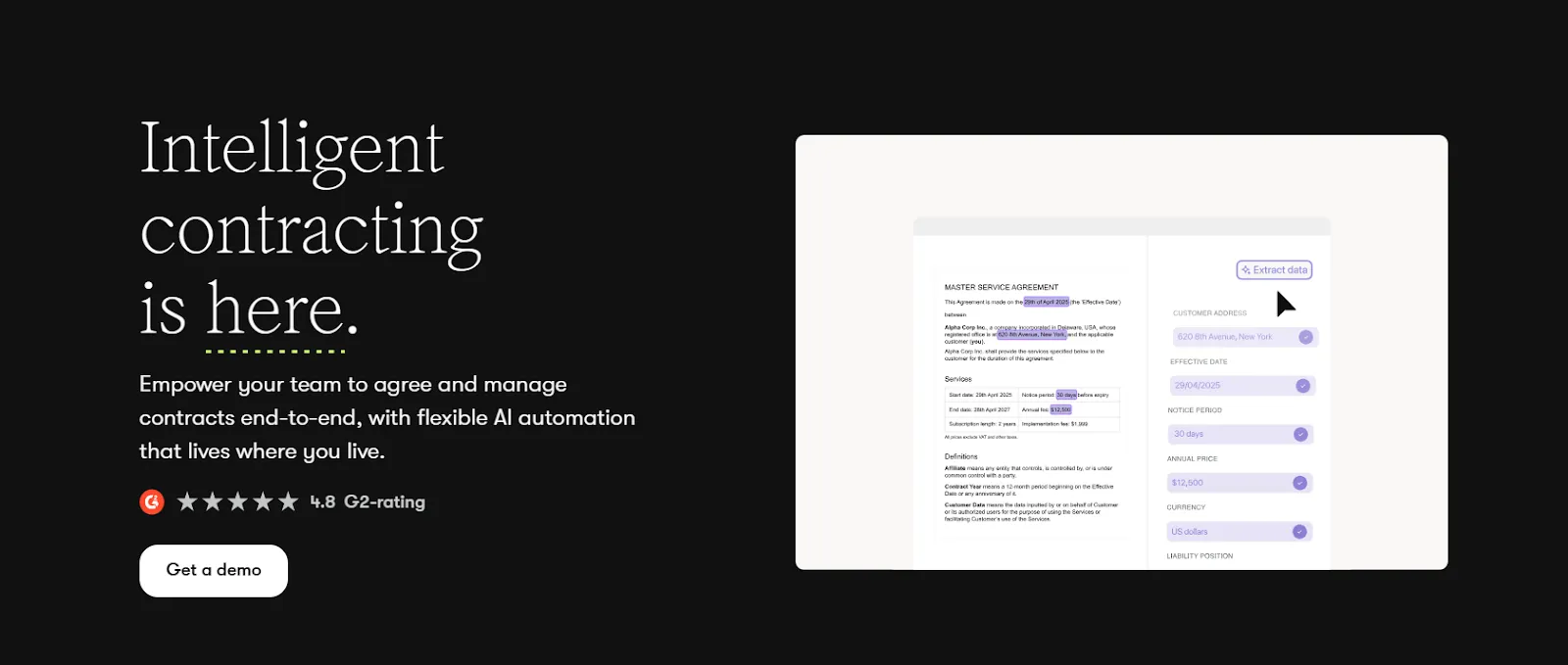
Rated 4.6/5 on G2, the platform supports self-serve contract creation across organizations without the traditional download-edit-upload-sign cycle.
Juro’s key features:
- Self-serve contract templates with configurable rules and smart fields
- AI-powered contract review and redline agents with legal guardrails
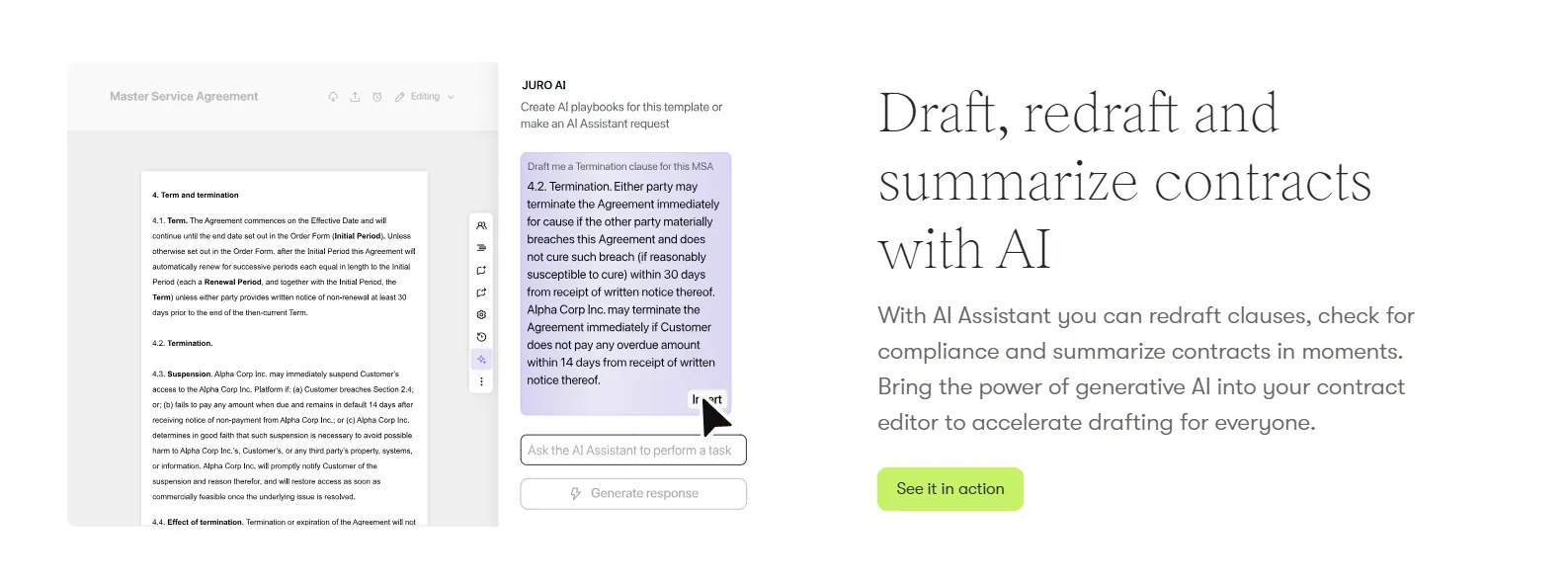
- Intelligent repository with AI-driven search across all contract data
- Real-time collaboration with commenting and version tracking
Juro’s pros:
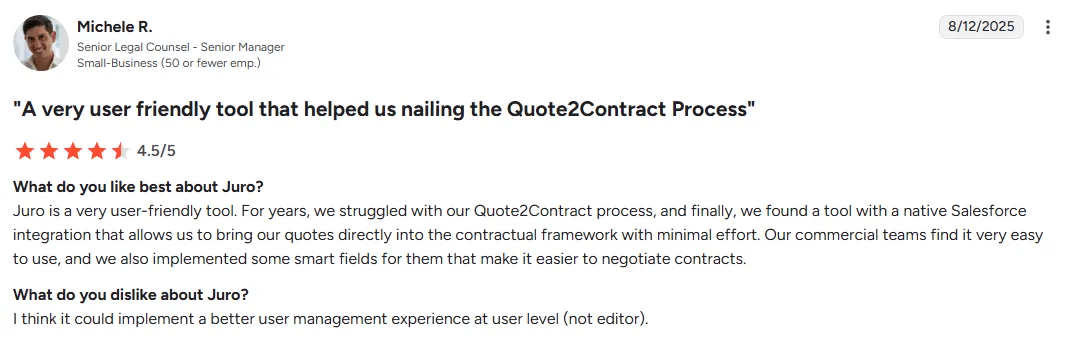
- Users praise how it makes contracting feels effortless across phone, laptop, and tablet
- Implementation described as "very easy" with "fantastic" onboarding support
Source
- Strong adoption rates due to user-friendly design for non-legal teams
Juro’s cons:
- Some users find it "better suited for working with templates than reviewing third-party paper contracts"

Source
- Contract redlining offers limited options — full acceptance or rejection only, no redlining of redlines
- Setting up complex templates with workflows and smart fields can be "time consuming"
Juro’s pricing:
Custom pricing based on team size and usage. Tailored demos available to discuss specific requirements.
9. Evisort (Acquired by Workday)
Evisort built the first large language model specifically for contracts and maintains proprietary AI rather than licensing generic third-party models.
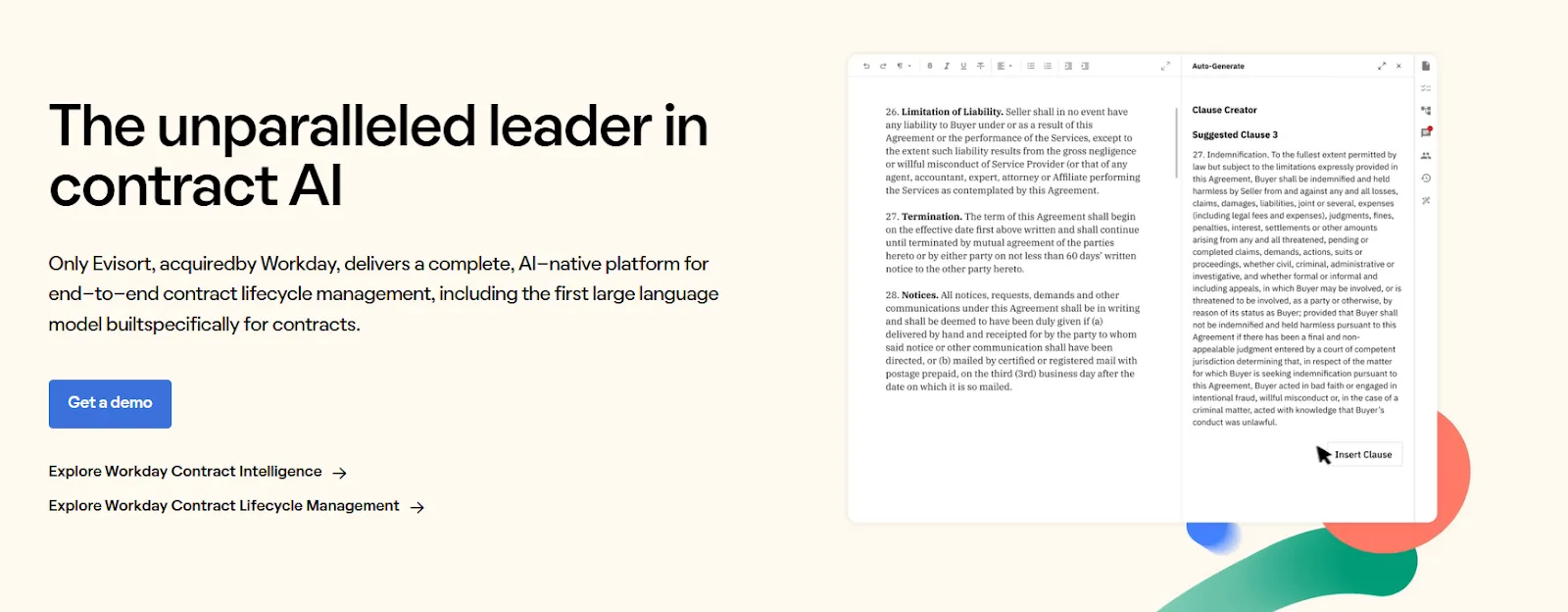
Now part of Workday, the platform delivers AI-native contract lifecycle management with enterprise-scale capabilities.
Evisort’s key features:
- Proprietary contract-specific LLM for better accuracy than generic AI models
- AI-powered contract analytics for risk identification and opportunity discovery
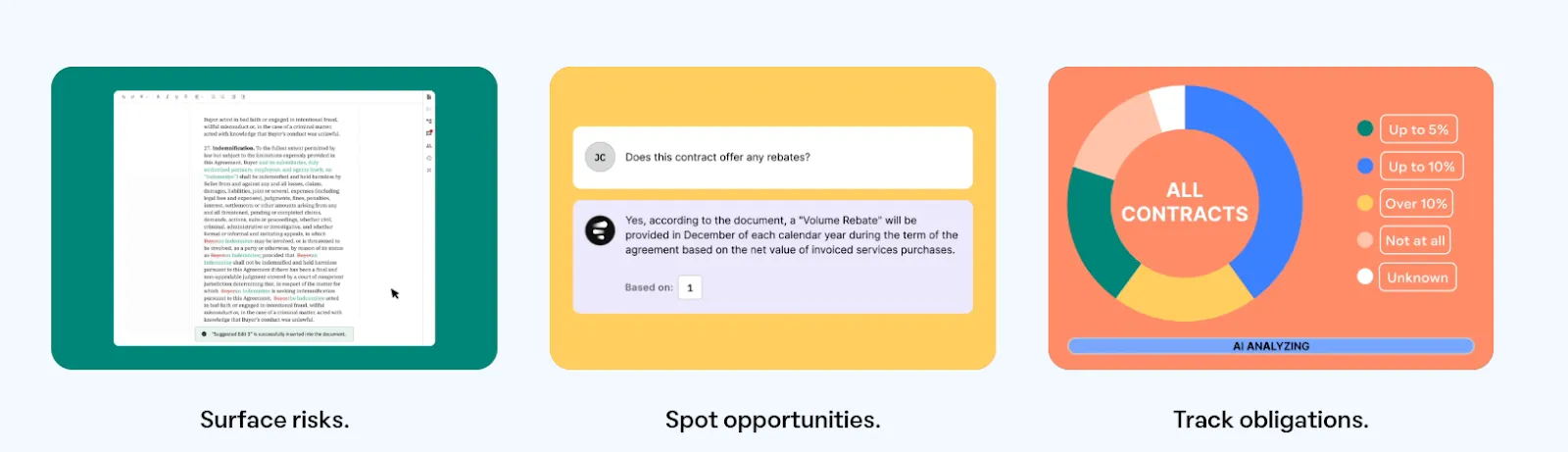
- Customizable AI that adapts to your specific contract language and requirements
- Workflow automation for contract approvals and execution
Evisort’s pros:
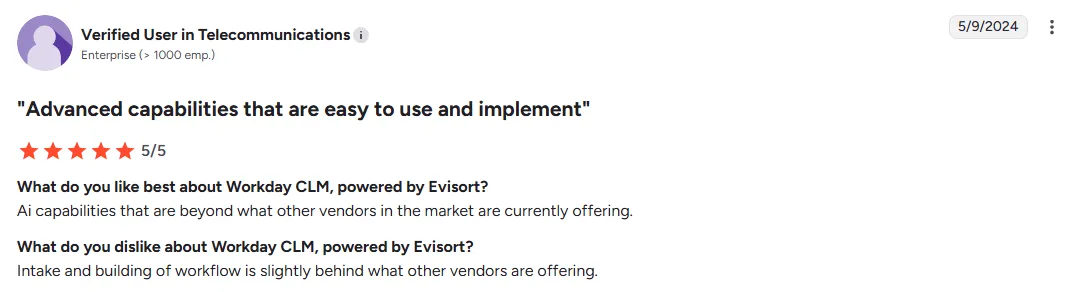
- AI capabilities described as "beyond what other vendors in the market are currently offering"
Source
- "Easy to learn especially compared to legacy CLMs" with intuitive UI
- Google Drive sync automatically imports contracts for immediate analysis
Evisort’s cons:
- Lacks ability to track multiple documents in one ticket, requiring separate tickets per document
- "Word processing capabilities" make complex editing and redlining difficult
- Intake and workflow building slightly behind some competitors
Evisort’s pricing:
Custom pricing. Now offered as Workday CLM, powered by Evisort, with pricing aligned to Workday ecosystem.
10. Icertis
Icertis serves global enterprises with Vera AI and agentic workflows that handle complex, multi-geography contract portfolios.
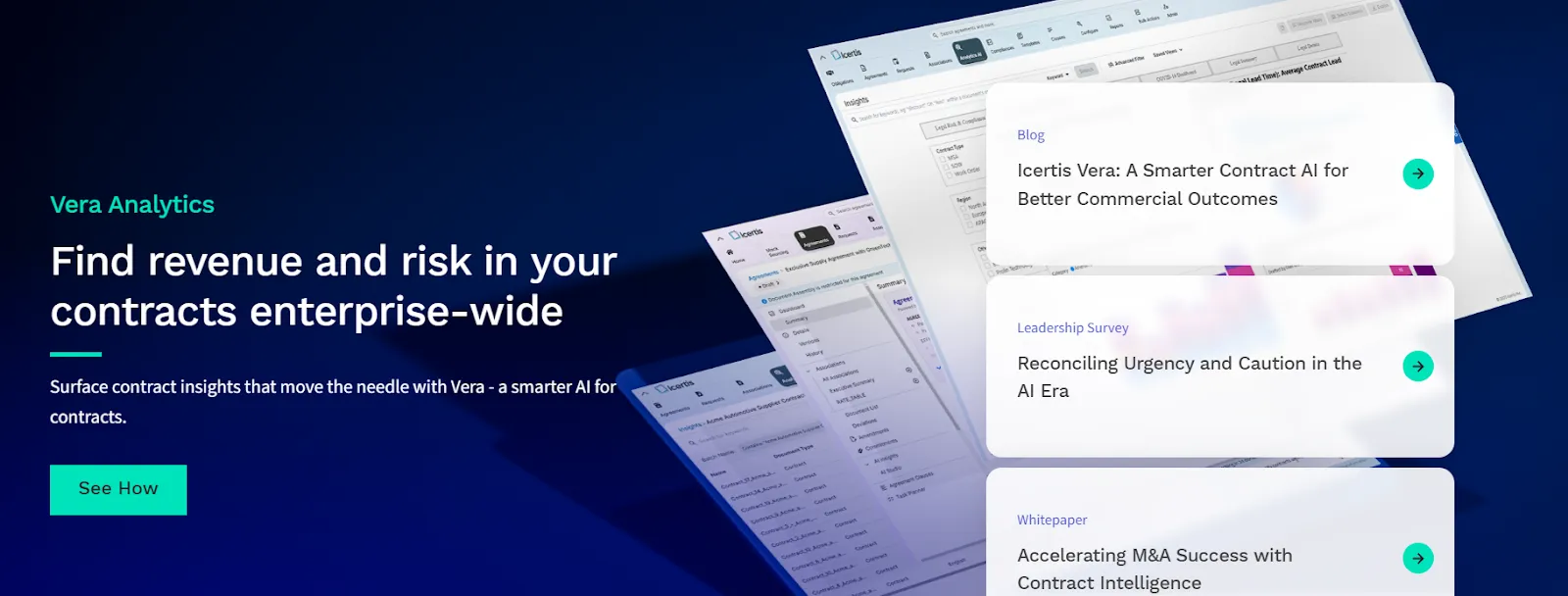
Named a Leader in the 2025 Forrester Wave and Customers' Choice in Gartner Peer Insights, the platform manages contracts for over a third of the Fortune 100.
Icertis’ key features:
- Vera Analytics for enterprise-wide revenue and risk discovery
- Vera Copilot using natural language to surface insights and search contracts
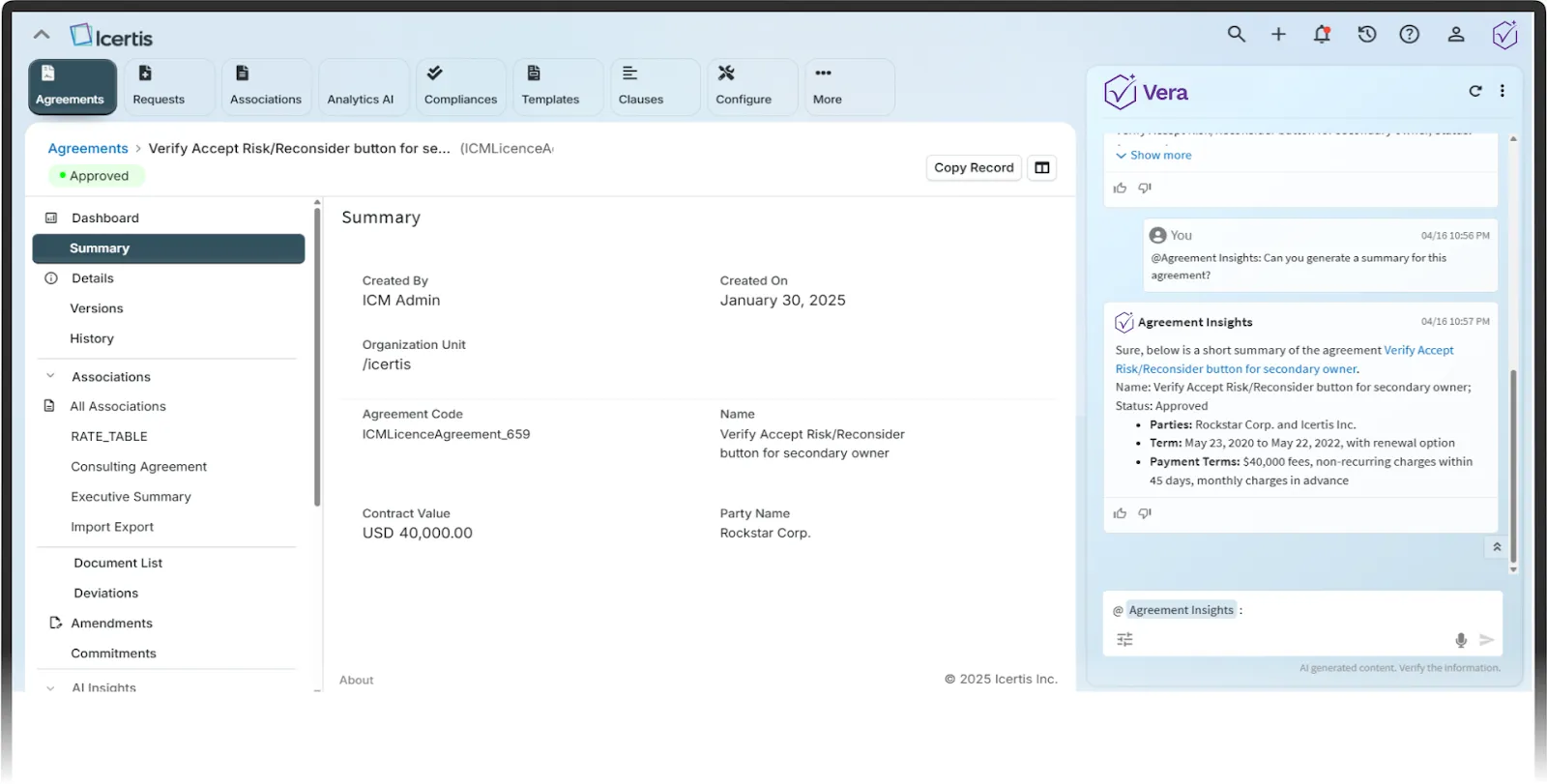
- Contract operations managing full lifecycle from creation to expiration
- Agentic workflows that automatically verify and fulfill contractual commitments
Icertis’ pros:
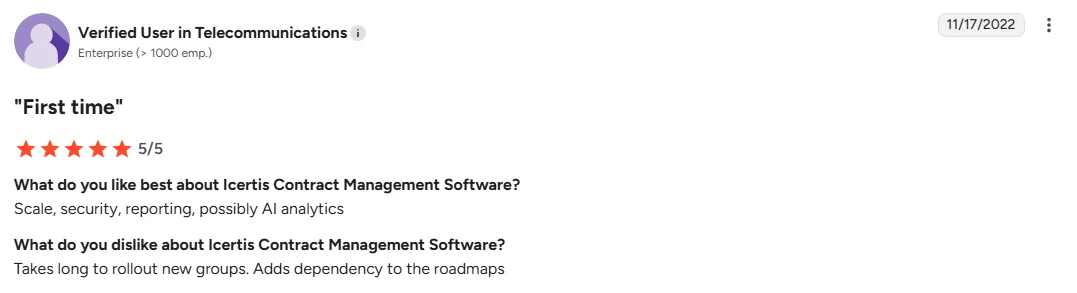
- "Scale, security, reporting, possibly AI analytics" noted as key strengths
Source
- Designed for global enterprises managing contracts across multiple jurisdictions
Icertis’ cons:
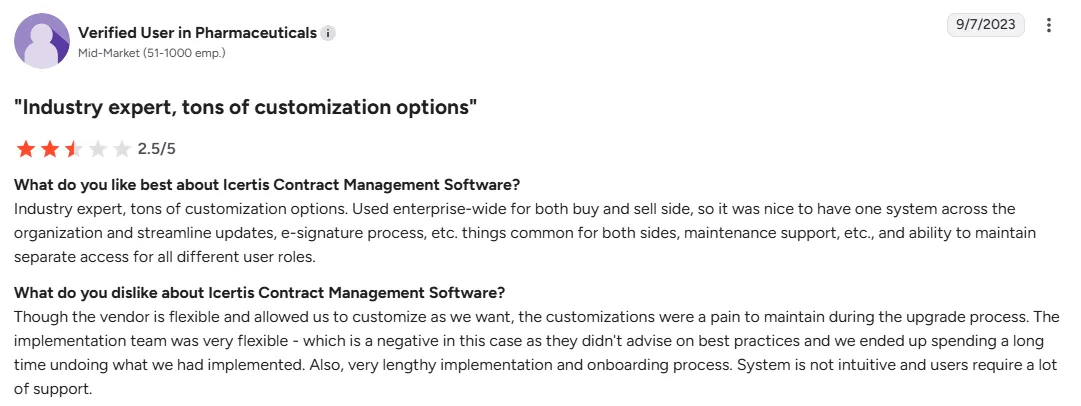
- "Very lengthy implementation and onboarding process" that can extend for months
Source
- "System is not intuitive and users require a lot of support" for adoption
- "Takes long to rollout new groups" creating roadmap dependencies
Icertis’ pricing:
Enterprise pricing available through direct sales. Quote based on contract volume, user count, and deployment complexity.
Benefits of AI contract review software
Yes, AI contract review improves turnaround time. But the bigger shift is this: legal teams can finally move from reactive document processing to proactive risk management and strategic advisory.
- Efficiency gains that free up strategic time
Legal teams using AI contract review software achieve 25-50% faster contract processing times according to Deloitte’s 2024 future of legal work research. So for high-volume, repetitive tasks like NDA reviews or compliance checks, time savings can reach 75% or more.
A contract that previously required three hours of lawyer time now takes 45 minutes. That recovered time lets legal teams handle growing contract volumes without expanding headcount — or finally tackle strategic work that's been backburnered for months.
- Risk mitigation through intelligent analysis
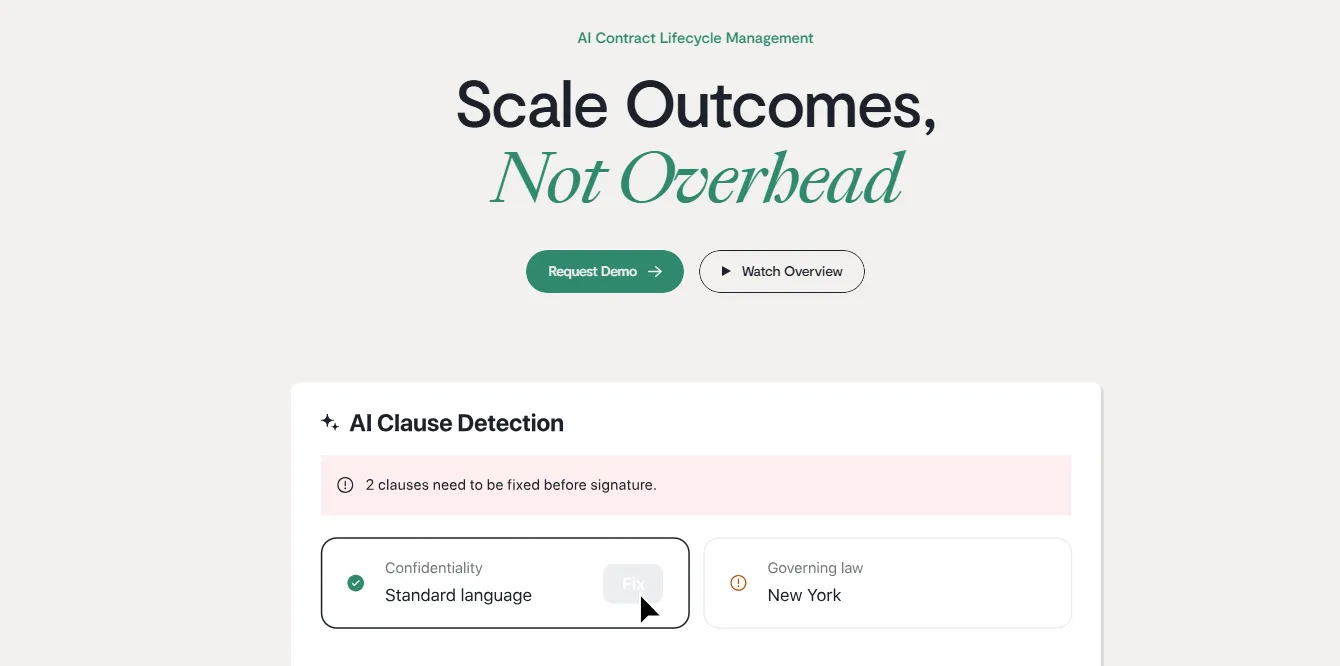
Contract review software spots issues human reviewers might miss. AI analyzes every clause against your playbook, flags non-standard terms, and identifies risky language like unlimited liability, auto-renewal clauses, or missing indemnification protections.
Gartner predicts that by 2027, 50% of organizations will use AI-enabled contract risk analysis, as catching one problematic clause can save millions in potential disputes.
- Data-driven insights for better decisions
AI contract review tools extract structured data from unstructured documents, turning contract portfolios into searchable, analyzable assets.
You can instantly answer questions like "Which vendors have auto-renewal clauses?" or "What's our average payment term across all agreements?" With this visibility, teams can manage contracts proactively instead of reactive firefighting.
But it's not all upside.
Challenges of using AI for contract review
Now that you know the benefits of an AI contract review software, it’s also important to understand the risks associated with them.
1. Unclear value realization
While AI contract review software can cut review time by 25-50%, some organizations might struggle to quantify the actual business value. Freed-up hours don't automatically translate to headcount reduction or cost savings. Legal teams need clear plans for redeploying that capacity to higher-value work.
2. Accuracy limitations with complex contracts
Contract review AI tools trained on standard forms can struggle when faced with unique language, unusual clause structures, or heavily customized agreements.
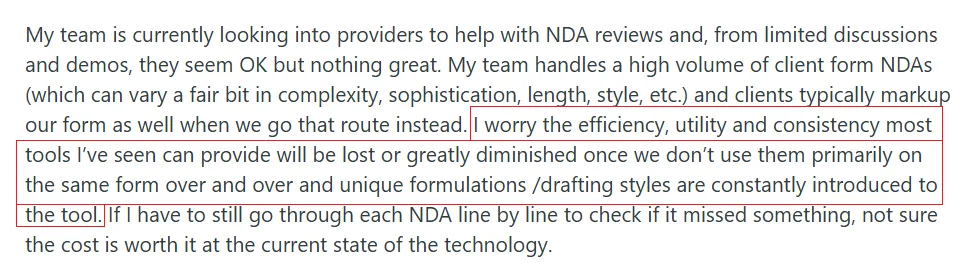
As one corporate attorney noted: "I worry the efficiency will be lost once we don't use them primarily on the same form over and over and unique formulations are constantly introduced."
Source
Teams handling high volumes of varied vendor agreements might find they still need line-by-line human review to catch what AI misses.
3. Integration and workflow friction
Many contract review software solutions require significant changes to existing processes. Tools that don't integrate seamlessly with Word, your CLM, or document management systems sometimes create friction rather than efficiency.
Poorly integrated solutions force users to duplicate efforts across multiple platforms. When tools add steps instead of removing them, the promised time savings would disappear.
4. Data security and confidentiality concerns
Data security and confidentiality risks remain top concerns, especially for sensitive client contracts or proprietary business terms.
Knowing the challenges means you can plan around them. Here's how.
5 tips for deploying and using AI to review contracts
Successfully implementing AI contract review software isn't some kind of plug-and-play shortcut. It requires deliberate testing, clear playbooks, and realistic expectations about what AI can handle independently. Here's the deployment framework that works:
The goal isn't perfect automation; it's giving your team more time for complex negotiations while AI handles routine clause identification.
Finally, your buyer's checklist for evaluating platforms.
How to choose the best AI contract review software
The best AI contract review software should feel like an extension of your team's expertise, not a tool that creates more work.
After reviewing 10 platforms, here's our verdict.
Start reviewing contracts smarter with Signeasy AI
AI contract review software won't replace legal judgment, but it amplifies your team's expertise.
The right platform catches risks faster, surfaces insights buried in contract portfolios, and frees your legal team to focus on strategic decisions instead of repetitive clause checking.
Signeasy's Intelligent Contract Management centralizes every agreement in one searchable workspace. Find clauses, obligations, and key terms in seconds with AI-powered search, set automated renewal alerts, and manage contracts across teams with proper access controls — no more digging through inboxes or shared drives.
Combined with AI extraction, collaboration tools, eSignature, and renewal tracking, you get complete contract management from review to execution in one platform.
At $20/user/month, you get enterprise-grade contract review AI tools without enterprise complexity or cost.
The HelloFresh and Chegg settlements (read the intro?) prove the cost of missed contract clauses. Don't let manual review put your organization at risk!
Contact Sales to Get Early Access to Signeasy's Intelligent Contract Management today.