

.webp)


When it comes to contract management, most teams worry about AI tools accessing sensitive contract terms without clear data governance policies. Others are paralyzed by migration anxiety when moving away from legacy tools or spreadsheets. And many are simply paying for complex systems that most of their team never fully adopts.
Every team wants contract management security that works without adding complexity. Signeasy protects your contracts with SSO, two-factor authentication, AES and SSL encryption, and full audit trails — within a platform your team will actually adopt.
This guide breaks down:
- What contract management security really means, and the biggest risks to address first
- A compliance mapping table you can use for evaluation
- How Signeasy helps you implement secure, compliant contract workflows without slowing your team down
What is contract management security?
Contract management security is the set of controls that protect your agreements across their entire lifecycle. It governs who can access a contract, how data is stored and encrypted, whether signatures are tamper-proof, and how every action gets logged for auditability.
Think of it as five interconnected layers. Access control, data encryption, signature integrity, centralized storage, and audit trails each serve a distinct purpose. When any of these layers has a gap, your organization faces exposure to data breaches, compliance violations, disputed agreements, and revenue loss.
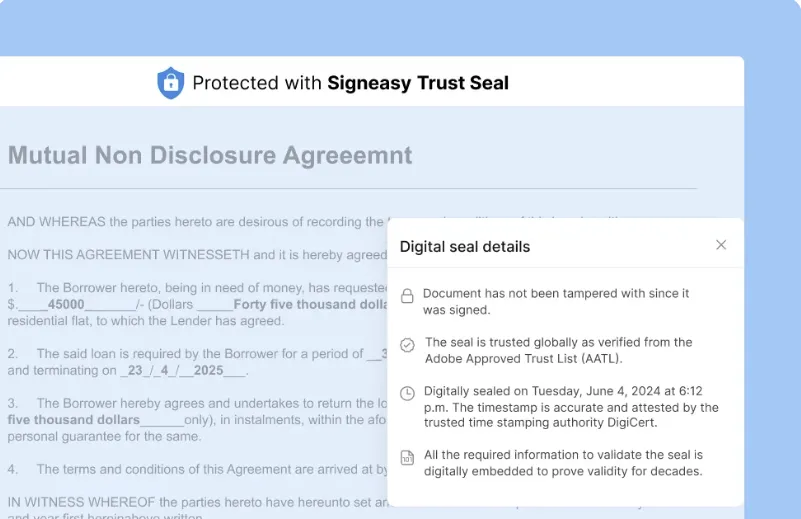
In Signeasy, document integrity is enforced through Trust Seal and full Audit Trails. Any alteration to a signed document is immediately visible, and every contract action is logged and traceable. Your compliance team gets the evidence they need without chasing it across tools.
Why contract security matters now
The stakes around contract security have reached a peak. IBM's Cost of a Data Breach Report (2024) found the average global breach cost hit $4.88 million. Contracts typically contain the most sensitive information your organization handles, from pricing terms and intellectual property clauses to employee compensation details and vendor obligations.
Scattered contracts make things worse. When agreements live across email threads, shared drives, and personal folders, you lose visibility into who accessed what and when. Missed renewal deadlines and overlooked obligations become routine rather than exceptional.
The cost of getting it wrong:
- Regulatory fines under GDPR can reach up to 4% of annual global revenue.
- Unauthorized contract access can expose intellectual property and erode your competitive position.
- SLA failures from missed obligations damage vendor relationships and put revenue at risk.
- Disputed signatures without tamper-evident audit trails weaken your legal standing in court.
- Ransomware targeting unencrypted contract repositories can freeze operations entirely.
Suggested read: Contract management for teams: A complete guide
The top contract management security risks to address first
Some risks carry more weight than others. Before you invest in controls, you need to understand which threats are most likely to affect your contracts and your compliance posture. Here are the five risk categories that deserve immediate attention.
1. Data breaches and cloud misconfiguration
Cloud-based contract platforms offer convenience, but misconfigured access keys, public storage buckets, and weak API security can expose thousands of agreements overnight. A single misconfigured permission can make confidential contracts accessible to anyone with the right URL.
Your IT team should audit cloud configurations quarterly. That means reviewing storage permissions and rotating access keys. Confirm that API endpoints enforce proper authentication before granting access to contract data.
2. Insider threats and over-permissioned access
The Verizon 2024 Data Breach Investigations Report found that 68% of breaches involved a non-malicious human element. Employees with more access than their role requires represent one of the most common contract security risks. Over time, permission creep gives users access to agreements they no longer need.
Least-privilege access should be the default. Review role-based permissions regularly and remove access that no longer aligns with someone's current responsibilities.
3. Insecure integrations and third-party risk
Your contract management platform rarely operates in isolation. It connects to CRMs, HRIS tools, ERPs, and payment systems, with each integration creating a potential entry point.
Third-party connectors with excessive permission scopes or unrotated API tokens expand your attack surface. Before enabling any integration, review the permission scopes it requires and grant only what is necessary. Rotate tokens on a set schedule and include third-party connectors in your regular vulnerability assessments.
4. Version sprawl and weak auditability
When contracts exist in multiple versions across email, desktops, and cloud folders, identifying the authoritative copy becomes a real challenge. Version sprawl makes it difficult to prove which terms were agreed upon and when.
A centralized contract repository eliminates this problem. With a single source of truth, every version is tracked and every edit is logged. Your legal and compliance teams can verify what changed, who made the change, when it happened, and which version is current.
5. Regulatory exposure
Contracts contain personal data, financial terms, health information, and intellectual property — all subject to regulations like GDPR, CCPA, SOC 2, and HIPAA. Falling short on any of these frameworks means more than fines. It means lost trust, stalled deals, increased litigation risk, and damaged partnerships.
Mapping your security controls to specific compliance outcomes is the most effective way to stay ahead of audits. Your contract platform should make it straightforward to demonstrate that access controls, encryption, audit trails, and eSignature integrity meet each framework's requirements.
Best practices for a secure contract management program
Effective contract management security requires multiple layers working together.
The best practices below give you a structured framework to evaluate your current posture and close gaps before they become audit findings or breach headlines.
1. Centralize the contract repository
Scattered contracts across email inboxes and shared drives create blind spots. When your team struggles to locate the latest version of an agreement, risk compounds quickly.
A single, searchable repository eliminates version confusion and gives everyone one place to store and retrieve agreements. Contract repository management makes that the default, auto-organizing every executed agreement in one governed hub.. In Signeasy's Intelligent Contract Repository, you can organize and manage all your contracts from a centralized hub rather than digging through inboxes.
.gif)
2. Strong identity and access management
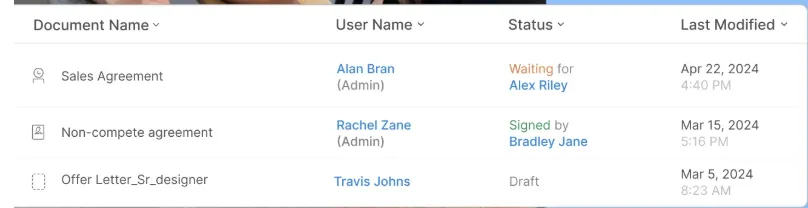
Every user who touches a contract should be verified and scoped to the minimum access their role requires. Single sign-on (SSO) reduces password fatigue while keeping authentication centralized.
Two-factor authentication (2FA) creates a second verification layer. Role-based access control (RBAC) ensures people see only what their responsibilities demand. In Signeasy, you can configure SSO and 2FA while assigning granular roles so each team member operates with least-privilege access by default.
3. Encryption in transit and at rest
Contract data transmitted over networks or stored on servers without proper encryption is exposed to interception. Your agreements should be protected with modern TLS during transmission and AES encryption while stored. Key management and rotation schedules should be documented and auditable.
Signeasy encrypts data with AES 128-bit at rest and SSL 256-bit in transit, so your contracts stay protected whether they are being signed or sitting in your repository.
4. Tamper-evident, legally compliant eSignatures
An eSignature is only as trustworthy as the integrity checks behind it. Tamper-evident signatures confirm that a document remained unchanged after signing. Legal compliance with ESIGN, UETA, eIDAS, and similar frameworks ensures those signatures are enforceable across jurisdictions.
Through Signeasy's Trust Seal, you can verify document integrity after every signature event. Signed documents meet ESIGN, UETA, and eIDAS requirements, so your agreements hold up under legal scrutiny.
5. Comprehensive audit trails and logging
When a dispute arises about who approved a term change or when a document was shared, you need evidence. An audit trail captures every action taken on a contract. Views, edits, approvals, shares, and signatures are all timestamped and logged.
Exportable logs make it straightforward to respond to compliance reviews or internal investigations. Using Signeasy's audit trails, you can trace a complete chain of custody for every document from creation through execution and beyond.
6. Secure intake and data minimization
How contracts enter your system matters as much as how they are stored. Secure intake forms validate submissions and restrict the collection of unnecessary personally identifiable information (PII).
Collecting only what you need reduces your exposure if a breach occurs. Review your intake workflows to confirm that sensitive fields are encrypted in transit and that PII is purged once processed.
7. Vendor and integration security
Your contract management platform connects to CRMs, HRIS tools, ERPs, and collaboration apps. Each integration creates an additional access point that requires oversight. Review the scopes and permissions for every connected application, rotate API tokens on a schedule, and apply least-privilege principles to all connectors.
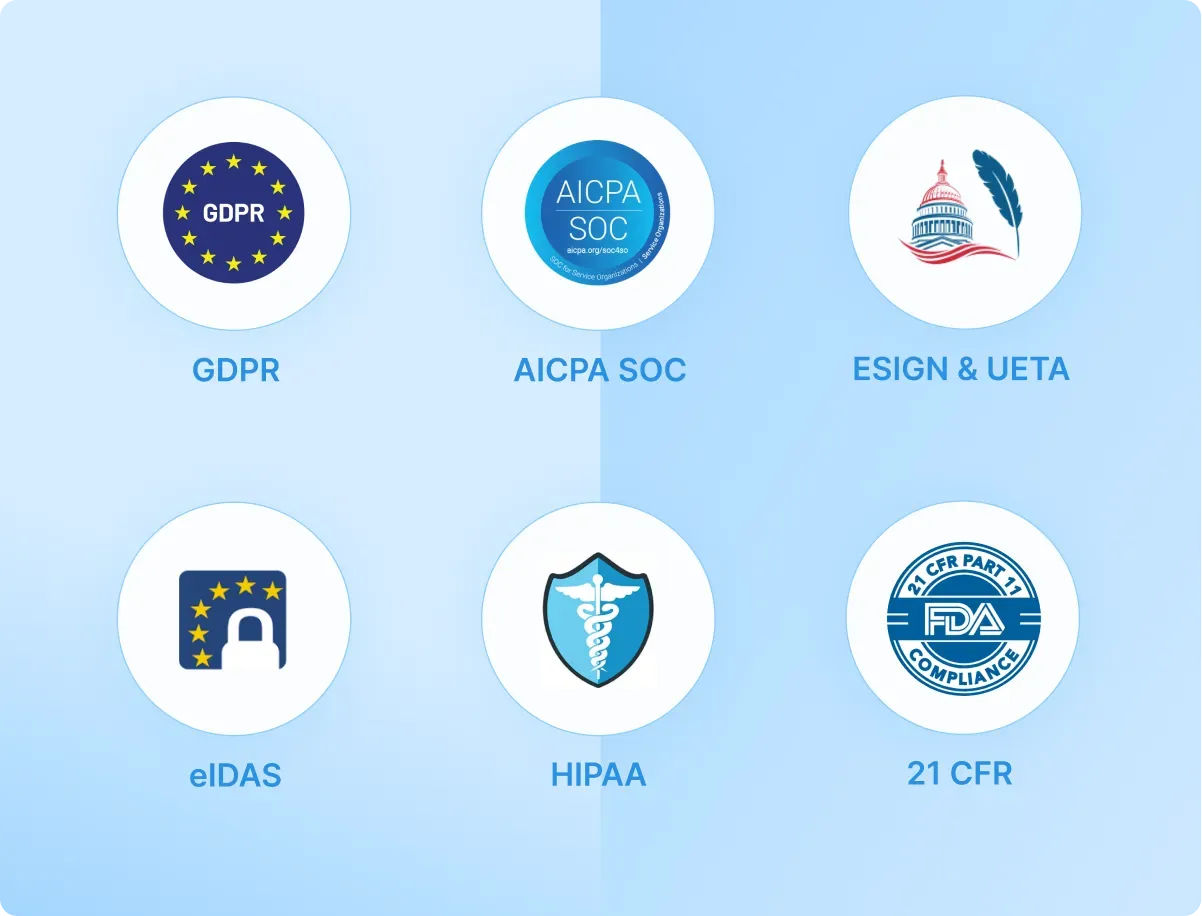
Signeasy maintains SOC 2 Type 2 certification and undergoes regular security audits, giving you a verified foundation when evaluating integration partners.
Suggested read: Vendor contract management: Best practices for your team
8. Zero trust mindset
Zero trust treats every user, device, and session as unverified until proven otherwise. Every access request is validated regardless of network location.
Applied to contract management, this means re-authenticating users for sensitive actions and checking device posture before granting access to agreements. Adopting these principles in your contract workflows limits the blast radius if a single credential is compromised.
9. AI security and data governance
AI-powered features like contract review and key term extraction speed up analysis significantly. They also raise important questions about data boundaries and model training practices. You need clear answers about whether your contract data trains vendor models, how long AI outputs are retained, and who can access AI-generated insights.
Signeasy AI retrieves relevant information from your contracts to speed up review and analysis. It operates under the same identity, encryption, audit, and access controls that govern the rest of the platform.
Questions to ask vendors before you enable AI
- Is my contract data used to train your AI models?
- Where is AI processing performed, and in which region is data stored?
- Can I restrict AI access to specific roles or teams?
- Are AI queries and outputs logged in the audit trail?
- What is the data retention policy for AI-generated summaries?
10. Business continuity and integrity validation
Outages, ransomware, and infrastructure failures put your contract data at risk. Backups and disaster recovery plans are your safety net. Test your restore procedures on a regular cadence to make sure they actually work when needed.
Tamper checks on stored documents confirm that archived contracts remain unaltered over time. A solid business continuity plan paired with ongoing integrity validation gives your compliance team evidence that agreements are recoverable and trustworthy even after an incident.
Compliance map: Which controls unlock which frameworks?
Security controls protect your data. They also generate the evidence your auditors and regulators require. Mapping each control to its compliance outcome makes it easier to demonstrate readiness during an audit or due diligence review.
For example, audit trails satisfy monitoring evidence requirements across SOC 2 and HIPAA simultaneously. RBAC paired with 2FA addresses access safeguard requirements under HIPAA and 21 CFR Part 11. Tamper-evident eSignatures provide the legal enforceability proof that ESIGN, UETA, and eIDAS demand.
The table below shows how common contract management security controls align with major frameworks. Each row also notes the corresponding Signeasy feature that supports the control.
The practical takeaway is that you can build one security posture and satisfy multiple frameworks at once. Signeasy's compliance coverage spans SOC 2 Type 2, HIPAA, GDPR, ESIGN, UETA, eIDAS, and 21 CFR Part 11. That breadth means fewer vendor security questionnaires to fill out and faster approval from your procurement and legal teams.
When presenting contract management security to internal stakeholders, share this mapping alongside your vendor's compliance certifications. It reframes the conversation from "Which tool should we buy?" to "Which tool already has the evidence we need?"
How Signeasy helps you stay secure without slowing down
Most contract security failures don't happen because teams ignored the risks. They happen because the tools meant to address those risks were too complex to adopt consistently.
Signeasy is built around the principle that security and usability aren't a tradeoff. SSO, 2FA, and RBAC are configured at the admin level — your team never has to think about them. AES and SSL encryption are on by default. Trust Seal validates every signed document automatically. Audit trails run in the background and are exportable the moment a compliance review lands on your desk.
The compliance coverage, SOC 2 Type 2, HIPAA, GDPR, ESIGN, UETA, eIDAS, and 21 CFR Part 11, means your legal, IT, and procurement teams aren't starting from scratch during vendor evaluations. The evidence is already there.
For sales teams, deals close faster because signatures work across every device. For legal ops, disputes are easier to resolve because every action is logged. For IT, there's one platform to govern instead of a scattered mix of tools and shared drives.
Security that your team actually uses is the only kind that works. Signeasy makes that the default.
Start your free trial and secure every contract from day one.