


























.webp)
.webp)
.webp)

.webp)
.webp)

.webp)
.webp)
.svg)








.svg)

.webp)

.webp)








Frequently asked questions
What is contract management software for legal teams?
Contract management software for legal teams is a secure digital platform purpose-built for in-house counsel, legal operations teams, and General Counsels to manage contracts in one place — from drafting and approvals to signing, storage, and renewal tracking.
Unlike general document management tools, legal contract management software includes court-admissible eSignatures, multi-step approval workflows, a searchable contract repository, AI-powered key terms extraction, and automated renewal reminders.
It replaces fragmented, email-based processes with a structured, auditable system — giving legal full visibility into every agreement the organization has signed, what's committed, and what's coming due.
For in-house legal teams managing growing contract volumes without growing headcount, it's the difference between reactive contract management and proactive risk control.
Unlike general document management tools, legal contract management software includes court-admissible eSignatures, multi-step approval workflows, a searchable contract repository, AI-powered key terms extraction, and automated renewal reminders.
It replaces fragmented, email-based processes with a structured, auditable system — giving legal full visibility into every agreement the organization has signed, what's committed, and what's coming due.
For in-house legal teams managing growing contract volumes without growing headcount, it's the difference between reactive contract management and proactive risk control.
Are electronic signatures legally binding for NDAs and legal contracts?
Yes — electronic signatures are legally binding and court-admissible for NDAs, settlement agreements, retainer agreements, MSAs, IP licensing agreements, and the vast majority of legal contracts.
In the United States, eSignatures are governed by the Electronic Signatures in Global and National Commerce Act (ESIGN) and the Uniform Electronic Transactions Act (UETA), both of which give electronic signatures the same legal standing as wet ink signatures.
In the European Union and UK, the eIDAS regulation governs electronic signatures and recognizes them as legally valid across member states.
Signeasy is fully compliant with ESIGN, UETA, and eIDAS — and also holds SOC 2 Type 2 certification and is compliant with GDPR and HIPAA. Every signed document includes a tamper-proof audit trail with cryptographic timestamps, signer identity verification, and a full chain of custody — giving legal teams the documentation needed to defend any agreement in court, arbitration, or regulatory review.
In the United States, eSignatures are governed by the Electronic Signatures in Global and National Commerce Act (ESIGN) and the Uniform Electronic Transactions Act (UETA), both of which give electronic signatures the same legal standing as wet ink signatures.
In the European Union and UK, the eIDAS regulation governs electronic signatures and recognizes them as legally valid across member states.
Signeasy is fully compliant with ESIGN, UETA, and eIDAS — and also holds SOC 2 Type 2 certification and is compliant with GDPR and HIPAA. Every signed document includes a tamper-proof audit trail with cryptographic timestamps, signer identity verification, and a full chain of custody — giving legal teams the documentation needed to defend any agreement in court, arbitration, or regulatory review.
How does Signeasy handle contract version control for legal teams?
Signeasy maintains a complete version history for every contract — capturing who made changes, what was changed, when, and from which device or location. When a contract is executed, the final signed version is permanently archived with a tamper-proof audit trail, ensuring there is never any ambiguity about which version of an agreement was actually agreed to.
For legal teams, this eliminates one of the most common sources of contract risk: version confusion. When a dispute surfaces months after signing, legal can immediately retrieve the exact executed version — with a full record of every prior revision, every approval, and every signature action — rather than reconstructing what was agreed from a chain of email attachments.
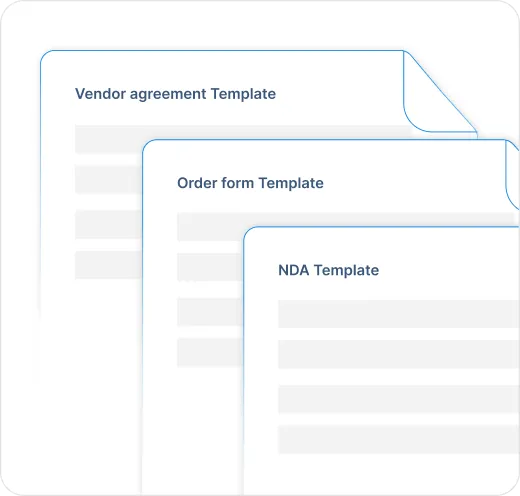
Legal administrators can also set templates as the approved starting point for routine agreements, ensuring that contracts sent by other teams always begin from the correct, current version.
For legal teams, this eliminates one of the most common sources of contract risk: version confusion. When a dispute surfaces months after signing, legal can immediately retrieve the exact executed version — with a full record of every prior revision, every approval, and every signature action — rather than reconstructing what was agreed from a chain of email attachments.
Legal administrators can also set templates as the approved starting point for routine agreements, ensuring that contracts sent by other teams always begin from the correct, current version.
Can legal teams set up contract approval workflows before sending for signature?
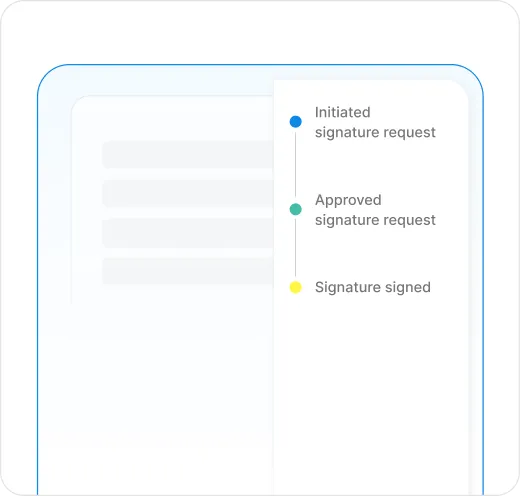
Yes. Signeasy supports configurable multi-step approval workflows — sequential, parallel, or a combination of both — so every contract can be routed through the right internal reviewers before it ever reaches a counterparty for signature.
In a sequential workflow, each approver must sign off before the next is notified — ideal for contracts that require escalating levels of authorization. In a parallel workflow, multiple approvers are notified simultaneously — faster for routine agreements where simultaneous review is sufficient.
Each approver receives an automated notification, and nothing advances without the required sign-offs. Every approval action — who approved it, when, and from where — is permanently recorded in the contract's audit trail.
For in-house legal teams, approval workflows mean contracts no longer bypass legal review, and the business can move quickly on routine agreements without creating compliance risk.
In a sequential workflow, each approver must sign off before the next is notified — ideal for contracts that require escalating levels of authorization. In a parallel workflow, multiple approvers are notified simultaneously — faster for routine agreements where simultaneous review is sufficient.
Each approver receives an automated notification, and nothing advances without the required sign-offs. Every approval action — who approved it, when, and from where — is permanently recorded in the contract's audit trail.
For in-house legal teams, approval workflows mean contracts no longer bypass legal review, and the business can move quickly on routine agreements without creating compliance risk.
How does Signeasy help legal teams track contract renewals and obligations?
Signeasy's Renewal Tracker uses AI to automatically extract key dates from every executed contract — including expiry dates, renewal windows, and regulatory deadlines — and converts them into automated reminders sent to the contract owner, the legal team, or both.
For legal teams managing large contract portfolios, this eliminates the single most common source of preventable contract risk: missed renewal windows. A 90-day notice period buried in a vendor agreement is no longer something that falls through the cracks — it becomes a calendar event that surfaces at the right time, with enough runway to review terms and renegotiate if needed.
Beyond renewals, Signeasy AI also extracts obligation milestones and key commercial terms from contracts, giving legal a proactive view of what the organization has committed to — not just when agreements expire, but what they require between now and then.
For legal teams managing large contract portfolios, this eliminates the single most common source of preventable contract risk: missed renewal windows. A 90-day notice period buried in a vendor agreement is no longer something that falls through the cracks — it becomes a calendar event that surfaces at the right time, with enough runway to review terms and renegotiate if needed.
Beyond renewals, Signeasy AI also extracts obligation milestones and key commercial terms from contracts, giving legal a proactive view of what the organization has committed to — not just when agreements expire, but what they require between now and then.
Is Signeasy secure enough for sensitive legal agreements and confidential contracts?
Yes. Signeasy is built to meet the security and compliance requirements of legal teams handling sensitive, confidential, and regulated agreements. Signeasy holds SOC 2 Type 2 certification — the gold standard for cloud security — and is compliant with GDPR, HIPAA, ESIGN, UETA, and eIDAS.
Every document stored in Signeasy is encrypted at rest and in transit using AES-256 encryption. Role-based access controls ensure that only authorized users can view, edit, approve, or sign any given agreement — so confidential NDAs, board resolutions, and settlement agreements are never exposed to the wrong people.
Every document action — viewing, editing, approving, signing, downloading — is permanently logged in a tamper-proof audit trail with IP address, device, and geolocation data captured.
For legal teams subject to regulatory scrutiny, due diligence, or litigation hold requirements, Signeasy's security infrastructure is built to hold up under examination.
Every document stored in Signeasy is encrypted at rest and in transit using AES-256 encryption. Role-based access controls ensure that only authorized users can view, edit, approve, or sign any given agreement — so confidential NDAs, board resolutions, and settlement agreements are never exposed to the wrong people.
Every document action — viewing, editing, approving, signing, downloading — is permanently logged in a tamper-proof audit trail with IP address, device, and geolocation data captured.
For legal teams subject to regulatory scrutiny, due diligence, or litigation hold requirements, Signeasy's security infrastructure is built to hold up under examination.
Can sales, HR, and procurement teams use Signeasy without changing legal's approved contract language?
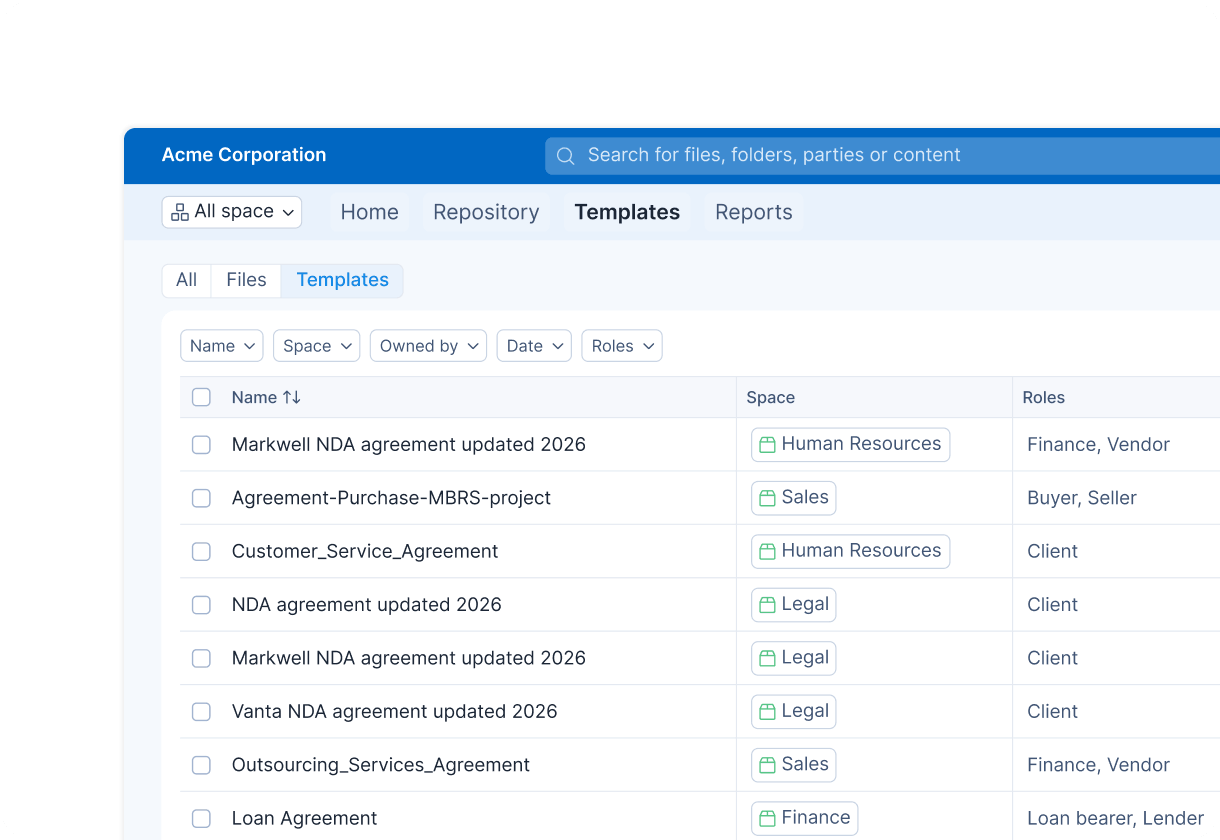
Yes — and this is one of the most valuable use cases for legal contract management software in practice. Legal teams build reusable templates from their most-used agreements — NDAs, MSAs, vendor agreements, offer letters, retainer agreements — and configure which fields other teams can fill in and which are locked. Sales, HR, and procurement teams can then initiate contracts directly from those approved templates, complete the permitted fields (counterparty name, deal value, start date), and send for signature — without touching the approved language, without needing legal to review every routine agreement, and without creating the risk of unauthorized edits.
Legal stays in control of the contract language. Other teams get the speed and autonomy they need. And every contract sent from a Signeasy template is automatically stored in the central repository — so legal always has visibility into what went out, to whom, and on what terms.
Legal stays in control of the contract language. Other teams get the speed and autonomy they need. And every contract sent from a Signeasy template is automatically stored in the central repository — so legal always has visibility into what went out, to whom, and on what terms.