

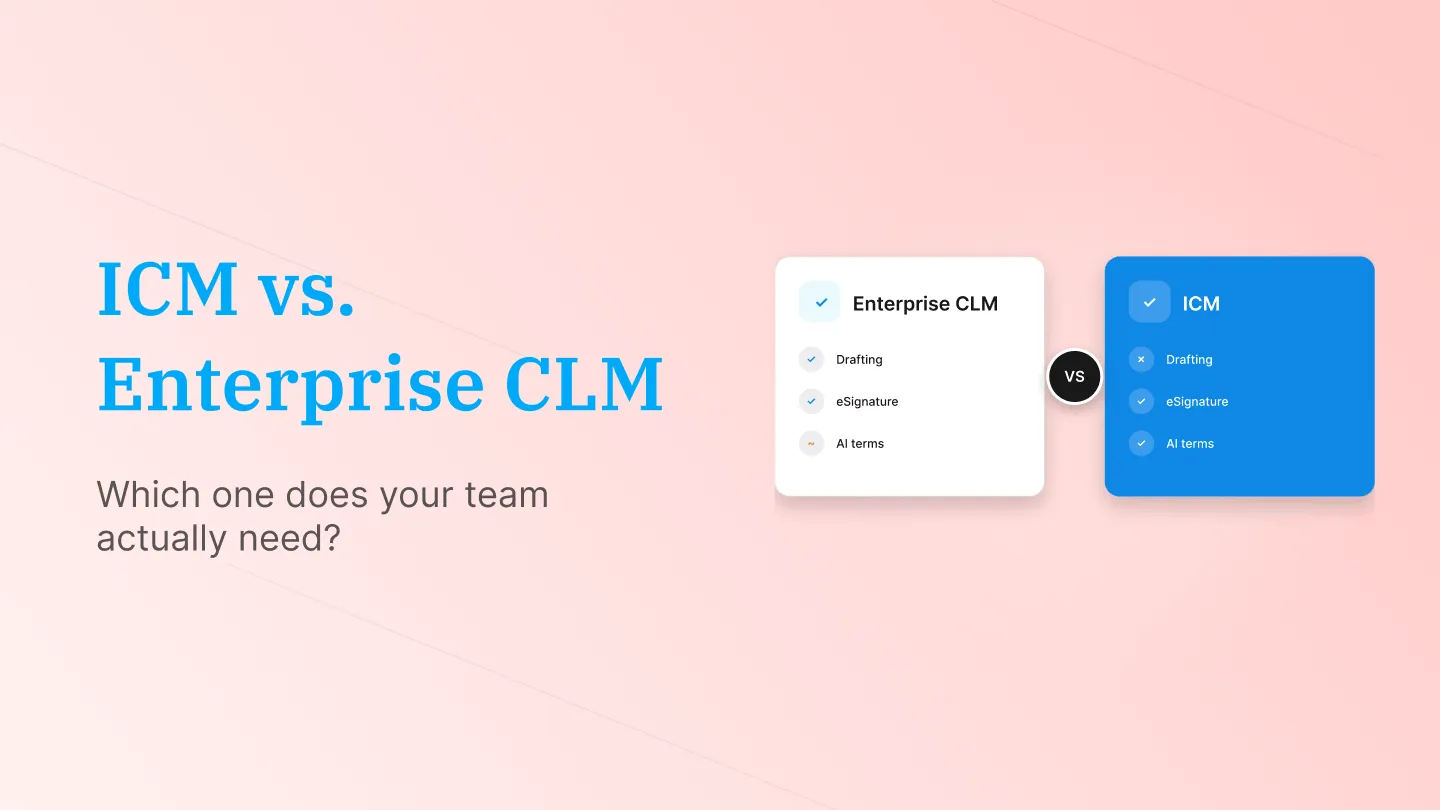


Ops and RevOps leaders evaluating contract software eventually hit the same fork: keep looking at enterprise CLM platforms, or consider something built specifically for what happens after a contract is signed. Enterprise CLM vendors are the default reference point in this category, but their pricing and implementation timelines are built for legal operations teams running complex negotiation workflows, not for a RevOps team trying to close deals faster and keep renewal dates visible.
This piece compares Intelligent Contract Management (ICM) to enterprise CLM directly: what each one actually does, where the real differences show up, and how to decide which one fits your team.
What is enterprise CLM?
Enterprise CLM (contract lifecycle management) is software that manages a contract from drafting through negotiation, redlining, approval, signature, and post-signature tracking. It's built for legal operations teams handling complex, high-volume contracts, typically with custom clause libraries, multi-stage approval chains, and dedicated implementation support.
What is Intelligent Contract Management (ICM)?
Intelligent Contract Management (ICM) is software that manages a contract's lifecycle after signature, using AI to store, search, and surface key terms, and to track renewals and obligations across every team that touches a contract.
ICM vs. enterprise CLM at a glance
When enterprise CLM is the right call
Enterprise CLM still makes sense for some teams. If contracts require heavy redlining, multi-party negotiation, and custom approval chains before signature, and Legal already runs that process with a dedicated team, a full CLM platform is built for exactly that. The tradeoff is cost and time: most enterprise CLM rollouts take months and require ongoing administration from a legal operations function most growing businesses don't have.
When ICM is the right call
For most Ops and RevOps teams, the bottleneck isn't drafting or redlining, it's what happens after a contract is signed: finding it, understanding its terms, and catching renewals before they turn into surprises. Intelligent Contract Management is built for that gap specifically, without the drafting and negotiation machinery, or the price tag, of a full CLM.
A decision checklist for Ops and RevOps leaders
Enterprise CLM is likely the right fit if...
- Legal runs a dedicated contract negotiation process with multi-party redlining.
- Contracts require custom clause libraries and multi-stage approval chains before signature.
- You have the budget and timeline for a multi-month implementation.
ICM is likely the right fit if...
- Your team needs visibility into signed contracts, not help drafting them.
- Multiple teams, including Sales, Finance, and Ops, need to find and understand contracts without waiting on Legal.
- You want to go live in hours, not months, and keep cost per seat predictable.
How ICM supports RevOps specifically
For RevOps, the practical value shows up in deal velocity and forecasting. Signeasy's Intelligent Contract Management integrates with CRMs including HubSpot, so a rep can close a deal in the CRM they already use, while renewal dates and payment terms stay visible to Finance and Ops without anyone opening a PDF. That visibility feeds renewal forecasting directly, instead of living in a spreadsheet someone updates manually.
Every signed agreement also includes a complete audit trail and is stored in an encrypted, compliant environment, so Ops doesn't have to choose between speed and governance.
Where Signeasy fits
Intelligent Contract Management gives Finance, Sales, HR, Procurement, Operations, IT, and Legal one searchable place for every contract, with AI-extracted terms and renewal reminders, without the implementation timeline of an enterprise CLM.
ICM Core starts at $45 per seat per month, and ICM Pro at $60 per seat per month (see full pricing), both billed with a 3-seat minimum and backed by a 100-day money-back guarantee.
Request Demo to see how Intelligent Contract Management compares to your current CLM shortlist.